This story was originally published on December 1, 2020. On November 5, 2026, the democratic socialist Nithya Raman won the Los Angeles mayoral race against incumbent Karen Bass.
Nithya Raman hasn’t even been sworn in as a Los Angeles city councilmember, but her election earlier this month has already sent profound ripple effects across the political landscape of Southern California. Los Angeles council districts are gargantuan by any municipal standard—just 15 people represent almost 4 million residents—and Raman’s Fourth District splays back and forth over the rugged Hollywood Hills, a series of irregular polygons delineating a handful of the city’s wealthiest and most politically entrenched neighborhoods. Winning the district has traditionally meant pandering to some of the city’s most vocal NIMBYs, who have historically slowed or stopped the construction of homeless shelters, affordable apartment buildings, and essential transit projects.
Yet the moment the race was called for Raman, the political dynamics shifted instantly. One of those lawsuit-happy obstructionists, a longtime president of a neighborhood group in the city’s Miracle Mile neighborhood—the person widely regarded as being solely responsible for delaying the implementation of a citywide bike-lane network—promptly resigned. In a parting email, the outgoing neighborhood leader noted that Raman’s victory signaled to him that there would be tough times ahead for the old guard of Los Angeles politics.
For a metropolis that has long struggled to manifest even the most basic elements of functional urban infrastructure—smooth and useful sidewalks, a thriving tree canopy, and much-needed housing developments—it is both promising and beguiling that Raman, an urban planner with prestigious degrees from Harvard and MIT, is ascending to office at such a critical juncture. But what Raman, who has previously worked as a consultant and started multiple non-profit organizations, believes she brings to the table is not just theoretical idealism, but a realistic, hard-headed assessment of how bureaucrats can work effectively within the rigid machinery of city departments. As someone who has dealt with the machinery of urban government for so long, and in so many different roles, she possesses a deep and practical understanding of its systemic restrictions.
Although she is intimately familiar with the machinery, she has never actually been part of the machine until now. Raman pulled off something virtually unheard of in modern Los Angeles politics: Having never held public office before, she managed to defeat a well-funded incumbent, in part by staging a massive, grassroots get-out-the-vote movement despite the immense
hurdles posed by a global pandemic. Reflecting on the unprecedented voter mobilization, she notes the staggering increase in civic participation. The district went from having roughly 24,000 people vote in a typical City Council race to seeing more than 130,000 ballots cast—a monumental surge that starkly contrasted with other districts holding elections at the exact same time. Ultimately, she received more votes than any L.A. councilmember in history.
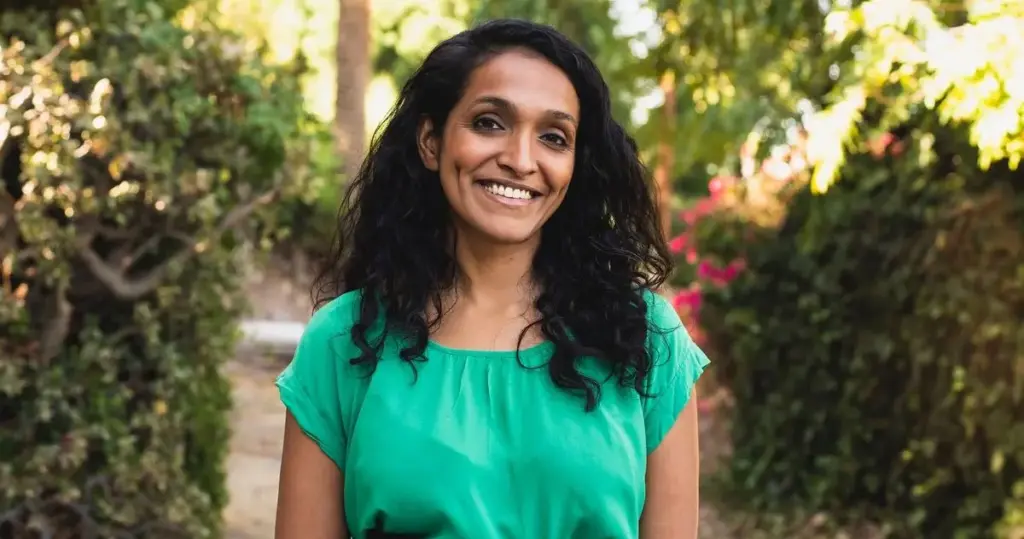
Raman comes across as warm and thoughtful over a video call from a well-lit corner of her bedroom closet, one of the few rooms in her home that she is able to make inaccessible to her five-year-old twins, where she occasionally laughs at the thought of making major policy decisions while staring directly at her winter wardrobe. But where Raman is demure and personal, her vision for Los Angeles—encapsulated by her campaign rallying cry to make City Hall work for everyday residents—is urgent, assertive, and uncompromising. Although her platform was crafted long before the pandemic upended urban life, its core tenets have become even more relevant for a city navigating an unprecedented series of crises.
She plans to dive in right away, once she is formally seated, with a comprehensive rent forgiveness proposal that she genuinely believes is feasible at the city’s massive scale. Furthermore, she has promised to open her office doors to the Angelenos who have historically been overlooked in city governance—renters, bus riders, and everyday working-class people—a commitment that, given the structural design of Los Angeles, will require nothing less than a major redistribution of political power. Take her own immense, gerrymandered district as a prime example: While her colleagues are pushing for more equitable redistricting, which remains a core priority of hers as well, Raman wants to go a step further. She is actively calling for structural charter reform to divide the city into a greater number of districts in an effort to better represent the diverse communities that have traditionally been left behind by City Hall.

In many ways, Raman’s push for systemic changes in how Los Angeles functions began back in 2014, just a year after she had moved to the city permanently. While working at the city’s administrative office, she was charged with assembling a detailed report on how Los Angeles was spending $100 million in dedicated homelessness funds. During this assignment, she experienced a galvanizing realization: much of the public money was being allocated not toward supportive services or housing, but toward criminalization, policing, and incarceration. Witnessing firsthand how that severe disparity was impacting her own unhoused neighbors in Silver Lake—where she lives with her husband, a television producer, and their twins—she co-founded a neighborhood homelessness non-profit aimed at providing immediate relief such as showers and meals, while simultaneously advocating for a wider range of permanent housing models that could be created faster and more affordably.
That exact approach to solving complex urban problems—combining a sweeping pragmatic vision with swift, on-the-ground action—became the foundational bedrock of her entire campaign. Raman wrote up remarkably detailed policy platforms addressing intricate issues such as public broadband internet, regional transportation equity, and immigrant rights. She shared these extensive proposals publicly through voluminous Twitter threads that served to educate constituents on how local government actually worked, or more frequently, failed to work, while walking her followers step-by-step through her proposed solutions. At times, her campaign felt less like traditional political messaging and more like a sustained, months-long civics lesson.
Her bold ideas positioned her firmly to the left of incumbent David Ryu. Five years prior, Ryu had run as a reform candidate, but he entered the race backed by deep-pocketed donors, early endorsements from fellow city councilmembers, and the nearly unilateral support of the Los Angeles political establishment. The establishment backing was so absolute that when L.A. Mayor Eric Garcetti—who happened to be a District Four constituent—released a video demonstrating how easy it was to vote by mail, his own ballot was briefly visible on camera, clearly marked with a vote for Ryu.
Despite these formidable odds, progressive momentum steadily built in Raman’s favor. She secured a high-profile endorsement from Bernie Sanders, earned accolades from the Sunrise Movement for her ambitious plan to transition the city to 100 percent clean energy by 2030, and aligned herself with a citywide awakening around racial justice. Raman incorporated these themes into a comprehensive proposal to reimagine public safety, directly amplifying the demands of local Black Lives Matter leaders. Reflecting on the campaign climate, Raman notes that the stakes felt exceptionally high, as citizens were deeply motivated by the largest civil rights movement in recent history and felt an intense urge to make their voices heard at the ballot box. Despite being significantly outspent by the incumbent’s donor network, Raman achieved a remarkable milestone reminiscent of the Sanders campaigns: according to official filings, she brought in over $200,000 exclusively through small-dollar donations.
Upon taking office, Raman will become only the third woman serving on the current 15-member City Council, while the city’s three other top-tier elected officials are also all men. Describing the situation bluntly, she calls the lack of female representation absurd. This glaring disparity, and its profound impact on how women are treated in civic spaces, is something Raman has been acutely aware of since serving as the director of Time’s Up Entertainment, a gender-equity non-profit formed in the wake of the Me Too movement. The structural barriers are immense; when crucial municipal meetings are scheduled late in the evenings without provisions for child care, it effectively shuts out individuals who serve as primary caregivers from ever considering a run for public office.
She points out that it remains extraordinarily difficult for working parents to bring their families to these meetings or to participate robustly in the political life of Los Angeles. Interestingly, she notes that while the COVID-19 pandemic brought countless negative consequences, the sudden shift of government meetings to digital spaces unexpectedly increased participation from residents who were previously unable to attend in person. She is determined to ensure that city leadership does not lose sight of these valuable lessons in accessibility.
Even as Los Angeles faces the prospect of continued lockdowns and severe economic strain, Raman is not sitting back and waiting passively for federal assistance. In addition to her targeted rent forgiveness initiative, she has developed concrete ideas for assisting families confronting severe food insecurity and the threat of personal bankruptcy. She emphasizes that there is significant work to be done simply by identifying individuals in urgent need and connecting them directly to resources that already exist within the municipal system—an effort she believes the city can undertake thoughtfully and precisely regardless of its immediate fiscal limitations.
True to her campaign ethos, Raman almost exclusively speaks in terms of collective action, creating an intentional sense that she is bringing the rest of Los Angeles along with her on a challenging journey. She acknowledges that she ran for the seat out of a deep frustration with the city’s persistent failures, but she insists that engaging so intensely with the voters of her district revealed a fundamentally new energy pulsing through Los Angeles. Despite the bleak circumstances surrounding the city at the moment, she remains resolutely hopeful about what can be achieved through collective civic engagement.