October arrives not merely as a calendar month, but as a threshold. It is the midpoint of the year’s second transitory season, a meteorological and psychological signal that we are crossing into the darker half of the solar cycle. The world outside transforms, shedding its vibrant greenery for an autumnal palette of ochre, umber, sienna, and cadmium. As the days grow shorter and the air turns crisp with a coldened, rhythmic drizzle, the rhythm of life shifts indoors. We find ourselves watching the myriad falling leaves spiral toward the dampened earth, a process of decay that mirrors a subtle change within the human psyche.
During this season, the imagination begins to smolder and spark. A somber mood takes hold, as we find ourselves inevitably drawn to the funereal tones set by the approaching Samhain. Just as moths are drawn to the flicker of a candle flame in a darkened room, the human spirit is intrinsically pulled toward the darker side of art during these weeks. It is a time to explore the interplay between the brushstroke and the supernatural, the way artists have historically externalized our collective fascination with the occult, the macabre, and the unknown.
The Malevolence of Goya’s Coven
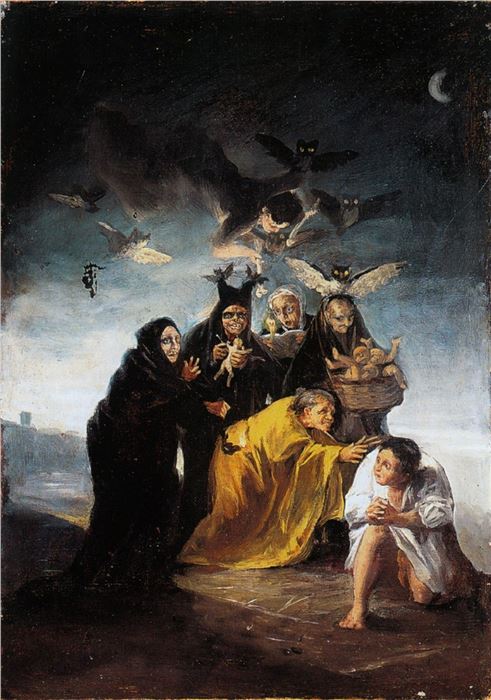
No artist captured the intersection of the grotesque and the ethereal quite like Francisco Goya. His painting, The Incantation (El conjuro), executed between 1797 and 1798, stands as a chilling testament to this thematic obsession. In this oil on canvas, currently housed in the Lázaro Galdiano Museum in Madrid, Goya presents a scene of profound disquiet. Under an overcast sky, presided over by a parliament of owls—traditional harbingers of ill omen—a coven of witches congregates upon a desolate, windswept clifftop.
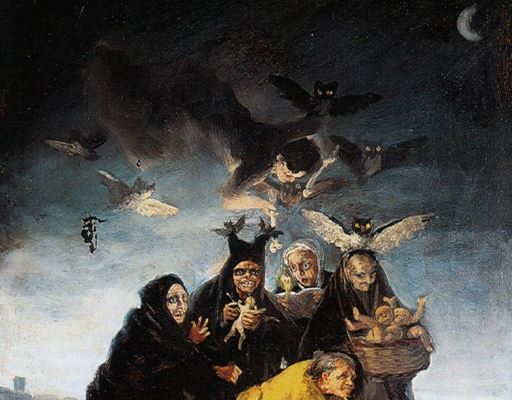
The scene is one of mirthful malevolence. At the center of the hexad, an innocent figure cowers in futile supplication, their posture one of absolute vulnerability beneath the cloaked, jagged forms of the witches. Each figure plays a specific, malicious part in the ritual. One witch chants from the weathered pages of a grimoire; another clutches a basket containing squirming infants; a third, distinguished by a pair of bats perched upon the points of her hood, methodically drives pins into a doll. A fourth figure gesticulates wildly as she utters her incantation, while the elder—draped in a striking golden cloak and seemingly sightless—reaches out with misshapen, grasping hands toward the unwilling sacrifice. Perhaps most unsettling is the sixth figure, captured mid-transformation, her form blurring between the strigid and the sorcerous as she holds a pair of bones, keeping time for this perverse, nocturnal carol.
El conjuro was part of a broader series of six works focusing on the theme of witchcraft. These were purchased by the Dukes of Osuna in the summer of 1798 for their newly constructed palacio in the Madrilenian barrio of La Alameda. It is a long-standing theory among art historians that these commissions, which included the famous Witches’ Sabbath, were created at the specific behest of the Duchess, who likely shared the period’s fashionable, if morbid, interest in the occult.
Mirror Gazing and the Victorian Occult
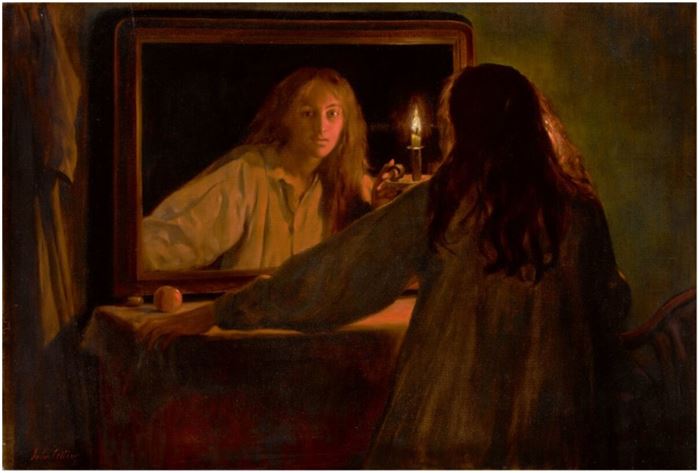
If Goya’s work represents the visceral, externalized horror of the supernatural, other artists have focused on the intimate, introspective nature of occult practice. John Collier’s 1895 oil painting, All Hallowe’en, captures a quieter, yet no less haunting moment. In the scene, a young woman is depicted in a dimly lit room, a single candle burning low in its holder. Clad only in a nightshirt, her hair disheveled as if she has just been roused from sleep, she gazes into the surface of a mirror. Her expression is one of intense focus, her eyes wide as she stares at her own reflection.
The subject is not engaging in vanity; she is performing an ancient form of divination known as mirror gazing, or catoptromancy. Popularized during the Victorian era as a parlor curiosity that flirted with genuine spiritualism, the practice involved staring into a reflective surface until the mind, untethered from the waking world, began to perceive images that do not exist in the earthly realm. These "ghostly echoes" were then interpreted by the practitioner as visions of the future or glimpses into the spiritual plane.
While All Hallowe’en lacks the voluptuousness often associated with Collier’s more celebrated works, it remains a poignant piece that perfectly captures the mood of late October. It serves as an invitation for the viewer to contemplate the thin veil between the mundane and the metaphysical, a theme that has fascinated occultists and artists alike for centuries.
The Prophetic Still Life and the Vampire’s Touch
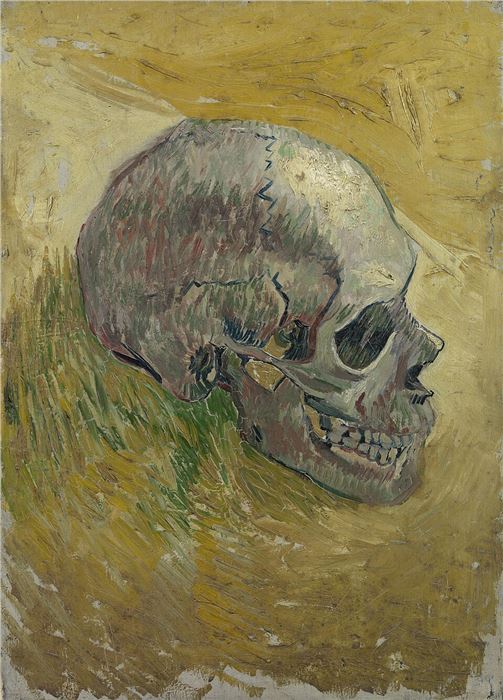
Moving from the human form to the skeletal, Vincent van Gogh’s 1887 Skull offers a more existential reflection on the nature of mortality. Against a swirling, turbulent backdrop of ochre, viridian, and giallo di Napoli, the solitary skull serves as a classic memento mori. It is a prophetic and poignant study, as timeless as the cycle of life and death itself.
Interestingly, technical analysis of the piece reveals a fascinating layer of history. The prominent craquelure found on and around the ramus is not merely an effect of age; it is the result of Van Gogh painting the skull over a previous work using a slow-drying zinc white base. This technical detail feels strangely appropriate for the subject matter: just as death eventually claims all, the paint of the present inevitably covers the traces of what came before.
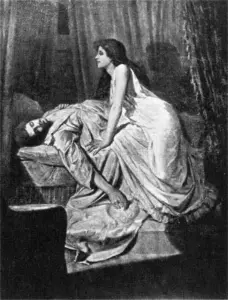
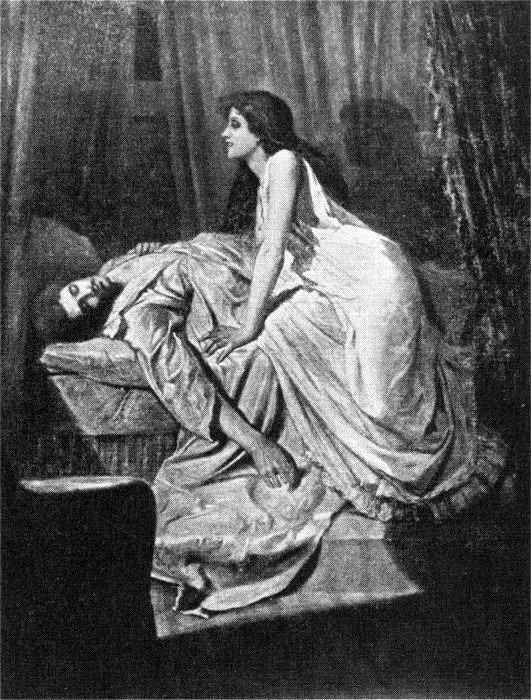
This sense of encroaching darkness is perhaps most famously rendered in the late 19th century through the lens of romanticized danger. Philip Burne-Jones’s 1897 painting, The Vampire, presents a classic, chilling tableau: a vampiress looms over an unconscious man, her eyes three-quarters closed in a state of satiation. A faint, knowing smile plays upon her lips, a reflection of the pleasure derived from the trickle of blood—sweet and warm—following the puncture of her teeth.
The history of this painting is inextricably linked to the social and artistic circles of late-Victorian London. Painted by the son of the famed Pre-Raphaelite Edward Burne-Jones, the work served as the direct inspiration for a poem of the same name by his cousin, Rudyard Kipling. When the painting and poem were exhibited together at the New Gallery in London in 1897, it caused a sensation, occurring just weeks before the publication of Bram Stoker’s Dracula.
The public reaction was fueled by more than just the painting’s inherent sensuality or its themes of violence. Burne-Jones was notoriously infatuated with the star stage actress Mrs. Patrick Campbell. After a period of showering her with gifts—furs, jewelry, and various tokens of affection—he realized his advances were not reciprocated. In a move that served as a form of artistic vendetta, Burne-Jones modeled the face of the vampire directly on his unrequited love.
Beyond the scandal, the painting remains a masterclass in composition. The way the cascading bedsheets blend seamlessly with the victim’s nightshirt and the killer’s gown, combined with the contrast between the victim’s limp posture and the vampiress’s taut, predatory tension, creates an atmosphere of profound foreboding. While the original painting has since vanished, with its current whereabouts unknown, its legacy remains embedded in the cultural imagination of the era.
As autumn deepens and eventually yields to the harsher grip of winter, art continues to offer us a way to immortalize the transitory. Whether through the swirling, frantic brushstrokes of a post-impressionist, the precise pencil lead of a sketchbook, or the captured light of a lens held in frost-chilled hands, we find a way to steal these fleeting moments away. We entomb the essence of the season within our chosen mediums, preserving the visual, the dark, and the beautiful, ensuring that even as the year fades, the soul of our observations remains intact.