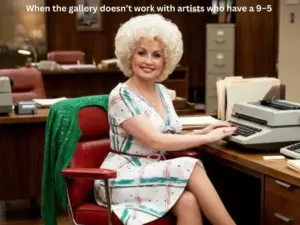
Ever been shamed for having a nine-to-five job as an artist? Paddy Johnson can relate.
Consider a simple comparison that highlights the absurdity of the art world’s expectations. Imagine you are a plumber who works a standard nine-to-five job during the week and fixes pipes on the evenings and weekends. Do you lie awake at night wondering whether you are a real plumber? Of course not. Plumbing pays reliably, and it comes with a clear structural foundation that includes a formal apprenticeship and a required license. Art, by contrast, has no equivalent. The pay is notoriously unreliable—often nonexistent—and there is no official board, certification, or licensing body that validates you to make it.
Without objective credentials or reliable compensation, the art community has spent generations inventing proxy tests to evaluate an artist’s seriousness and value. Unfortunately, most of these internalized benchmarks are arbitrary, exclusionary, and deeply inane. Do you maintain a dedicated studio space outside of your home? That is considered serious. Do you hold an Ivy League Master of Fine Arts degree? That is very serious. Do you teach at one of those prestigious institutions? That is about as serious as the traditional art world gets. And what about having no day job at all? If your answer is no, congratulations—according to prevailing art-world snobbery, you are the most serious artist of all.
Every single one of these traditional markers ultimately concerns wealth and class rather than artistic merit. Maintaining a separate studio requires independent rent money, which is increasingly out of reach in major metropolitan centers. Securing a teaching job requires expensive higher-education degrees, deep professional connections, and usually years of precarious exploitation as an adjunct professor with no job security or health benefits. Meanwhile, operating without a day job means you are subsidizing your practice either through steady commercial art sales or generational family wealth. Artists who sell their work easily often come from privileged social circles where friends and peers can actually afford to buy high-priced contemporary art.
The socioeconomic pressures forcing artists into silent compromises have only intensified with the evolution of the modern labor market. An artist who survives on sporadic contract work often reads as more serious to galleries and curators than one who punches a clock at a full-time job, because freelance or contract work theoretically preserves flexible hours for studio time. That is the comforting theory, anyway. In practice, relying entirely on the gig economy leaves artists far more financially exposed, lacking basic safety nets, paid time off, or employer-sponsored health benefits to support them through creative dry spells or medical emergencies. The modern gig economy promised liberation and flexibility, but it systematically eroded the traditional part-time jobs that artists historically relied upon to make ends meet while maintaining a steady creative practice. Now, for many working-class creators, the relentless hustle of the freelance market has become an exhausting albatross.