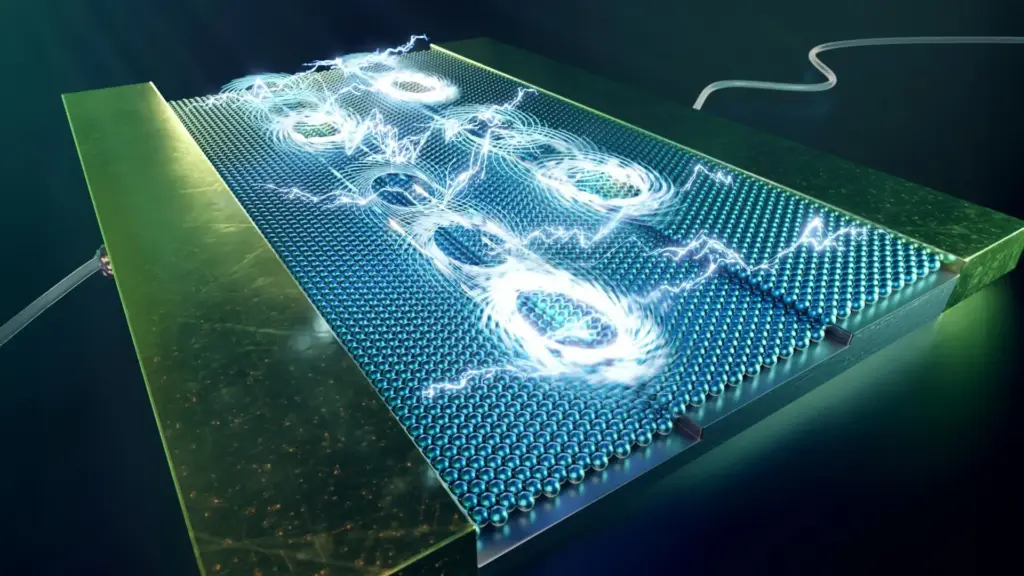
TOKYO — In a breakthrough that could pave the way for a new generation of ultra-efficient electronics, scientists in Japan have discovered that surface steps just one atom high can act like microscopic railroad tracks, guiding the movement of quantum vortices inside an ultrathin superconductor. Under specific experimental conditions, the research team found that these swirling quantum structures moved more than 1,000 times more easily along the atomic steps than across them. Furthermore, the scientists demonstrated that this remarkable guiding effect can be precisely adjusted simply by changing the ambient temperature or the strength of an applied magnetic field.
The discovery was made by a team of researchers at the Research Center for Materials Nanoarchitectonics (MANA), an elite institution operating as part of Japan’s National Institute for Materials Science (NIMS). Their findings offer a promising and fundamentally novel approach to controlling complex quantum behavior. In the long term, this atomic-scale manipulation could help engineers develop superconducting electronics that consume significantly less energy while processing information far more efficiently than conventional silicon-based technologies.
The details of the breakthrough have been published in the scientific journal Physical Review B, drawing attention from the broader condensed matter physics community for its elegant use of surface topography to tame unruly quantum phenomena.
Why Controlling Quantum Vortices Matters
Superconductors are a class of remarkable materials capable of carrying electrical current with absolute zero electrical resistance, provided they are cooled below a specific critical temperature unique to each material. This zero-resistance property makes them intensely attractive to scientists and engineers seeking to develop extremely energy-efficient electronics, powerful medical imaging equipment, high-speed maglev transportation, and advanced quantum computing architectures.
However, the practical application of superconductors often comes with complex physical hurdles. Most type-II superconductors contain tiny quantum structures known as vortices. These structures form when external magnetic fields penetrate the bulk of the material, creating minuscule regions surrounded by circulating electrical currents.
While these vortices are a fundamental characteristic of superconductivity under magnetic loads, their behavior can severely disrupt performance. When vortices are forced to move—often driven by the flow of transport currents—they generate energy dissipation, which manifests as electrical resistance and introduces thermal and electronic noise.
Consequently, being able to control precisely where these vortices travel, or halting their movement entirely, has long been a primary objective for researchers working to optimize superconducting devices. Until now, directing their movement in extremely thin, two-dimensional superconductors has proved particularly difficult due to the complex interplay between quantum mechanics and material defects.
To investigate this persistent challenge, a research team led by Takashi Uchihashi at MANA turned their attention to an ultrathin superconductor whose surface naturally featured a series of regularly spaced atomic steps. Using scanning tunneling microscopy—an advanced imaging technique capable of visualizing surfaces down to the individual atomic level—the researchers were able to confirm that these atomic-scale steps ran parallel to one another. Furthermore, they directly observed individual vortices neatly positioned along these topographical features, setting the stage for a deeper physical investigation.
Atomic Steps Act Like Rails for Quantum Motion
When the MANA team began probing the transport properties of the ultrathin superconductor, their experiments revealed an extraordinary difference in how easily the vortices could move depending on their orientation relative to the atomic steps.
Employing four-terminal resistance measurements, a rigorous technique that allows scientists to measure electrical resistance with extreme precision, the team discovered that vortices traveled more than 1,000 times more easily along the direction of the atomic steps than they did across them when exposed to intermediate magnetic fields.
In practical terms, the tiny, single-atom-high steps functioned identically to microscopic rails, creating heavily favored pathways for the quantum vortices to follow.
"Our study shows that atomic-scale steps can act as effective rails that guide superconducting vortices, and that this guiding effect can be tuned simply by changing the temperature or magnetic field," said Takashi Uchihashi, describing the team’s observations.
Digging deeper into the data, the researchers identified a particularly intriguing regime of behavior when the applied magnetic field was held within a range of approximately 0.10 to 0.20 tesla (T), the standard international unit used to measure magnetic field strength. Within this specific window, the vortices were able to flow fluidly and freely along the length of the steps without becoming trapped by random imperfections or microscopic impurities scattered throughout the material.
This phenomenon, recognized by physicists as one-dimensional pinning-free vortex flow, is especially significant because it means vortices can travel along a cleanly defined, predictable path without encountering the usual structural obstacles that typically restrict, hinder, or completely halt their movement.
At the lowest end of the temperature spectrum, the research team observed yet another unusual quantum effect. Under these cryogenic conditions, the motion of the vortices was no longer governed purely by classical mechanics, but instead was heavily influenced by quantum tunneling. This quantum phenomenon allows subatomic objects and microscopic structures to pass straight through energy barriers that would normally block their movement entirely under the laws of classical physics.
A New Path Toward More Efficient Superconductors
The cumulative findings demonstrate that even a surface feature as infinitesimally small as a single atom in height can exert a massive, highly deterministic influence over the movement of quantum vortices.
By utilizing these natural atomic steps as built-in guiding tracks, scientists may soon be able to control vortex motion with a degree of precision previously thought impossible. Moreover, the ability to dynamically adjust and modulate that motion simply by tweaking external parameters like temperature and magnetic field strength provides engineers with an additional, highly flexible handle for influencing how superconductors behave under operational conditions.
Although translating these fundamental laboratory insights into commercialized, large-scale practical applications will undoubtedly require substantial further development and engineering innovation, this atomic-scale approach opens up exciting new horizons. In the future, such techniques could help researchers effectively manage both vortex movement and localized heat flow in next-generation superconducting technologies, ultimately paving the way for advanced electronic devices that consume dramatically less power while delivering unprecedented performance.