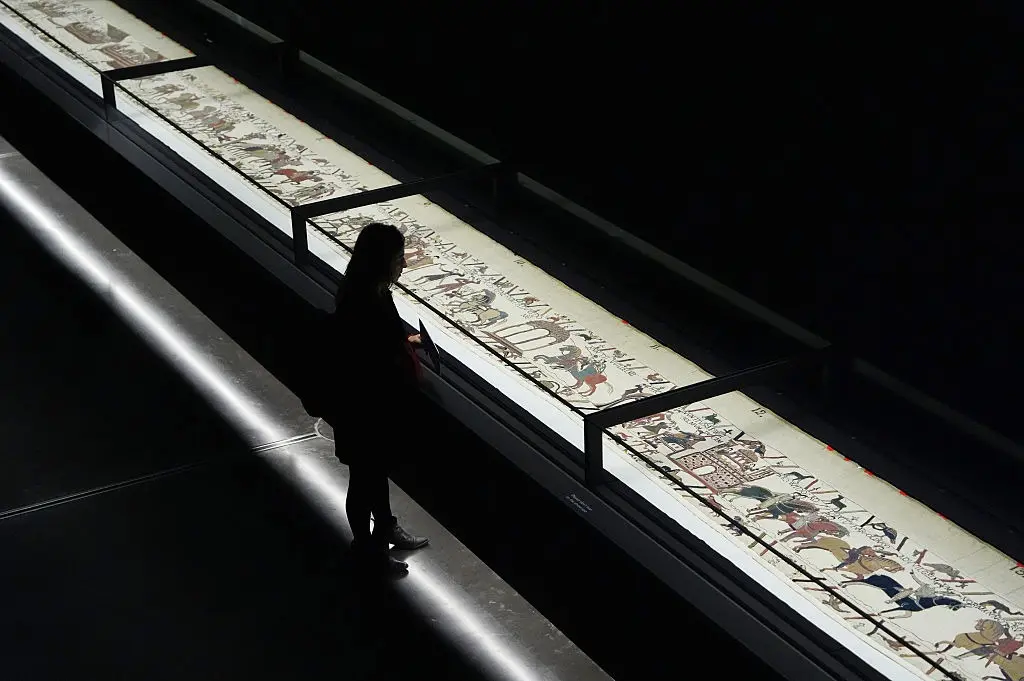
When the legendary Bayeux Tapestry returns to its home region of Normandy next summer following a high-profile ten-month loan exhibition at the British Museum in London, the nearly 1,000-year-old embroidered masterpiece will be presented in a completely new way. Rather than returning to the traditional vertical hanging method that defined its decades in France, the 11th-century textile will be re-installed on a slanted table, closely mirroring the flat, darkened presentation style currently utilized by curators in London.
According to reports from French cultural publication Le Monde, the massive 770-pound, 220-foot-long embroidered cloth had previously been displayed vertically at the Bayeux Museum in Normandy. That museum is currently closed for comprehensive renovations and is scheduled to reopen to the public in October 2027. During its landmark stay at the British Museum, however, the fragile artifact has been carefully laid flat within a specialized, darkened exhibition hall to safeguard its delicate fibers from the strain of gravity. When the treasure goes back on view in Normandy after its travels, museum authorities plan to transition it to a slanted table system, marking a significant evolution in how visitors will experience the monumental historical artifact.
France’s Minister of Culture, Catherine Pégard, addressed the impending shift in presentation through a statement posted on the social media platform X. She noted that the tapestry’s display method was "bound to change" and emphasized that the adjustment is not a reactionary measure to any damage incurred during its recent transport to London. Instead, Pégard clarified, the shift has been "underway for a very long time," reflecting decades of conservation discussions within the French cultural sector.
The Bayeux Museum has actually been considering abandoning the vertical suspension system—which has supported the tapestry since the 1980s—for about a decade, Pégard wrote in her statement. She expressed strong support for the updated approach, assuring the public that the historic artifact will be treated with the utmost care upon its homecoming.
"The Tapestry will return under the agreed conditions and will be presented in its full length, on a slanted table, to better preserve it and to offer a better visit," Pégard wrote. "Thus, we will see the Tapestry again in a new museum, with a new presentation. We can only welcome this."
Tapestry fans and cultural heritage experts across France and internationally have remained on high alert regarding the artifact’s safety and display ever since the historic loan agreement between French and British authorities was officially signed in the summer of 2025. The agreement marked a monumental moment in cultural diplomacy, temporarily bridging the English Channel with one of the most famous and politically charged visual narratives of the Norman Conquest of England in 1066.
When the millennium-old textile finally arrived in London a year later, in July 2026, French officials moved quickly to reassure the public about its pristine condition. At the time, France’s general director of heritage and architecture formally announced that inspections had confirmed there had been no damage sustained during the complex international transfer.
However, public scrutiny intensified just two months later when the New York Times reported that conservators working closely with the artifact at the British Museum had actually discovered "two new small breaks among its millions of threads, both of which were a few millimeters long." While museum officials and conservators frequently point out that ancient textiles of this age undergo microscopic shifts and normal wear over centuries, the revelation sparked intense debate among historians, preservationists, and citizens regarding the risks of moving such a fragile cultural treasure across international borders.
Despite the ongoing discussions and the close monitoring by international conservators, public enthusiasm and demand to see the masterpiece remain exceptionally high. The Bayeux Tapestry is scheduled to remain on view at the British Museum until July 11, 2027, drawing steady crowds to its current darkened exhibition space. Ticket demand has been so intense that admission slots are currently sold out through the end of the year, with museum administrators scheduling the next batch of ticket releases for Wednesday to accommodate the overwhelming public interest before the exhibition concludes and the artifact begins its much-anticipated journey back to Normandy.