The traditional narrative surrounding Fairfield Porter (1907–1975) is one of steadfast independence in the face of an overwhelming artistic consensus. For much of his career, Porter stood as a quiet, determined advocate for figuration during an era dominated by the explosive, gestural force of Abstract Expressionism. While he moved within the circles of titans like Jackson Pollock and Willem de Kooning—men who were not only his peers but his personal friends—Porter remained an outlier. He eschewed the radical abstraction that became the hallmark of the New York School, choosing instead to anchor his practice in the observation of the tangible world.
Porter famously declared that "art does not stand for something outside itself," a philosophy that allowed him to pursue a path of quiet, lyrical realism. He drew profound inspiration from the intimate, domestic works of Édouard Vuillard and Pierre Bonnard, translating their sense of interiority into his own landscapes, portraits, and tranquil home scenes. For decades, this commitment to the observable world meant he operated on the periphery of critical acclaim. However, as the fervor for pure abstraction cooled toward the end of his life, Porter began to secure the sterling reputation he holds today. While he may not possess the universal household recognition of his more volatile contemporaries, he has undeniably ascended to the pantheon of 20th-century American masters.
A Painter of Summer and Domesticity
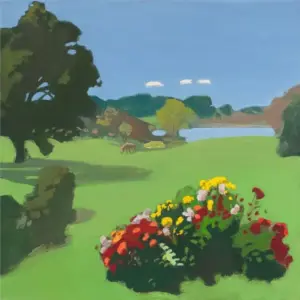
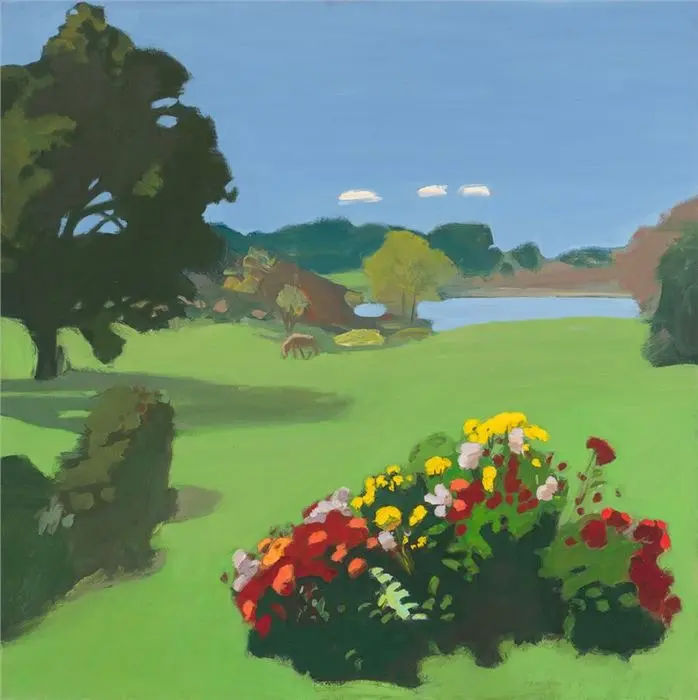
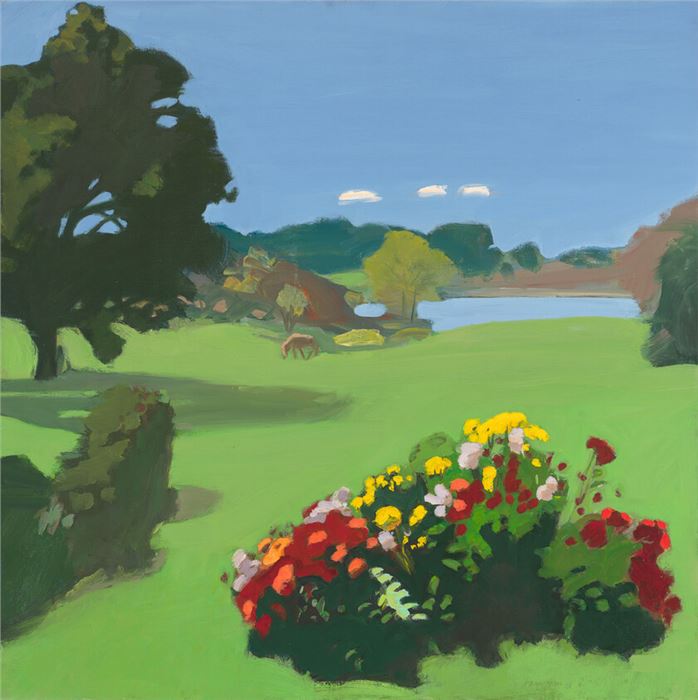
When art historians and enthusiasts contemplate a "typical" Fairfield Porter, they almost invariably turn to his pastoral works. Pieces such as Chrysanthemums under a Blue Sky (1961) define the popular perception of his oeuvre: a lambent green lawn, a serene, expansive sky, and the quiet stillness of a pond. In that specific painting, the vibrant, clusters of red, yellow, and orange chrysanthemums act as a focal point, drawing the viewer into a moment of suspended animation.
His interior scenes tell a similar story of calm and observation. In Claire White (1960), the titular subject—an elegant, middle-aged woman—sits poised in a chair before a window, her simple white dress catching the light. It is an image of profound taste and stillness. This focus on the domestic sphere extended to the various homes Porter inhabited in Southampton and Maine. His canvases, such as The Harbor (1966), Islands (1968), Trees in Bloom (1968), Oak Tree (1969), and The Dog at the Door (1971), function as an expansive, ongoing study of familiar surroundings and the idyllic, natural world that bordered them.
This body of work eventually led to a specific critical pigeonholing. In 1985, Artforum famously, if somewhat dismissively, characterized the artist as "a painter of summer, of dappled fields, of porches—a suburban painter, really." While this assessment accurately identifies the atmosphere of many of his most famous works, it obscures the complexity of his artistic vision, ignoring the darker, more industrial, and deeply psychological dimensions of his career.
The Urban Counterpoint: New York as a Subject
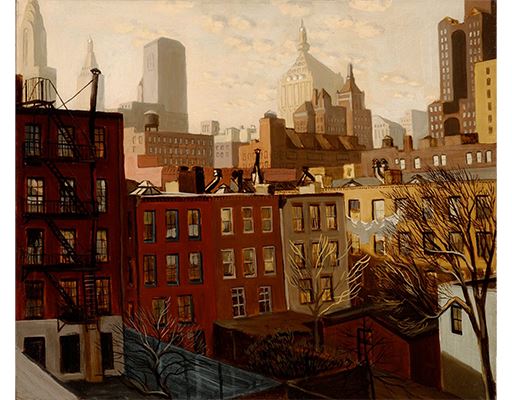
To define Porter solely by his pastoral proclivities is to overlook a significant and evocative component of his work: his cityscapes of New York. These urban scenes, spanning from his early efforts in the 1930s and 1940s to his final works in the 1960s and 1970s, reveal an artist deeply attuned to the rhythms of the metropolis. Though these cityscapes represent a smaller portion of his total output compared to his bucolic scenes, they are vital to understanding his broader aesthetic.
Porter’s approach to the city was not an attempt to escape into nature, but rather a desire for what he called "direct understanding." He once explained that he did not "like to be superior to a story or picture. I like to be able to be lost in it. This is not a desire for escape; it is a desire for direct understanding, which is a feeling that gives a sense of psychological power." This desire for connection informed his urban paintings, which range from the orderly and optimistic to the stark and unsettling.
Union Square and the Ambiguity of the Street
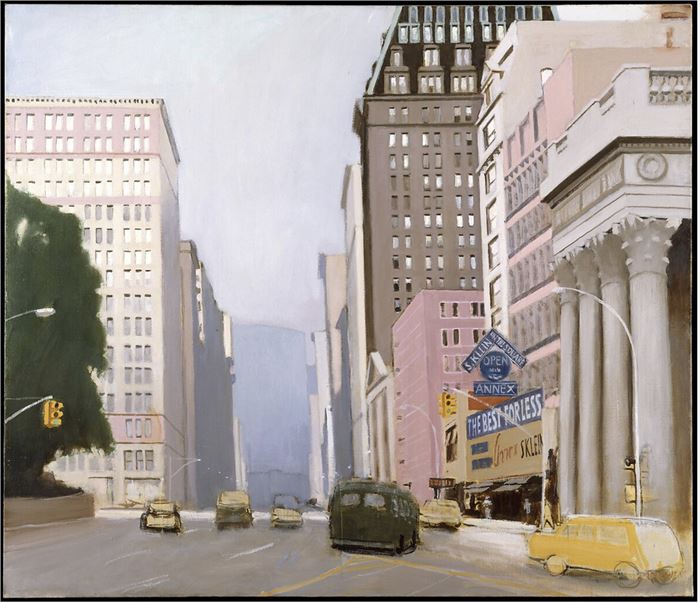
The cityscapes of Fairfield Porter generally fall into two distinct strains. The first is characterized by a sense of order and optimism, capturing a version of mid-20th-century New York that feels distant from the fiscal decay that would grip the city by the mid-1970s. In these paintings, primarily focused on Midtown and Union Square, the streets are bustling with well-dressed businessmen and elegant women. The architecture is rendered with a sense of calm, featuring wide streets, clear light, and subtle greenery.
Union Square, Looking up Park Avenue (1975) is a quintessential example of this strain. The painting depicts a handful of cars navigating the curve of the street near the Union Square Savings Bank. The palette is muted yet warm, featuring a "cool but cozy" pewter gray sky set against building facades of creamy taupe, beige, and soft cotton-candy pink. There is no grit, no disorder, and no sense of urban malaise—only the city captured on a bright, purposeful day. Porter, who believed the light in New York was superior to that of Paris or Rome, managed to find the "extraordinary" in the ordinary, echoing his own admiration for the works of Vuillard.
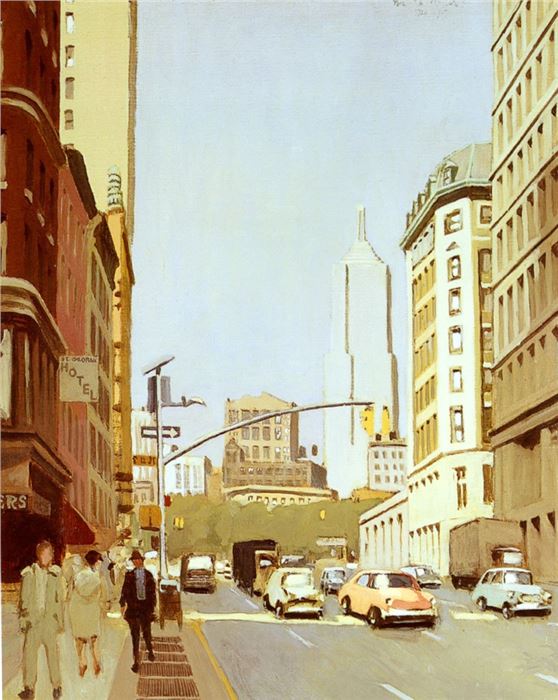
However, the patrician Porter was not always focused on such polished, pastel-hued avenues. A significant subset of his urban work leans into a more ambiguous, painterly abstraction that evokes mystery and, at times, a profound sense of unease. In Untitled (East 11th Street) (ca. 1961), for example, an empty street bisects the canvas. While the buildings on the left are rendered with clear, recognizable features, the structures on the right are nearly abstract—splotchy, unfinished rectangles that recall the formal experiments of Hans Hofmann.
This sense of alienation is heightened in works like City Street (ca. 1970), which is entirely devoid of human presence. The emptiness of the scene in a city typically characterized by density creates an uncanny effect, leaving the viewer to wonder about the silence of the space. Even when Porter included figures, as in Street Scene (ca. 1943), the mood remains fraught. The woman in the foreground appears visibly nervous, a tension that art critic Lance Esplund noted is only partially tempered by the beauty of the surrounding ochres and salmon tones. Esplund, in his appraisal, suggested that for all their aesthetic charm, many of Porter’s cityscapes remain "grimy, gritty, [and] uneasy."
A Vibrate Energy: The Spectral City
The most striking example of this unsettling urban energy is found in Cityscape (ca. 1970s). The background features a mundane view of a bridge and urban architecture, but the foreground is dominated by three spectral, haunting figures. A man, a woman, and a small, ambiguous object—perhaps a stroller or a cart—hover on the left side of the frame, their interactions mysterious and disconnected. A ghostly, barely defined figure of a girl emerges from the brown street, rendered in light, ethereal brushstrokes.
This "unfinished" quality, which Porter’s friend and fellow artist Jane Freilicher noted was a recurring trait in his work, serves a specific purpose here. It prevents the image from settling into a static narrative, causing the canvas to vibrate with an odd, unresolved energy.
Ultimately, it would be inaccurate to categorize Fairfield Porter as a "painter of the city" in the vein of the Ashcan School, whose mission was to document the raw, often gritty reality of urban life. Porter’s New York is not a sociological study; it is a subjective experience. His cityscapes offer a window into the Mad Men-era metropolis of gray flannel suits and clear, cool light, but they also capture something more enduring: the city’s timeless, and often paradoxical, ability to simultaneously beguile and unnerve those who walk its streets. By looking beyond the dappled fields and summer porches, one finds in Porter a nuanced observer of both the natural world and the complex, shifting shadows of the urban landscape.