
For the first thirty minutes of Alejandro G. Iñárritu’s latest cinematic achievement, Digger, the audience is lulled into a familiar, albeit lavish, cinematic comfort zone. A sprawling narrative about absolute power and environmental ruin unfolds on screen, introducing viewers to the most powerful man in the world and the irreversible ecological catastrophe he has unleashed. Yet, as with much of Iñárritu’s visionary filmography, what initially appears straightforward turns out to be something entirely different. With every subtle shift in perspective, the catastrophic reality depicted on screen moves a little closer to the audience watching, ultimately dissolving the boundary between the fiction in the theater and the reality of the viewer.
Spoiler alert! We are about to delve into what Digger spends its first half hour hiding — if you have not seen the film yet, save this piece for afterwards.
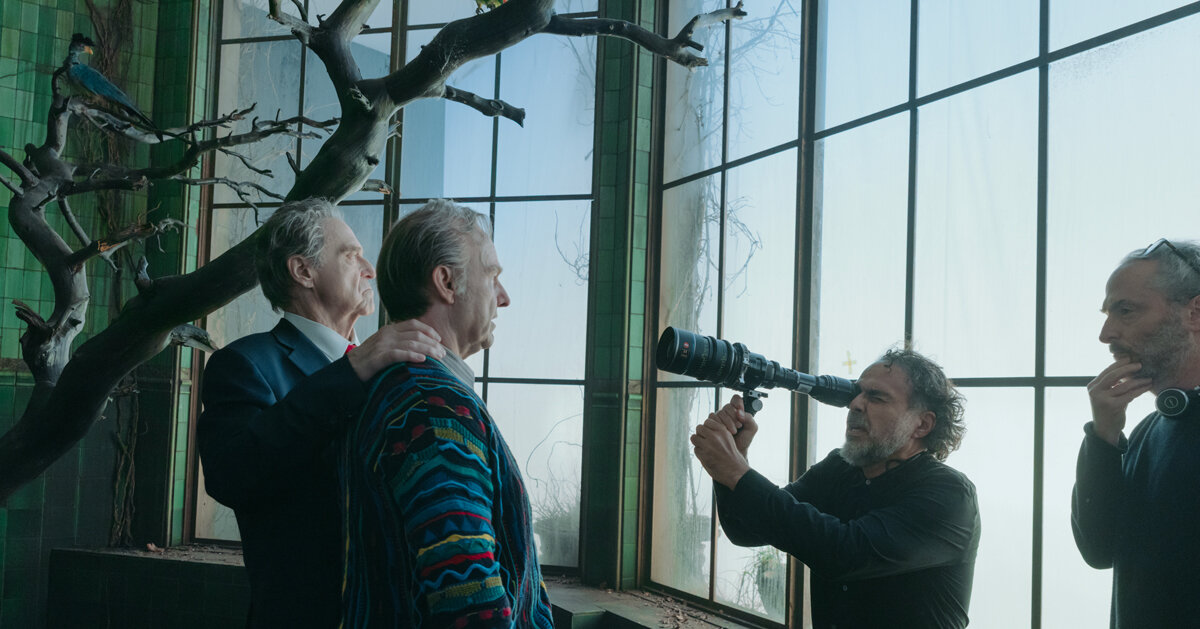
A Closer Look at the Scenography in Alejandro G. Iñárritu’s ‘Digger’
Approximately half an hour into Digger, a model tree falls over, a section of what had previously appeared to be a vast hillside opens up, and a giant man steps out to pick it up while the rest of the film crew floods the frame behind him. The director immediately starts shouting instructions, Tom Cruise drops his heavy Texas accent, and everything watched up to that point is revealed to be a technical rehearsal for the 25th-anniversary production of a stage play titled Fossil Fools.
In this meta-theatrical framework, Cruise plays Curtis Markson, an actor cast as the oil baron Digger Rockwell. The play itself centers on a massive global and climate disaster caused by Rockwell—widely regarded as the most powerful man in the world—whose aggressive Greenland drilling operation releases an enormous ice shelf toward Europe, ultimately drowning the coastlines of the world.
This major plot twist is fundamentally a designer’s reveal. It arrives not through heavy-handed dialogue, but through the mechanical intrusion of a stage technician stepping into the shot to manage a fallen tree. This moment sets the tone for the four distinct vantage points the film forces its audience to inhabit. Each position is meticulously established through physical scenery rather than explicit character exposition: a lavish mansion that keeps disaster at a safe distance; a theatrical play viewed by a seated audience; a play that unmasks itself as a historical reconstruction of real-world trauma; and finally, a terrifying scenario where all distance vanishes entirely. The sets are not merely decorative structures; they serve as a measuring instrument for the psychological distance between spectator and spectacle, systematically compressing that distance over the course of two hours until it ceases to exist.

Set Design as a Storytelling Device
The complex world of Digger was brought to life by celebrated production designers Dennis Gassner and Richard Johnson. Gassner, a seven-time Academy Award nominee and winner for Bugsy, boasts a legendary filmography that spans Barton Fink, Road to Perdition, Blade Runner 2049, and the Daniel Craig-era James Bond films. However, the credit that resonates most profoundly with Digger is The Truman Show, for which Gassner built an entire artificial town disguised as reality.
Digger cleverly inverts that dynamic. In The Truman Show, the protagonist remains entirely unaware that he lives inside a set, while the audience is let in on the secret from the opening moments. In Digger, every actor on screen knows precisely where they are standing, while the audience is kept completely in the dark.
The film’s opening world is established within Digger Rockwell’s extravagant mansion. He wakes beside a bedroom window framing an idyllic view reminiscent of an Albert Bierstadt painting, surrounded by taxidermied alligators pinned to the ceiling and full-body mirrors lined with antlers that reflect his image into infinity. Every design choice in this residence constructs the portrait of a monstrous man whose misdeeds exist at a comfortable remove from the viewer’s everyday life. It relies on a classic cinematic convention: a villain in his lair, a distant ecological disaster unfolding in the frozen north, and a sturdy fourth wall holding the horror at arm’s length. The set design performs the traditional function of theatrical spectacle, rendering a catastrophe watchable by localizing it safely elsewhere.
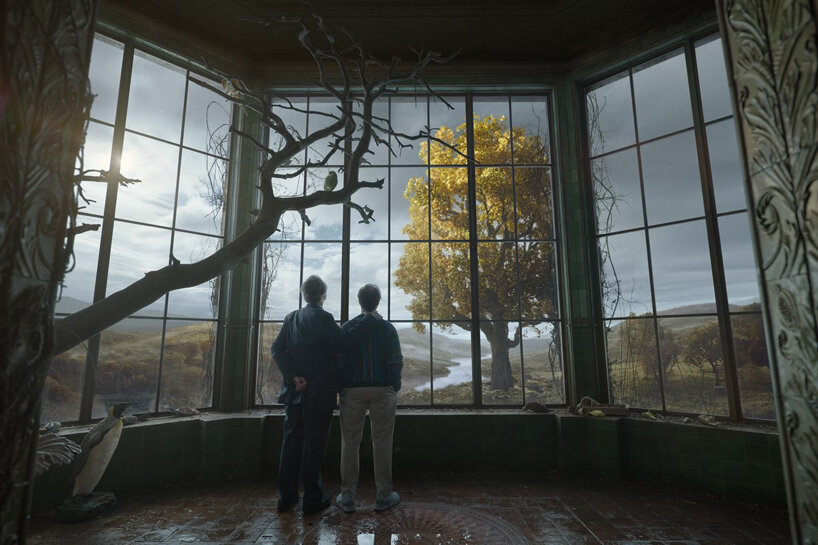
Color Palette and Props Reinforce the Narrative
Once the theatrical illusion shatters with the falling tree, the film retroactively grants the audience an alibi. Armed with the knowledge that they have been watching a stage production, the artificiality of the preceding half hour ceases to be a cinematic flaw and transforms into a deliberate stylistic signature. Maggie, Digger’s one-eyed geriatric cat, is revealed to be a conspicuously obvious animatronic within a film amply financed to render a realistic animal. Miniatures appear with their seams proudly showing, while painted clouds and model aircraft cross the sky on physical sticks. Nothing on screen is careless; every element is intentionally crafted to remind the viewer of the artifice.
The film’s color palette reinforces this thematic argument. In interviews regarding the film, Iñárritu has pointed to the influence of Johannes Vermeer and Danish painter Vilhelm Hammershøi for color treatment, alongside Edward Hopper and Rembrandt for stark contrast. Hammershøi’s influence is particularly palpable on screen: a career defined by near-empty grey interiors, restricted color palettes, and doorways opening onto further doorways.
Iñárritu describes this muted grey as an instrumental tool rather than a mere mood enhancer, noting that as Digger’s narrative tightens its grip, color steadily drains away. Consequently, the theatrical stage appears drained of life while the backstage area buzzes with bustling human activity, creating a physical reassurance. Grey represents the realm of fiction, while color signifies reality—and that reality appears, for a time, to hold firm.
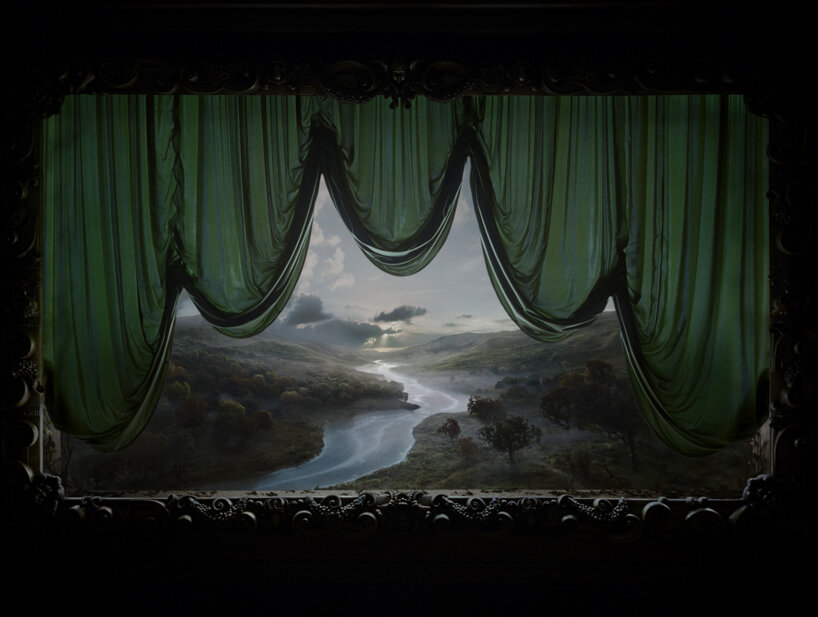
A Movie Plot Twist in Stages
The third major reveal strips away this comfortable alibi entirely. Fossil Fools is not a fictional invention; Digger Rockwell was a real historical figure, the catastrophic disaster genuinely occurred, and the character bankrolling the modern stage production turns out to be Rockwell’s own nephew, who is staging his family’s historical tragedy for a paying audience. At this juncture, the physical set design remains identical, yet its entire meaning undergoes a seismic shift.
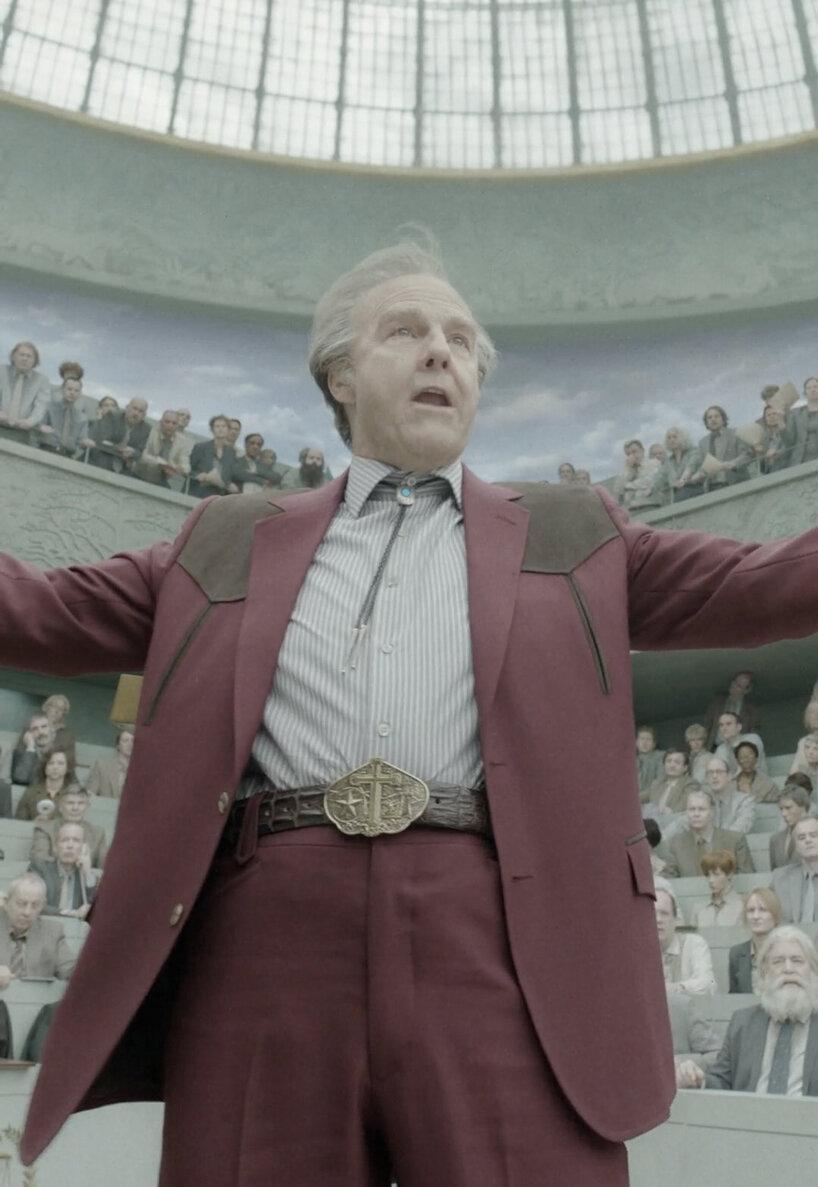
The grey chamber where Digger addresses a tribunal of European politicians—complete with councillors dressed in matching tones that cause them to nearly blend into the walls—stops reading as theatrical caricature and begins to function as chilling testimony. The visible seams on the miniatures no longer signal a mere play; instead, they evoke a museum diorama, openly acknowledging itself as a model of an actual historical atrocity.
This structural evolution clarifies why Iñárritu spent roughly a decade developing the project. Over the course of that decade, the fictional elements he was drafting frequently materialized in the real world. When the initial drafts were written, ice shelves were not routinely detaching from the poles, and methane release was still primarily a technical term rather than a daily headline. As the director noted in interviews, reality was actively chasing fiction and ultimately surpassing it.

Fiction and Reality Collapse into One
The play within the film concludes with Digger diving from his drilling rig to his death. The theatrical audience inside the film rises to a standing ovation, complete with a formal curtain call. Suddenly, an internal intercom announces an emergency Level 25 alert, or Level 4. Every person in that diegetic theater instinctively reaches for a breathing mask and files out into a flooded, militarized street littered with debris and ruined machinery—stepping directly into the very world the play had spent the evening describing, underscored by Melanie’s 1970 track What Have They Done to My Song, Ma.
The backstage color, it turns out, was never authentic reality; it was simply a slightly later stage of the exact same civilizational collapse. Then the film credits roll, and roughly ninety minutes into the sequence, the emergency announcement sounds once more—this time inside the actual cinema where the audience is sitting. Several audience members stand up to leave precisely on that cue.
Stepping outside afterward into an ordinary sunny afternoon generates an immediate, unexpected sense of gratitude, quickly followed by the sobering realization of how thin the margin is between that pleasant afternoon and the ruined street the film’s characters had just navigated.
This single sound cue encapsulates the entire thesis of the film and explains why the meticulous set designs are just as crucial as the narrative script. When asked whether the film’s bleakness reflects his personal outlook, Iñárritu described Digger as a disaster movie in which the disaster is humanity itself, adding that if we can gather in the same room, share the same reality, and understand where we stand in the narrative, there remains hope. This is precisely what the film’s production design achieves over two hours: four distinct sets, four progressive distances, until everyone is finally gathered in the same room, confronting the same reality, and asked to understand exactly where they stand in the story.
Project Info:
- Name: Digger
- Director: Alejandro G. Iñárritu
- Cast: Tom Cruise, Riz Ahmed, John Goodman, Sandra Hüller, Michael Stuhlbarg, Jesse Plemons, Sophie Wilde
- Screenplay: Alejandro G. Iñárritu, Alexander Dinelaris, Nicolás Giacobone, Sabina Berman
- Story: Sabina Berman, Alejandro G. Iñárritu, and Jez Butterworth
- Production Design: Dennis Gassner and Richard Johnson
- Costume Design: Jacqueline West
- Director of Photography: Emmanuel Lubezki
- Music: Cosmo Sheldrake
- Duration: 128 minutes
- Release: October 2026, Warner Bros. Pictures