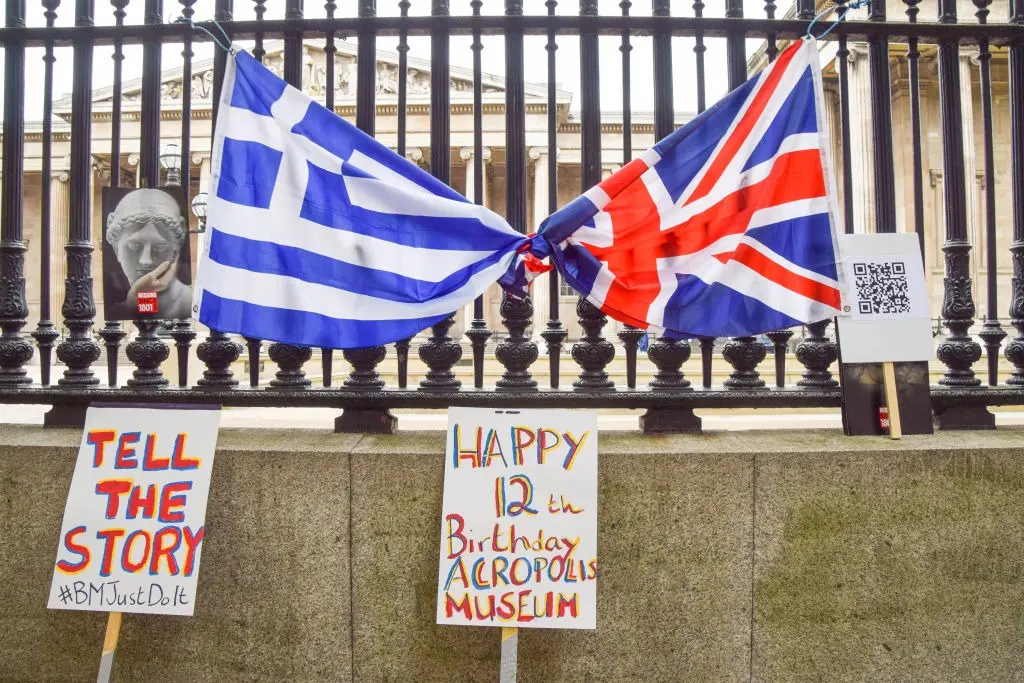
George Osborne, the chairman of the British Museum, has expressed renewed hope that a mutually agreeable arrangement can be struck to share the ancient Parthenon Marbles between Athens and London, despite a diplomatic feud that has now spanned more than two centuries.
Speaking to reporters in the Greek capital on Tuesday, Osborne addressed the long-standing international cultural dispute, emphasizing his belief in a compromise that could satisfy both British and Greek interests.
“I’m still optimistic that we can reach an agreement,” Osborne told reporters in Athens. “If everyone enters into it with the spirit of we’re not going to get everything we want, as is always the case with a successful agreement, then there’s a deal to be done.”
The Parthenon Marbles, which were created between 447 and 432 BCE by the renowned ancient Greek sculptor Phidias, depict mythological gods, sacred processions, and historical narratives through intricate marble relief panels, standalone sculptures, and friezes. Frequently referred to in the United Kingdom as the Elgin Marbles, the artifacts take their alternative name from Thomas Bruce, the seventh Earl of Elgin and a Scottish nobleman who served as the British ambassador to the Ottoman Empire.
Lord Elgin removed the sculptures from the ancient Acropolis in Athens in 1801, during a period when Greece was under Ottoman occupation. He later sold the collection to the British government, which subsequently transferred the priceless antiquities to the British Museum, where they have been housed and publicly exhibited ever since.
Since gaining its independence from the Ottoman Empire in 1832, Greece has consistently sought the permanent return and reunification of the marbles. Athens has long argued that Lord Elgin lacked any legitimate legal or moral grounds to remove the monuments from their original architectural context. British officials, conversely, have historically cited domestic legislation, specifically the British Museum Act of 1963, as a primary legal barrier. The statute strictly prohibits the museum from deaccessioning or permanently parting with objects in its statutory collection.
Over recent years, tensions between the United Kingdom and Greece have escalated significantly. This friction has been fueled by several factors, including the grand opening of the ultra-modern Acropolis Museum in Athens—which features a dedicated, light-filled gallery specifically designed to house the missing sculptures alongside the rest of the surviving Parthenon frieze—as well as recurring reports of roof leaks and other preservation concerns within the aging galleries of the British Museum in London.
Despite these hurdles, Osborne reiterated his vision for a cross-border partnership during his Tuesday remarks.
“I very much hope we can come to some arrangement whereby the Parthenon sculptures that are in London can be seen in Athens but they have to be shared,” Osborne said. “I know that’s not the position of everyone in Greece, and I understand that and respect that, but that is our position, and so if we want to make progress, it has to be in that spirit.”
Osborne’s recent comments follow a pointed opinion editorial published in September in the Guardian by Greek Prime Minister Kyriakos Mitsotakis. In the essay, Mitsotakis strongly criticized recent remarks made by British Museum director Nicholas Cullinan. Cullinan had previously pointed to France’s historic loan of the medieval Bayeux Tapestry to the United Kingdom as “a very compelling example of international partnership,” suggesting that a similar model of reciprocal cultural exchange could potentially serve as a template for resolving the dispute over the Parthenon Marbles.
Mitsotakis fiercely rejected that parallel in his editorial, arguing that the two situations are fundamentally different and that comparing the divided Parthenon sculptures to the loaned tapestry misrepresents the historical reality of the monuments.
“Nobody would seriously contemplate cutting what survives of the tapestry in two and displaying half in London and half in Bayeux, and claiming this was an adequate way to understand it,” Mitsotakis wrote in the Guardian. “Yet that is exactly what happened to the Parthenon sculptures.”
Osborne, a former Chancellor of the Exchequer who has taken a central role in guiding the British Museum’s diplomatic outreach regarding the sculptures, has been at the forefront of behind-the-scenes negotiations. In 2023, the prominent London institution confirmed that it had been engaged in confidential discussions with the leadership of the Acropolis Museum. At the time, officials indicated that the parties were coming close to finalizing an arrangement under which the sculptures would gradually return to Greece over time as part of a broader, long-term cultural exchange program.
Ultimately, however, that proposed agreement never materialized. Just days after the museum’s announcement, Greek Culture Minister Lina Mendoni clarified that Athens would not accept any structural deal that implicitly affirmed or legitimized the United Kingdom’s historical ownership claims over the treasures. Instead, Mendoni countered with a Greek proposal for an exchange framework that would guarantee world-class antiquities from Greece—including objects of comparable historic and artistic prestige to the Parthenon Marbles—would regularly travel to London for ongoing public display.
The international debate surrounding the sculptures is now poised to enter a new diplomatic phase. World leaders are scheduled to convene in Brussels next month for an upcoming EU-UK summit. Speaking at a conference hosted at the University of Athens on October 6, Prime Minister Mitsotakis indicated that broader diplomatic discussions concerning relations between the European Union and the United Kingdom—which formally voted to leave the political and economic bloc in 2016—will inevitably touch upon the unresolved dispute over the British Museum’s collection.
“The Parthenon sculptures will be part of this debate,” Mitsotakis told conference attendees. “This is not just an issue for Greece, it’s an issue for Europe.”