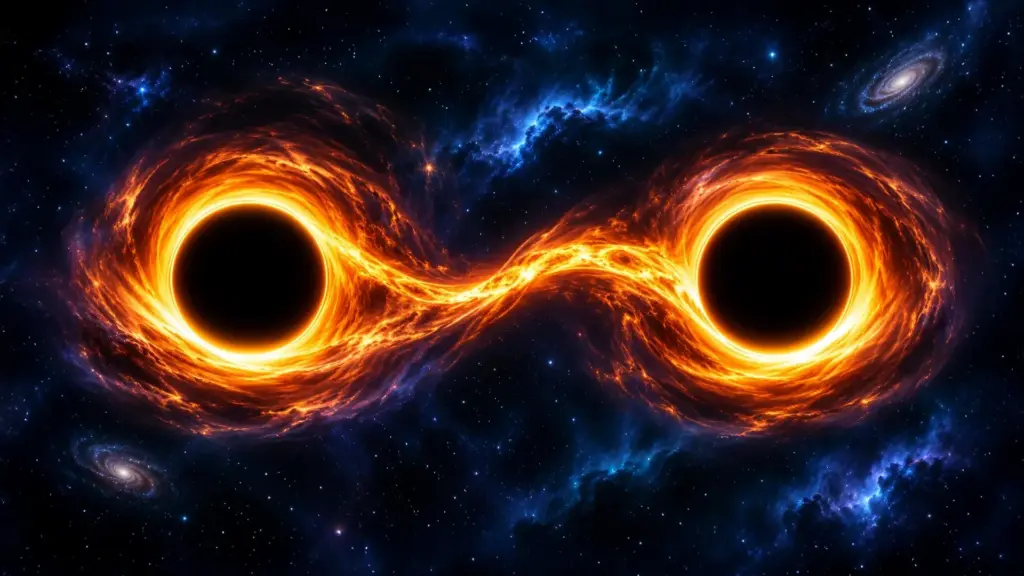
Black holes are universally recognized in modern astrophysics for their cataclysmic mergers. When two of these massive cosmic entities spiral inward and collide, they send ripples through the fabric of spacetime known as gravitational waves, eventually forming a single, larger black hole. But science has long wondered about the inverse scenario: could the reverse process ever occur? Could a single, unified black hole somehow divide itself into two smaller ones?
A compelling new theoretical study suggests that this extraordinary possibility may not be entirely ruled out by the fundamental laws of physics, although the specific conditions required to achieve such a feat would be nothing short of extreme.
The research, recently published in the scientific journal Physical Review D under the compelling title "When Black Holes Admit Pair-of-pants Topologies," takes a deep dive into the complex physical laws that normally keep black holes strictly intact. The study examines whether certain hypothetical circumstances might ever allow these cosmic monoliths to break apart.
"In our study, we investigate which physical laws normally prevent a black hole from splitting into two. We also investigate if certain circumstances may allow a split to happen," explains Francesco Sannino, a co-author of the study, a professor of physics at the University of Naples Federico II in Italy, and a leading figure at the Quantum Field Theory Center at the University of Southern Denmark.
The international research team behind the paper brings together theoretical physicists from multiple prestigious institutions. Alongside Sannino, the project included Giacomo Cacciapaglia, a researcher with the French National Centre for Scientific Research (CNRS) at the Laboratoire de Physique Théorique et Hautes Énergies, which operates as a joint CNRS and Sorbonne Université laboratory in Paris. Additional critical contributions to the theoretical modeling were provided by Manuel Del Piano and Vania Vellucci, both researchers based at the Quantum Field Theory Center at the University of Southern Denmark.
Why Black Holes Normally Cannot Split Apart
To understand why a black hole splitting sounds like science fiction, one must look to thermodynamics, the foundational branch of physics that governs how energy behaves, how heat is transferred, and how physical systems change over time. Within thermodynamics, a central concept is entropy. Entropy is a measure of disorder or, more precisely, a description of how many different microscopic arrangements a system can possess while appearing entirely unchanged from an external perspective.
It is a well-established principle in theoretical physics that black holes possess entropy—a property famously proportional to the surface area of their event horizons. This fundamental thermodynamic property places strict, unyielding limits on what can physically happen to a black hole during its lifecycle.
For a standard black hole that is not rotating, the mathematics dictate that dividing into two smaller black holes would result in a net reduction of the total entropy of the system. In the realm of thermodynamics, such a decrease makes the entire process fundamentally unfavorable. This immutable thermodynamic restriction helps explain why black holes do not ordinarily break apart and why nature favors cosmic mergers over cosmic divisions.
However, the research team found that this rigid picture could change dramatically when introducing extreme physical parameters—specifically, when a black hole spins at an exceptionally high speed.
Extreme Rotation Could Allow Black Holes to Split
The team’s rigorous mathematical calculations suggest that rapid rotation may create a narrow, highly restrictive loophole in the physical rules that normally prevent black holes from dividing. In principle, a sufficiently fast-spinning black hole could store enough rotational kinetic energy to overcome the traditional thermodynamic restrictions that govern stationary objects.
Yet, solving the thermodynamic puzzle is only half the battle. Even if the laws of physics could somehow permit a black hole to divide, the two newly formed resulting objects would still need to move far enough apart from one another to avoid immediately falling back together under their own immense mutual gravity.
"But the two resulting black holes must also be able to separate rather than immediately fall back together. When we include this requirement, the window largely closes again, except possibly for black holes rotating close to their maximum possible rate," notes Francesco Sannino.
The study’s unusual and evocative title refers to the specific geometric shape that a black hole’s boundary would trace through the dimensions of space and time if such a rare split were to actually occur. This boundary, known more formally as the event horizon, would begin its existence as a single, unified structure before separating into two distinct, diverging branches.
When viewed across the dimension of time, the resulting geometric shape would strikingly resemble a pair of trousers, featuring one solid upper section that abruptly divides downward into two separate "legs." This topological concept is precisely what theoretical physicists mean when they refer to "pair-of-pants topologies."
Extra Dimensions Offer Another Possibility
Beyond the limits of standard rotational physics, the researchers also cast a wider net, investigating much more unusual scenarios involving advanced theoretical frameworks in which space possesses additional dimensions far beyond the familiar three spatial dimensions experienced in everyday life.
Theoretical physicists have already identified exotic objects that resemble black holes within some of these advanced mathematical models—objects that can inherently become unstable and begin breaking apart under specific conditions. These theoretical possibilities suggest that the familiar rules governing black holes in standard four-dimensional spacetime may not apply in the exact same way when viewed under more exotic, higher-dimensional conditions.
In certain specialized cases modeled by the team, splitting could even become thermodynamically favorable, a shift that is particularly pronounced when one of the two resulting black holes is dramatically smaller in mass than the other.
However, theoretical physicists emphasize an important distinction: a physical process being allowed or even favored by thermodynamics does not automatically mean it will happen in the physical universe. Researchers still face the formidable task of determining whether such fragmentation can truly occur in nature and what exact astrophysical conditions would be required to make it a reality.
Could Astronomers Detect a Black Hole Splitting?
Following the publication of their theoretical study, the scientists are now actively working to better understand just how likely or unlikely these extraordinary events might be. Finding a definitive answer may ultimately depend on uncovering new aspects of gravity that stretch far beyond Albert Einstein’s century-old theory of general relativity, making an already complex problem exceptionally challenging to solve.
"We cannot yet give a single probability for a black hole to split. It depends on how gravity behaves beyond Einstein’s theory, and we are working to quantify this. We expect small primordial black holes to be more prone to splitting than much larger astrophysical black holes. We may detect a split indirectly: gamma-ray telescopes such as Fermi-LAT can search for signals from tiny black-hole fragments that might form during mergers," explains Sannino.
Primordial black holes—hypothetical objects theorized to have formed in the dense, chaotic fractions of a second immediately following the Big Bang—represent prime candidates for this kind of behavior, given their microscopic scales compared to stellar-mass or supermassive black holes observed in the modern universe.
Although there is currently no confirmed observational evidence of any black hole splitting in the cosmos, the theoretical possibility of detecting unique signals from tiny fragments offers scientists a potential pathway to investigate the idea further. Finding empirical evidence of such phenomena could provide invaluable clues about the true behavior of gravity under the most extreme conditions imaginable in the universe.