The global ceramic tile and bathroom furnishings industry converged on Italy this autumn for Cersaie 2026, transforming the sprawling Bologna Exhibition Centre into a vibrant epicentre of design, technology, and professional development. Spanning more than 1.5 million square feet of exhibition space, the five-day international event welcomed a robust 92,352 visitors through its doors. Inside the bustling halls, a total of 1,190 exhibitors showcased the cutting edge of surface design, installation methods, and manufacturing capabilities, offering a comprehensive look at where the industry is heading as it moves toward the close of the decade.
From hands-on craftsmanship and workforce development initiatives to advanced showroom training and striking new product debuts, Cersaie 2026 delivered a multi-layered experience for architects, designers, distributors, and trade professionals.
Installation Insights
Hands-on learning and technical mastery remained at the very forefront of the exhibition experience, particularly within the dedicated Tiling Town pavilions. Visitors and trade professionals crowded around live demonstrations and expert-led training sessions designed to demystify and elevate advanced installation techniques. With large-format tiles continuing to dominate architectural and residential specifications, mastering the precise handling, cutting, and placement of oversized slabs has never been more critical for installers.
A major focal point of this educational programming was the World Tiling Lab, which marked its fourth successful edition at the show. This collaborative global initiative is organized jointly by Cersaie, Confindustria Ceramica, the European Union of National Tile Associations, and the national tile installers’ associations from the participating countries. This year, the lab featured six international teams of elite tile installers representing Italy, Switzerland, Denmark, Morocco, the United States, and Brazil.
These skilled professionals put their expertise to the test by installing ceramic surfaces across six intricate, real-world settings. The ambitious installations included fully functional bathrooms complete with showers and bathtubs, an outdoor leisure area featuring a swimming pool, a dynamic living space complete with a staircase and a fireplace, a ventilated facade incorporating a French door and window sill, and a sophisticated ceramic-clad seating structure. The live demonstrations underscored the vital partnership between material manufacturers and skilled trade labor, emphasizing that the beauty of high-end ceramic design relies heavily on flawless execution.
For the Next Gen
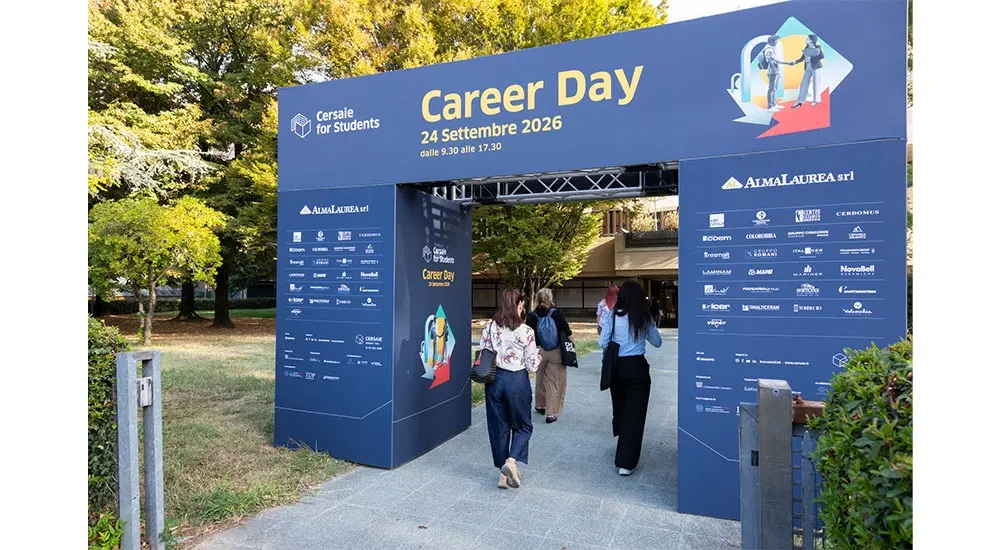
Beyond technical training for current professionals, Cersaie 2026 placed a heavy emphasis on securing the future of the sector through workforce development and education. For the third consecutive year, the exhibition hosted the Ceramic Industry Career Day, an initiative specifically engineered to build direct, personal bridges between young talent and representatives of the Italian ceramic manufacturing sector.
The program welcomed students and recent graduates into an environment dedicated entirely to career guidance and professional matchmaking. Twenty-five leading ceramic manufacturers participated in the event, conducting one-to-one introductory interviews with attendees eager to break into the industry. Complementing the corporate booths were dedicated exhibition stands representing several universities involved in the partnership, creating an academic bridge to the commercial sector.
To ensure students felt fully prepared for these career opportunities, the venue hosted a specialized CV Check Desk. Here, attendees received practical, individualized advice on how to craft an effective resume, alongside professional coaching designed to help them approach job interviews with poise and confidence.
The Career Day curriculum extended well beyond basic recruitment, incorporating forward-thinking seminars that addressed the disruptive impact of artificial intelligence on modern manufacturing and design. In-depth sessions explored European research projects related to the ceramic sector—organized in collaboration with the Centro Ceramico and participating universities—while a targeted career guidance workshop catered specifically to final-year secondary school students weighing their future higher-education and career paths.
Showroom Employee Training
Completing the comprehensive, 360-degree educational programming aimed at professionals across every tier of the ceramics supply chain, Cersaie 2026 introduced a dedicated series of training meetings tailored specifically for Italian showroom staff. Recognizing that showroom personnel serve as the vital frontline connecting manufacturers with the end consumer, the exhibition addressed the need for specialized retail education.
Throughout all five days of the event, Veronica Verona, owner of L’Accademia dello Showroom, led a series of intensive sessions designed to elevate the daily skill sets of these key industry players. The curriculum moved far beyond technical product specifications, focusing instead on the nuanced psychology of customer interactions and the effective management of high-end, premium product sales.
The courses instructed participants on how to guide buyers toward making conscious, well-informed design choices rather than relying on basic features and pricing sheets. By learning how to articulate the aesthetic, functional, and emotional benefits of luxury ceramics, showroom employees were equipped to effectively communicate the true value behind premium price points, transforming a routine retail transaction into a consultative design partnership.
Design Trends and New Products at Cersaie 2026
On the manufacturing and design front, Cersaie 2026 revealed several prominent shifts in aesthetic preferences and product engineering. Surfacing manufacturers are increasingly expanding their operational scopes into the realm of bathroom furnishings, with a growing number of brands offering complete vanities fully clad in their proprietary ceramic materials to achieve a seamless, monolithic look.
In terms of dimensions, brands are continuing to push boundaries by introducing new modular sizes. Formats such as 30 by 120 and 160 by 160 centimeters emerged as particularly popular choices within large-collection offerings, providing designers with greater flexibility for continuous wall-and-floor applications.
Aesthetic palettes for the year were defined by a sophisticated warmth. Light neutrals, an extensive spectrum of sand and clay tones, and rich shades of burgundy dominated the exhibition floors. Advances in digital printing and texturing technologies allowed manufacturers to enhance natural surface textures with remarkable realism, frequently pairing subtle bases with high-relief decorative elements.
Outdoor product lines presented an interesting dialogue between contrasting elements, with deckled tile edges offering an earthy, tactile contrast to crisply rectilinear stones. Decorative motifs were neatly divided between organic botanical patterns and bold abstract geometries. Surface finishes also offered rich variety, with some matte collections achieving an ultra-flat, light-absorbing appearance, while others adopted a softer, more luminous satiny touch.
Among the standout product debuts making waves at the exhibition, several manufacturers captured particular attention from design critics and trade attendees. ACQUARIO DUE explored the interplay of light, line, and texture with its new Calathea Lustro collection. Meanwhile, Atlas Concorde partnered with AMDL Circle—the renowned design studio founded by Michele De Lucchi—to develop Boost Hux, a fresh concrete-effect collection with strong architectural roots.
Versace Ceramics, operating under the ABK Group umbrella, introduced Harmony Mirror, a collection characterized by colored reflective surfaces designed to capture the brilliant, gleaming shine of metallic finishes. Flaviker presented Cosmopolitan, an updated interpretation of the brutalist concrete aesthetic softened through the use of warmer, more livable color tones.
Casalgrande Padana showcased Limestone, a versatile porcelain stoneware collection engineered for seamless transition across both indoor and outdoor environments, suitable for heavy-duty use on both floors and walls. Sant’Agostino debuted Mediterra, a rectified porcelain line inspired by the ancient look of rammed earth and the earthy malleability of clay. Finally, Refin Ceramiche presented Palladia, available in three distinct colorways, which reimagines traditional marble terrazzo through a contemporary sensibility and refined scale.
As the doors closed on the five-day event, attendees left Bologna with a wealth of new inspiration, technical knowledge, and product insights. Comprehensive coverage of Cersaie 2026 will continue in upcoming industry publications, highlighting the innovations that will shape interior and architectural design in the seasons ahead.