By Adriane Quinlan
When Jordan Firstman began planning shoots for his film Club Kid in 2024, he and his crew took a foundational scouting trip clubbing in Bushwick. The film follows a gay party promoter, played by Firstman, who grows weary of the nocturnal scene upon learning he has a son, prompting him to sober up and reinvent himself as his old life disintegrates. Stephen Phelps, the production designer, naturally gravitated toward shooting at real parties. Coming from an anthropological school of filmmaking that trails actors through unstaged locations to capture genuine reactions from bystanders—an approach he utilized for Sean Baker’s Anora—Phelps faced a major hurdle: underground clubs are notoriously averse to cameras. In environments where locking phones in pouches or placing stickers over lenses has become standard practice, spaces like the basement club Basement wanted nothing to do with a film production.
Staging a fake party, however, would have required hiring hundreds of extras, an option Firstman swiftly dismissed. "I’m like, ‘These are not cool people,’" Firstman said at a recent talk. "No shade, dilapidated extras. But then me and my producers all got on Grindr and just started being like, ‘Come to Bushwick for $100.’"
While the Grindr strategy yielded little actual turnout according to friends, the production successfully leveraged personal networks within New York City’s queer nightlife community. Ben Hannon Hubley, a documentary filmmaker and longtime friend of Firstman, came on as a co-producer focused on casting. Hubley created a detailed spreadsheet of actual scenesters to populate the party sequences. "You can’t capture chosen-family vibes if everyone is a stranger," Hubley explained. Zak Stone, another mutual friend who had previously thrown his own parties before transitioning to run a record label and manage talent, joined as an associate producer. Stone brought invaluable connections to local artists, venues, and promoters willing to back the pitch. Ultimately, two real parties stood in for three different fictional locations, with many of the extras being regular participants in those very spaces. "It’s a real time capsule of our lives," Hubley said. "And during the process of making it, some of us were going on a similar journey."
Spoilers ahead.
The film opens on a high note with a birthday celebration at Club Labor, a fictional venue founded by Peter (Firstman) and his friend Sophie (Cara Delevingne). The production team booked the Market Hotel in Bushwick to serve as the location. "There’s not that many places that are still active today that have been going as long as they have," Stone pointed out, noting the iconic backdrop of the subway passing right by the venue against the elevated section of the J/M/Z on Broadway. Phelps noted that the triangular room was preferable to a standard empty box. "If you have different shapes, it’s easier to create different nooks," he said. Firstman had previously handed Phelps Eric Goode’s book on Area, the legendary 1980s Tribeca club known for conceptual displays by Andy Warhol and models dressed as statues.
To recreate that
spirit, the crew booked DJ MCMLXXXV to play a tattoo artist, installed a dancer’s cage, and invited Amanda Lepore, who appears in the film alongside a whip and a sub. "There was also an element of theater, where the acting within the fake party created real entertainment for the fake partygoers," Stone said. "The DJ was playing music and everyone was dancing, so you felt like you were at a party, but 30 seconds later someone was saying ‘ACTION!’ and cutting the music for dialogue." Cast members and extras had to maintain their dance energy and avoid laughing while actors delivered their lines.
The crowd drew from Facebook event invite lists for parties dating back a decade, including China Chalet, Heaven on Earth, and Ladyfag events. Visual inspiration also came from a 1995 Bad Boys scene featuring silver Mylar confetti streaming across a dance club. "Jordan loved that," Phelps said. The crew deployed similar confetti, wrapped columns in silver Mylar, and constructed a shiny hanging moon and a six-foot prop. When Firstman enters, he bypasses the venue’s narrow, dark entrance for a grander stair on the building’s opposite side, decorated by Phelps with fabric streamers and a bubbly purple-pink neon sign suggesting the scene did not take itself too seriously.
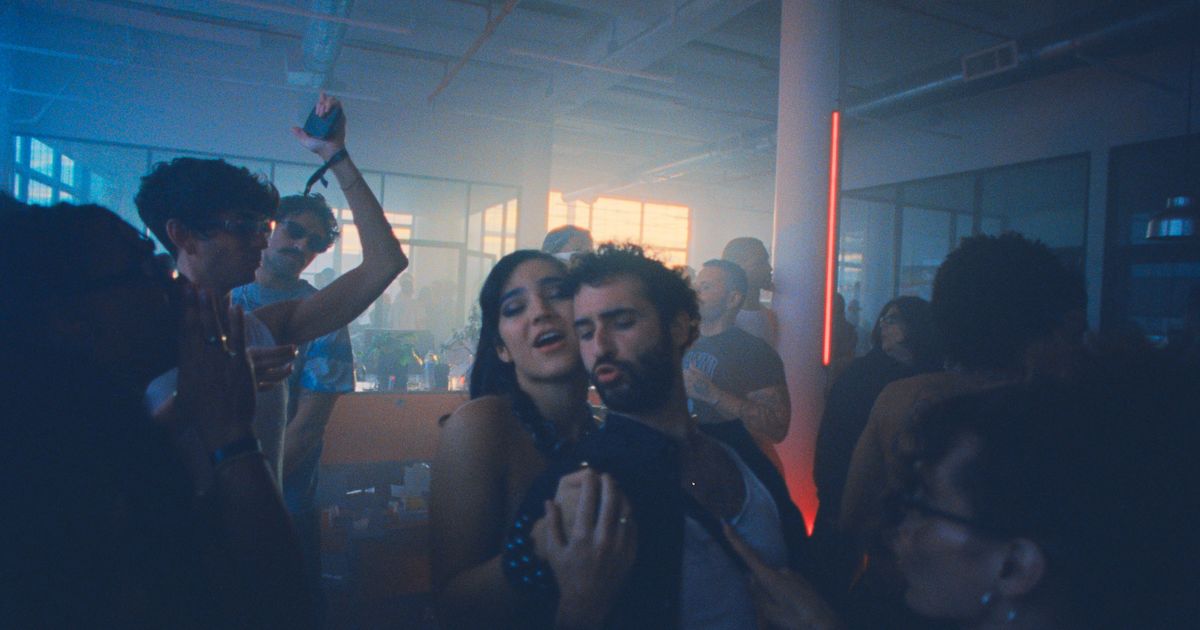
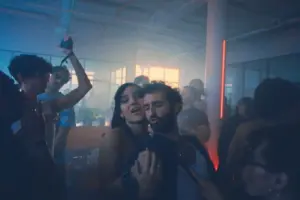
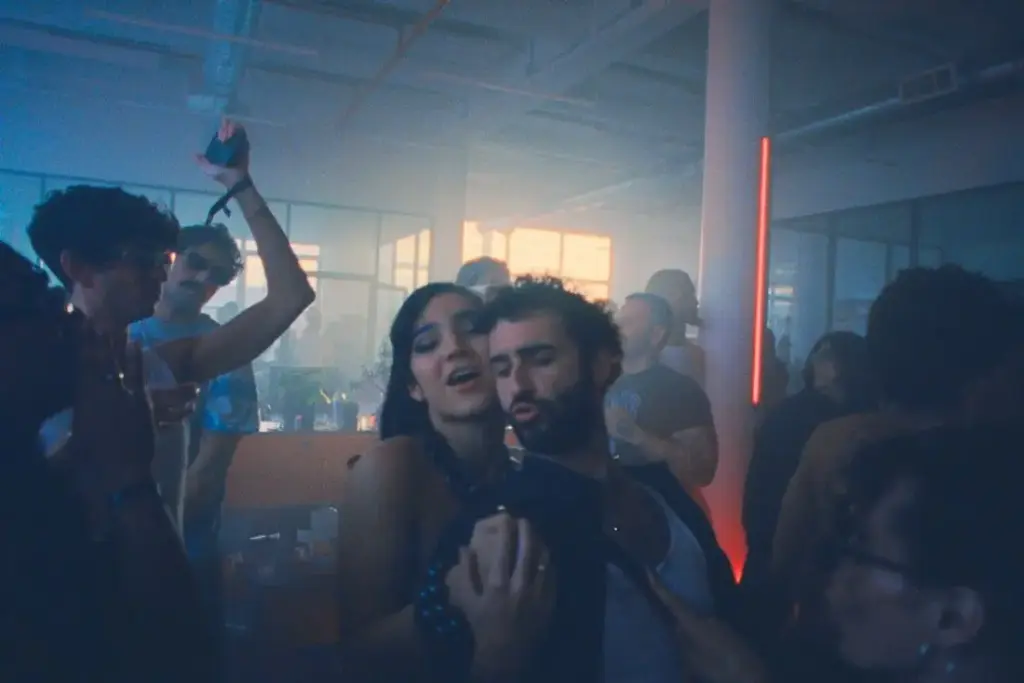
Ten years later, Peter returns to a more corporate iteration of Club Labor. Instead of ascending into adoring crowds and a silvery, heavenly atmosphere, he descends a staircase into a gloomy cloud of red light and fog. The club sign features a more serious font, and the dance floor hosts fewer costumes and more exposed skin. "What we were trying to show is that a lot of cool New York parties that have a more queer and inclusive vibe became popular with big groups of ‘muscle gays’ and started to lose their community feel," Stone explained. "Now, promoters are in a bind because those rich gays are the ones who pay to get in."
This scene was filmed at Pit//Stop, a real underground rave run by Noah Shakoor, who agreed to give the team access to the event’s East Williamsburg iteration. Shakoor warned attendees ahead of time and placed warning signs at the entrance. "If you wanted to be on-camera, you could, and if you wanted to completely avoid it, you could," Stone said. "We were shooting on film with a huge camera, so it was quite obvious where this was happening in the party." Coincidentally, the lighting already installed for Pit//Stop had been designed by GUMGUM Studio, a lighting firm the producers had hired for other sets. "Lighting the underground in New York is mainly just navigating small unconventional spaces with sometimes shaky structural integrity and finding ways to create the illusion of expansive, otherworldly universes," said Zanzie Addington-White, GUMGUM’s creative director. "We’ve put a lot of effort into doing that. But not much of that work gets shown because phones aren’t allowed at 90 percent of the spaces we exist in."
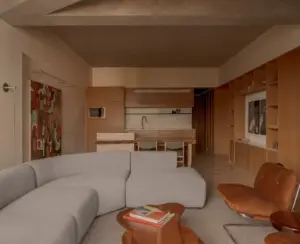
Later in the narrative, Peter hears about an after-party "at that cracky WeWork," as a character played by Miss Benny yells through a bathroom door. The line describes the actual office of Porto Rocha, a design agency whose clients include MoMA PS1 and Nike. Located in a former Bushwick factory, the airy, industrial office features tangerine-colored Haller cabinets, Clerici lounge chairs, and kelly-green sofas by HAY. Married co-founders Leo Porto and Felipe Rocha moved into the space in 2022 and began hosting casual Friday happy hours for employees and clients. Given the office’s central location within the local club scene, friends frequently dropped in between parties. "We’ve always had the DJ equipment, and we have a lot of friends that are DJs too, so they would come for a drink, play some music," Porto said. These gatherings eventually evolved into larger after-parties. "It’s a safe space where people feel really comfortable being themselves, and that’s really rare nowadays," Porto added.
The couple met Firstman through a mutual friend and later reconnected at the bar Animal while Firstman was conducting research. When Firstman asked if they would permit filming at their after-party, they agreed, though they were startled when the crew arrived with full cinematic equipment. "I was like, ‘Jordan, you didn’t tell me this is like a movie movie,’" Porto recalled with a laugh. The production crew was similarly surprised, expecting a quiet hangout and bringing their own extras and DJs. "We ended up not even having our people DJ because they had great people. They were having a raging after-party at like, 4 a.m.," Stone said. Much of the written dialogue for the scene was ultimately cut because the natural atmosphere provided everything needed visually.
"Everything you see there is exactly as it is. There’s nothing changed at all," Porto noted, before correcting himself: "Actually, I was controlling the smoke because too much smoke can be bad for filmmaking, apparently." While the couple had asked the production to avoid filming signs bearing the company name and tried to stay clear of the cameras, they were surprised when the first published film still released as the official poster featured Firstman with Felipe visible in the background. "Lincoln Center was showing this image!" Rocha remarked.
Later in the film, Firstman’s character reluctantly visits another party to sell drugs. Filmed at the Pit//Stop location, which doubled for Club Labor in 2026, Firstman improvised extensively. "We kind of rolled with it," Hubley said. "It feels doc-style in that way." An impromptu make-out session with a stranger and a spontaneous trip into the bathroom were entirely unscripted. "People thought I was really selling them drugs," Firstman told Andrew Scott in an interview for Interview. "Then other people were coming up to me and I would give them a bump and they’d be like, ‘What the fuck is this? This isn’t K.’ And I was like, ‘It’s like lactose.’"
After taking a hiatus from nightlife, Peter and his circle reinvent Club Labor, allowing his now 10-year-old son, Arlo (Reggie Absolom), to open the night with the first DJ set. For this iteration, the production secured H0L0, a Bushwick club featuring nubby brick walls and warm wood floors. "It has a more intimate feeling, and some DJs — like Juliana Huxtable — prefer that," Hubley said. Two structural support columns anchored the DJ stand, while Phelps added cascading fabric, plants, and rows of candles based on a reference image Hubley had captured.
GUMGUM designed a custom blue and orange lighting setup for H0L0 that mirrored the warm color palette of Arlo’s bedroom. When the film returns to the same space later for a different event, the lighting design shifts to incorporate strobes. "We wanted to work in a different way for each club scene, rather than have the film feel like, another party, another party, another party," Phelps said.
Reflecting on the production, Firstman emphasized how effectively the film documents a living era. "We were so lucky to be let into these spaces that are not easy to get into, even as a civilian," he noted during a festival appearance. "Often, it takes movies a couple years to catch up with culture. But we were live. It was almost like we were livestreaming the party because we were let into the actual parties that were happening in the moment."