Born into the shadow of the Guatemalan Civil War, Regina José Galindo has spent her career transforming her own physical form into a site of resistance. For Galindo, the body is not merely a vessel for existence; it is a political territory where the structural violence of the state, the trauma of history, and the pervasive reality of gender-based oppression are inscribed. By staging visceral, often harrowing performances, she exposes how violence against women is not a peripheral issue, but a constant, written reality on the skin of those living in precarious environments.
As a contemporary visual artist based in Guatemala City, Galindo has emerged as one of Latin America’s most profound voices in performance art. Her work transcends the traditional boundaries of the gallery, demanding that viewers witness the uncomfortable truths of systemic neglect and state-sponsored brutality. Her contributions to the global art scene have been widely recognized, most notably through her receipt of the Golden Lion for best young artist at the 51st Venice Biennale in 2005 and the prestigious Prince Claus Award in 2011. Her influence stretches across continents, with exhibitions hosted in major cultural hubs from Europe to the United Arab Emirates. Yet, despite this global acclaim, her heart and her practice remain deeply rooted in the soil of her homeland.
A Creator Shaped by the Legacy of Conflict
To understand Galindo’s work, one must understand the environment of her upbringing. Born in 1974, she entered the world in the midst of the Guatemalan Civil War, a brutal, decades-long conflict that lasted from 1960 until 1996. The war was fundamentally a struggle over power, land, and the rights of the marginalized, pitted against a series of repressive military regimes. The geopolitical volatility of the region—exacerbated by the 1954 U.S.-backed coup that dismantled democratic reforms—set the stage for a period of state-sponsored terror.

The human cost of this era is staggering; estimates suggest that between 40,000 and 200,000 people were killed or forcibly disappeared by government forces. The victims were predominantly peasants and Indigenous people, specifically the Maya, who stood in the way of state interests. Growing up in this atmosphere of constant surveillance and sudden disappearance, Galindo internalized the fragility of life. This historical trauma informs her current artistic output, which often centers on the themes of state repression, the invisibility of victims, and the impunity that continues to haunt Guatemala today.
The urgency of her work is compounded by the modern-day reality of gender-based violence in her country. Statistics remain grim: it is estimated that one in two Guatemalan women will experience some form of gender-based violence in their lifetime. Recent data from 2026 highlights that between January and July alone, the government registered 2,676 cases of sexual violence, with a significant portion of these involving underage girls. For Galindo, art is not an abstraction; it is an act of documentation and protest against a cycle of violence that shows no sign of abating.
From Poetic Expression to Bodily Resistance
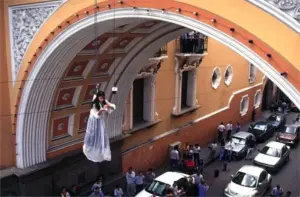
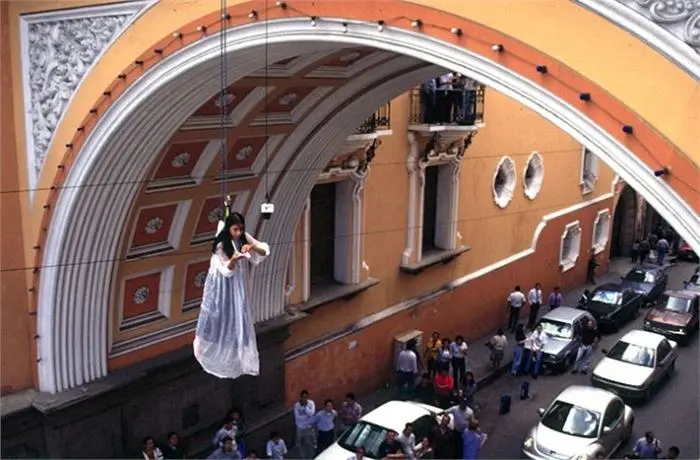
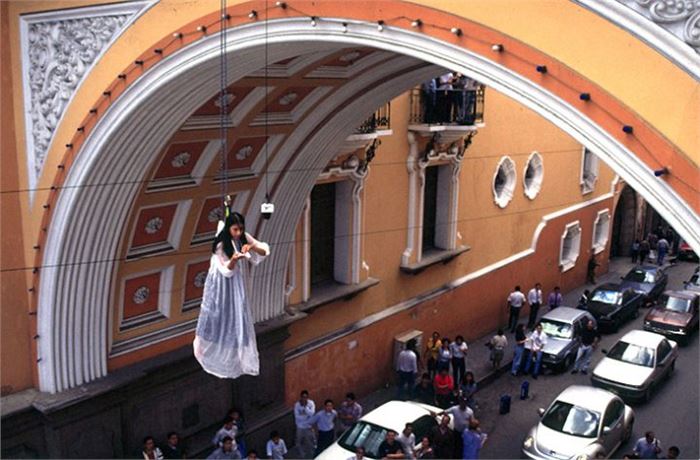
Galindo’s creative evolution began with writing and drawing, but she eventually turned to the medium of her own body, following in the footsteps of predecessors who utilized the self to interrogate societal norms. Her entry into performance art was marked by the 1999 piece Lo voy a gritar al viento (I’m Going to Shout It to the Wind). Staged during the II Festival del Centro Histórico of Guatemala City, the performance featured the artist suspended from the arch of the city’s Post Office Building. Dressed in a sheer white garment reminiscent of a child’s first communion dress, she recited poetry while dangling above the urban landscape. It was an early indication of her willingness to occupy public space to demand that the marginalized be heard.
As her career progressed, Galindo’s performances became increasingly rigorous, pushing her body to the thresholds of endurance. In Himenoplastia (2004), she underwent a surgical procedure to reconstruct her hymen. By inviting the audience to engage with this medicalized process, she scrutinized the societal obsession with virginity and the arbitrary, patriarchal standards placed on women’s bodies. The work exposed the performative nature of purity and the lengths to which women are forced to go to satisfy traditional expectations.
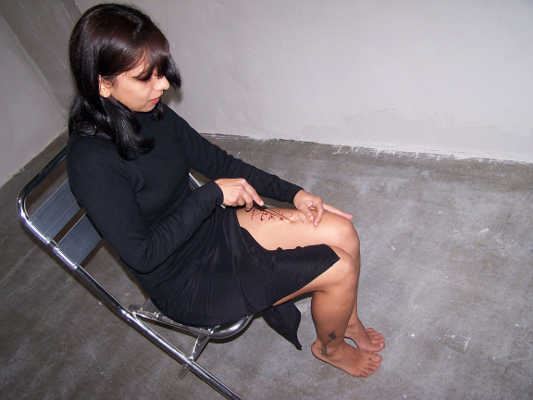
In 2005, she produced one of her most searing works, Perra (Bitch). In this performance, Galindo used a knife to carve the slur "perra" into her own thigh. The act was a direct reference to the language used against victims of femicide—a term frequently found on the bodies of tortured and murdered women in Guatemala. By claiming the slur, she forced the audience to confront the reality of gender-based hatred. Similar to the works of Marina Abramović, Galindo’s performances are characterized by an absolute commitment to the message, often placing her own physical and psychological integrity in genuine jeopardy.
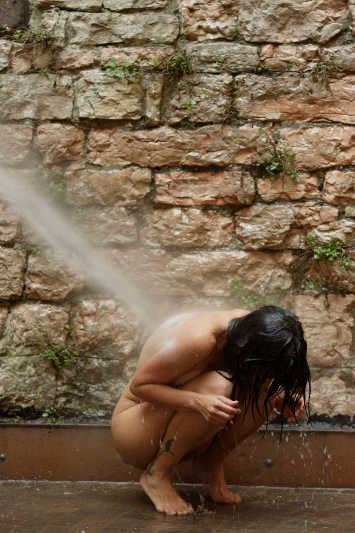
In 2006, her work Limpieza social (Social Cleansing) brought the metaphor of the "unwanted" to the fore. In this piece, presented in Trento, Italy, a naked Galindo was subjected to a high-pressure water hose. The act mimicked the dispersal of protesters by police and the dehumanizing cleaning rituals forced upon prisoners entering a jail. The work served as a biting critique of how states and societies "cleanse" themselves of those deemed problematic—petty criminals, political dissenters, and the impoverished.
Confronting the Spectacle of Global Injustice
Galindo’s political scope is not limited to the borders of Guatemala. She has frequently turned her lens toward the United States, particularly regarding the treatment of migrants and the industrialization of incarceration. In her 2008 piece America’s Family Prison, she rented a model prison cell—the kind showcased at trade fairs for the private-prison industry—and occupied it with her husband and their infant child for 24 hours. By inviting the public to view them as if they were museum exhibits or commodities, she exposed the cold, bureaucratic nature of the detention systems that tear families apart.
Her critique of the United States’ political climate reached a peak in 2017 with Make America Great Again, performed in Los Angeles. During this piece, Galindo tied herself to a post, appearing naked and vulnerable. She invited a professional dominatrix to whip her back each time a viewer placed a coin in a jar. Through this interaction, every participating member of the audience became a silent accomplice to the violence. The work functioned as a harrowing metaphor for the Trump administration’s rhetoric and the broader public’s passive complicity in the mistreatment of migrants and marginalized communities.
More recent works, such as La manada (2018) and Guatemala feminicida (2021), continue this trajectory of defiance. La manada responded to a high-profile rape case in Spain, involving a group of men surrounding the kneeling artist. Guatemala feminicida saw her dragging a flag-like cloth through the streets of her home city, the blue of the national flag replaced with black, symbolizing a country in mourning for its murdered women.
While Galindo remains realistic about the limitations of art—acknowledging that a performance cannot single-handedly topple a government or reverse decades of systemic violence—she remains committed to the transformative power of her medium. As the feminist artist Judy Chicago once remarked, "I do not think art can change the world. I think art can educate, inspire, empower people to act."
Regina José Galindo’s work stands as a testament to this philosophy. She does not offer easy answers or comfort; instead, she provides a mirror to the world’s brutality, hoping that the viewers who witness her pain will, in turn, become more politically aware and perhaps, eventually, find the courage to demand change. As long as the body remains a battleground for social and political forces, Galindo will be there, documenting the scars and challenging the silence.