The international design and architecture community is entering a vibrant season filled with blockbuster exhibitions, historic museum expansions, and provocative explorations of sustainability, adaptive reuse, and cultural identity. From major institutional retrospectives in London and Washington, D.C., to industrial transformations along the British coast, upcoming and ongoing events offer a comprehensive look at how design intersects with history, technology, and contemporary culture.
At the forefront of this season’s cultural offerings, the Design Museum in London has launched a wide-ranging exhibition exploring the profound origins of Surrealist art and design, alongside dynamic contemporary responses. Curated in close collaboration with the Vitra Design Museum in Germany, the landmark exhibition brings together an extraordinary trove of furniture, interior design, fashion, photography, and fine art. Spanning nearly a century of creative output, the show features foundational 20th-century figures such as Salvador Dalí and Man Ray, while tracing the movement’s lasting influence through recent tastemakers, including couture fashion powerhouses Schiaparelli and Dior, as well as visionary Icelandic musician Björk. The exhibition invites visitors to reconsider the boundaries of the subconscious and the everyday object, demonstrating how surrealist principles continue to shape modern aesthetics.
What’s Going On in Washington, D.C.
Marking a major milestone for the American capital’s cultural landscape, collectors Don and Mera Rubell are expanding their philanthropic footprint with a massive new venue. Having acquired contemporary art since 1965, the Rubell family currently possesses one of the world’s largest and most wide-ranging private art collections. While the first Rubell Museum opened its doors in Miami in 1993, this month the foundation is unveiling its second major location: a sprawling 32,000-square-foot space situated inside a former public high school in Washington, D.C.
The historic building underwent a sensitive and extensive renovation led by renowned architecture firm Beyer Blinder Belle, adapting the educational facility into a world-class exhibition venue. In a poignant homage to the building’s past, the inaugural exhibition takes its title from a landmark 1971 album by Marvin Gaye, who is an alumnus of the former school. The inaugural show features over 200 works created by 40 distinct artists. Among the exhibition’s centerpieces is a rare, 20-part ink-and-gouache series by Keith Haring, which the celebrated artist completed in a single continuous sitting while immersed in the music of Marvin Gaye and Bob Marley.
Ole Scheeren: Spaces of Life
In Karlsruhe, Germany, the ZKM Center for Art and Media is preparing to host the very first solo exhibition dedicated to the work of high-rise architect Ole Scheeren. Founded in 2010, Scheeren’s eponymous firm has gained global acclaim for monumental, highly experimental architectural projects that challenge conventional urban typologies. Born in Karlsruhe, the German architect began his illustrious career at Rem Koolhaas’s OMA office in Rotterdam, eventually rising to international prominence as the lead partner behind such iconic structures as the award-winning China Central Television (CCTV) Station in Beijing and the cascading Interlace residential complex in Singapore. Scheduled to run through the winter and spring, the ZKM exhibition, titled "Ole Scheeren: Spaces of Life," offers an intimate look at the philosophies and processes driving Scheeren’s visionary urban interventions.
Ongoing Exhibitions and Environmental Explorations
As museums and galleries continue to address the pressing challenges of climate change and industrial heritage, several ongoing exhibitions are capturing the attention of design professionals worldwide.
At the AA Gallery in London, an evocative exhibition titled "The Future is a Journey to the Past: Stories about Sustainability" explores the evolving definition of ecological stewardship and how the built environment can actively mitigate conflicts between natural ecosystems and human activity. Curated by Bologna-based Mario Cucinella Architects, the exhibition features a comprehensive timeline tracing the historical evolution of environmental activism alongside a curated selection of built projects by the firm that exemplify sustainable design strategies. The exhibition draws its core inspiration from principal Mario Cucinella’s book of the same name, published earlier this year, in which the architect reflects on ten distinct journeys to cities and regions across the globe while offering critical speculations on human resource consumption.
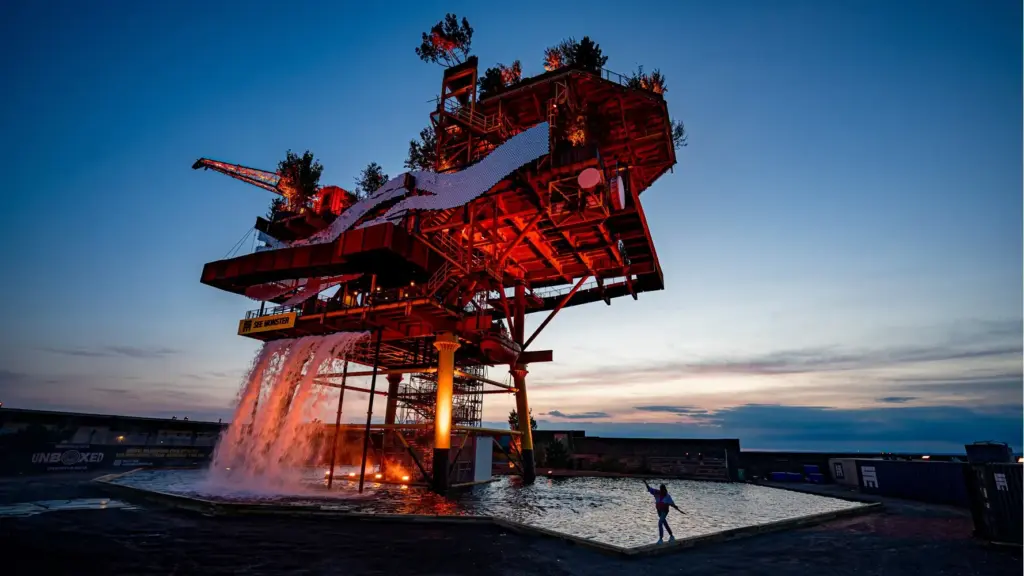
Along the coast of the Bristol Channel in Weston-super-Mare, England, visitors can witness one of the United Kingdom’s most ambitious acts of adaptive reuse. "See Monster," created by design studio Newsubstance, has transformed a retired North Sea oil rig into one of the nation’s largest public art installations. After being towed around the British Isles for much of the summer, the decommissioned industrial structure is now permanently docked off the Somerset coast. Visitors can journey behind a dramatic water feature cascading from the lower platform to access four stories of interactive elements, including a multi-level slide, a seated amphitheater, and elevated gardens. Commissioned for the nine-month-long Unboxed Festival, "See Monster" serves as a powerful testament to the creative potential of repurposing heavy industrial infrastructure.
Meanwhile, London’s Korean Cultural Centre UK, in partnership with the Art Center Nabi in Seoul, is presenting "Our Friendly Neighbors," an exhibition highlighting cutting-edge new works by contemporary Korean artists Yiyun Kang, Bang & Lee, and Jinjoon Lee. The selected installations investigate the intricate intersections of art, technology, and ecology, prompting viewers to reconsider the nature of community and connectivity in the wake of the COVID-19 pandemic and accelerating globalization.
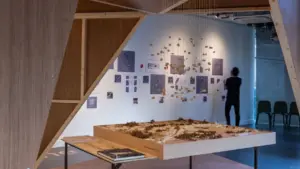
In New York City, the Irwin S. Chanin School of Architecture at Cooper Union is hosting "Model Behavior," an exhibition featuring more than 70 works by 45 diverse artists and architects, including Olafur Eliasson, Peter Eisenman, Eyal Weizman, and Greg Lynn. Curated by the collective Anyone Cooperation, the exhibition asks a fundamental question: how do architectural models both reflect and actively influence human behaviors far beyond the traditional boundaries of design?
On the West Coast, the Santa Barbara Museum of Art is currently staging the first solo exhibition of award-winning architect Marshall Brown. Titled "The Architecture of Collage: Marshall Brown," the show features 25 of the architect’s striking works. Brown refers to these creations as "chimeras"—named after the mythical lion-goat-snake hybrid of ancient Greece—because they are constructed using photographs of existing buildings whose discrete elements are seamlessly recombined to invent entirely new architectural forms and spatial relationships.
Events and Cultural Celebrations
In the realm of live events, Las Vegas is preparing to celebrate its rich history of architectural innovation. The Neon Museum, whose iconic visitor center was designed by the legendary architect Paul Revere Williams, is hosting "Duck Duck Shed: Celebrating Las Vegas Architecture, Design, and Culture." The four-day event focuses on the decades of creative daring that defined the city’s hospitality and entertainment design. The program features prominent guest speakers, including urban planner Alan Hess and architect Jon Sparer, the creative minds behind such legendary properties as the Mirage, Paris Las Vegas, and the Bellagio.
Competitions and Student Opportunities
Looking ahead to the coming year, surface manufacturer Formica has officially launched its 2023 FORM Student Innovation Competition, inviting aspiring designers to push the boundaries of material application. This year’s competition challenges student entrants to submit a color rendering and a comprehensive project statement for a furniture design informed by the concept of maximalism. To qualify, student submissions must incorporate three or more Formica- or FENIX-brand products, with at least one material selected directly from the SurfaceSet 2022 collection. The deadline for student submissions is March 6, 2023.