Brussels-based designer Ori Orisun Merhav is challenging conventional boundaries of material production by looking to the natural world for inspiration, specifically focusing on the biological processes of tiny insects. Through her evolving research practice, Made by Insects, Merhav is transforming a natural polymer produced by lac insects into glowing sculptures, elaborate chandeliers, and sculptural furniture. By heating and blowing the resinous, amber-colored material into clusters of translucent bubbles—some perched delicately on branching steel structures and others suspended from ceilings—she is opening up a compelling conversation about the future of multispecies design and how biological organisms can actively inform how we manufacture and inhabit our world.
The material at the heart of Merhav’s work is commercially known as shellac, a substance traditionally familiar as a protective wood finish or coating. However, in the hands of the Brussels-based designer, this familiar substance takes on a completely entirely different spirit. Her latest works extend years of meticulous research into advanced 3D printing and large-scale installations, actively imagining a future where an insect-produced material integrates seamlessly into our built environments. Recognizing her experimental and boundary-pushing approach to material production, Merhav was honored with a 2026 Dutch Design Award, cementing her status as a leading voice in sustainable, bio-informed design.
The Tiny Insects Behind an Unlikely Design Material
The natural polymer that powers Merhav’s creations is produced by tiny insects scientifically known as Kerria lacca, which are roughly the size of a grain of sand. These minute creatures attach themselves securely to the tender branches of host trees, feeding on their nutrient-rich sap. As they feed, they convert sugars into a natural resin that gradually hardens around their bodies, forming a protective enclosure that allows the insects to develop, thrive, and reproduce.
Once this lifecycle completes, the hardened resin can be carefully harvested from the tree branches, washed, and processed into shellac. For centuries, humans have utilized this natural substance in furniture finishing, sealing, and various craft applications.
Ori Orisun Merhav first crossed paths with these remarkable insects while researching complex ecological relationships during her studies at the prestigious Design Academy Eindhoven. Deeply fascinated by their biological ability to manufacture a high-performance polymer through internal metabolic processes, she traveled all the way to Thailand to study lac cultivation firsthand and meet the local communities who harvest the resin. During her time there, she gained invaluable knowledge regarding the insects’ intricate life cycles and the traditional agricultural practices surrounding their sustainable production.
This profound research journey ultimately culminated in her 2022 graduation project, The Lac Lab Open Source, which functioned as an evolving archive of material experiments. Over time, this archive blossomed into her broader practice, Made by Insects. This initial immersion also exposed Merhav to the economic realities facing natural shellac production today, where the steady rise of synthetic polymer alternatives has systematically reduced global demand for the natural resin, threatening traditional livelihoods and localized ecological knowledge systems.
Learning to Build from the Insects Themselves
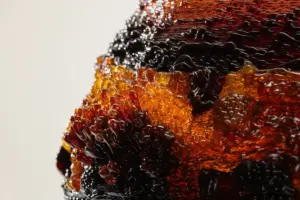
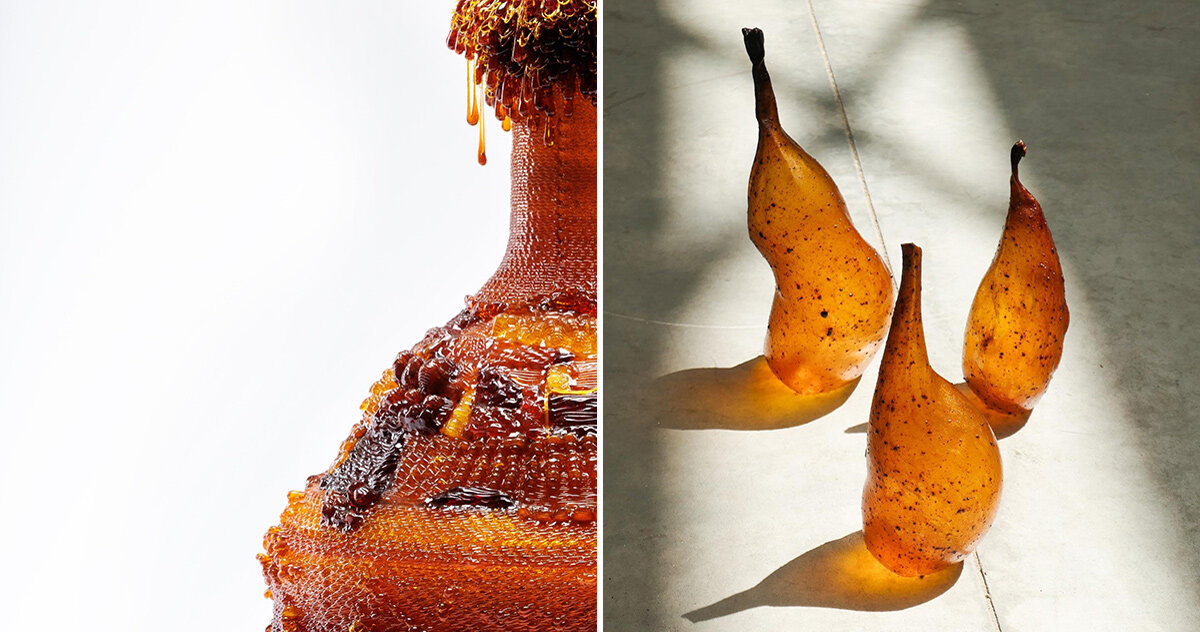
Returning to her studio, Merhav began exploring the physical and mechanical capabilities of shellac far beyond its conventional, flat applications. Because the natural polymer softens when heated and hardens again as it cools, she realized she could manipulate it much like glass. By borrowing traditional glassmaking techniques, she began stretching the warmed material into thin, translucent membranes and blowing it into hollow, luminous forms.
Her earliest experiments successfully produced large, individual bubbles, but she quickly encountered structural hurdles. Their delicate, thin walls made them remarkably brittle and exceedingly difficult to transport or integrate into larger architectural pieces. Determined to overcome these limitations, Merhav looked more closely at the physical structures built by the insects themselves, discovering that their natural protective enclosures were not solitary chambers, but rather comprised many smaller, highly interconnected cells working in structural unison.
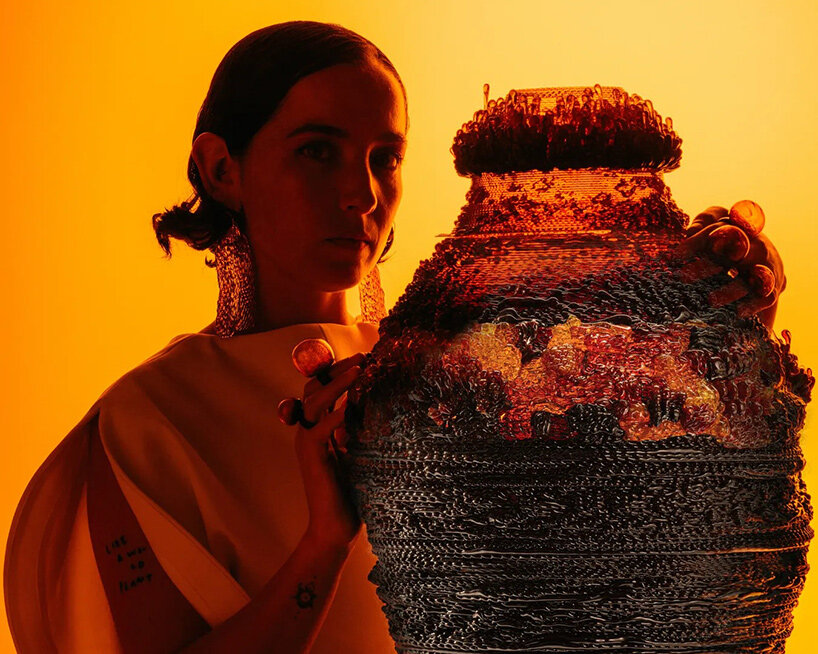
This vital observation fundamentally changed her design approach. Merhav began blowing smaller volumes of the resin and joining them together into larger, composite structures, thereby developing an entirely new architectural language of clustered forms that draws directly from the insects’ own construction methodologies. In works such as the Branching Insects Chandelier and Meet Me Under the Insects Tree, these amber-colored bubbles creep organically along slender metal supports, casting a warm, ambient glow through their naturally uneven, organic surfaces.
While these finished pieces possess an almost botanical, plant-like appearance, their underlying structural logic stems directly from the protective resinous shelters engineered by insects. The work bridges the gap between natural biological architectures and human-scale interior objects, prompting viewers to reconsider the structural sophistication found in the non-human world.
3D Printing a Polymer Made by Another Species
Building upon her manual blowing techniques, Merhav’s experimental practice soon expanded into the realm of digital fabrication. Collaborating with technical innovators such as Ginger Additive, Reflexlab, and Aeditto, she successfully produced her first 3D-printed shellac objects in 2023. She later continued this specialized research alongside material engineer Tom Samson and the Bio-Polymer Lab at Avans University of Applied Sciences in the Netherlands.
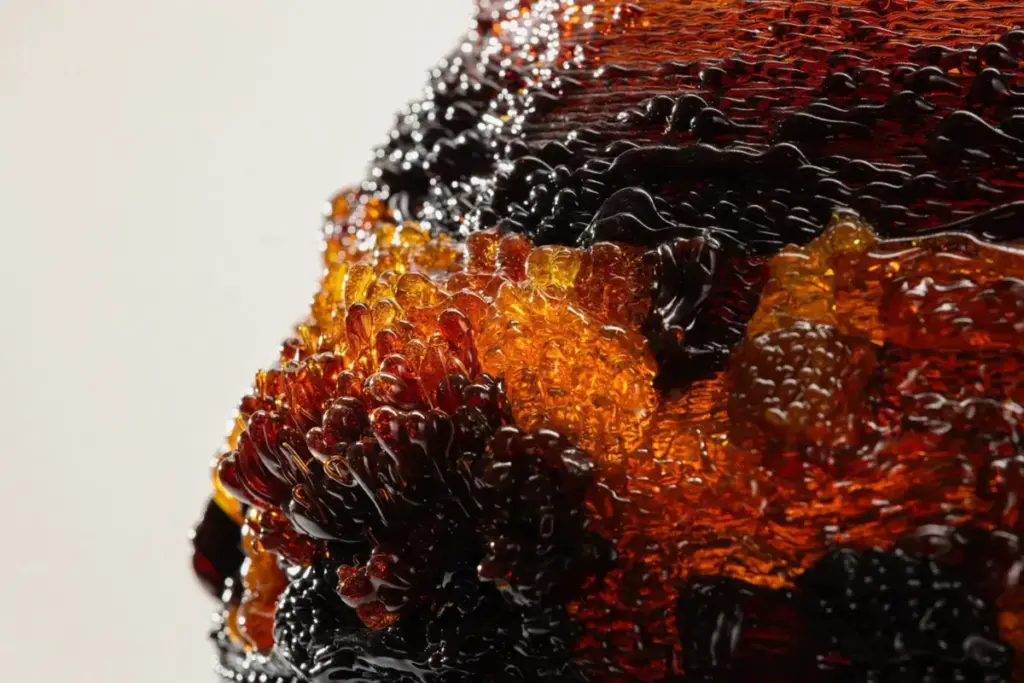
This advanced phase of the research explores how a naturally occurring biopolymer can be fed through a robotic printer without undergoing harsh chemical modifications. Precise temperature controls and the material’s unique behavior during thermal extrusion dictate how the forms take shape in real time, leaving behind beautifully irregular surfaces and visible, tactile layers of hardened resin.
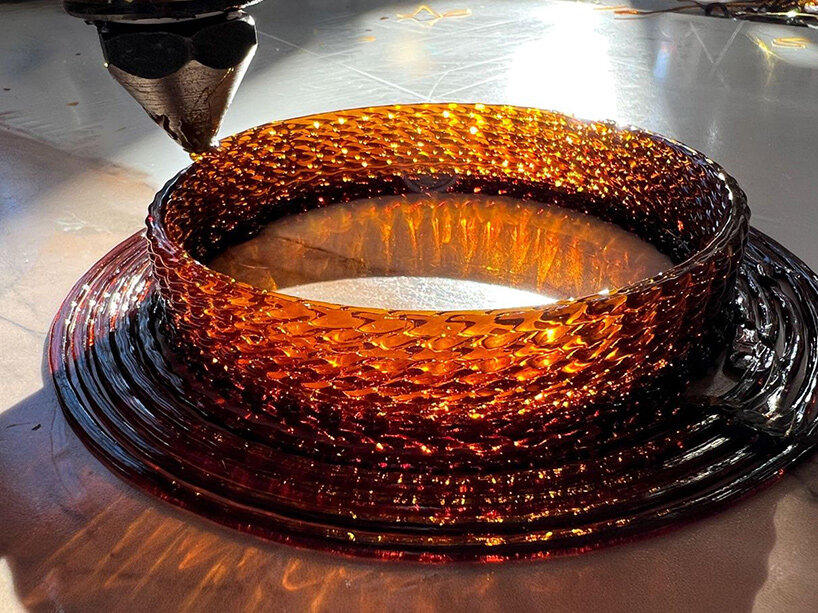
Her Morphogenesis vessel series offers a closer look at the aesthetic and structural potential of this emerging technique. These objects rise upward in irregular, cellular walls, where pronounced ridges of deposited material form dense, web-like networks around their hollow interiors. The resulting objects blur the line between digital manufacturing and organic growth, proving that bio-derived materials can successfully participate in advanced technological workflows.
A Woven Insect Canopy Takes Shape in London
At the Sarah Myerscough Gallery in London, Merhav’s ongoing research has materialized into a fully immersive environment that visitors can physically navigate. Titled Portal Into The Multi-Species, the exhibition runs from October 14th to November 7th, 2026, welcoming guests into an entrance corridor lined with delicate shellac bubbles attached to branching steel armatures. As visitors move further inside the gallery space, the sculptural forms increase in scale and tactile complexity.
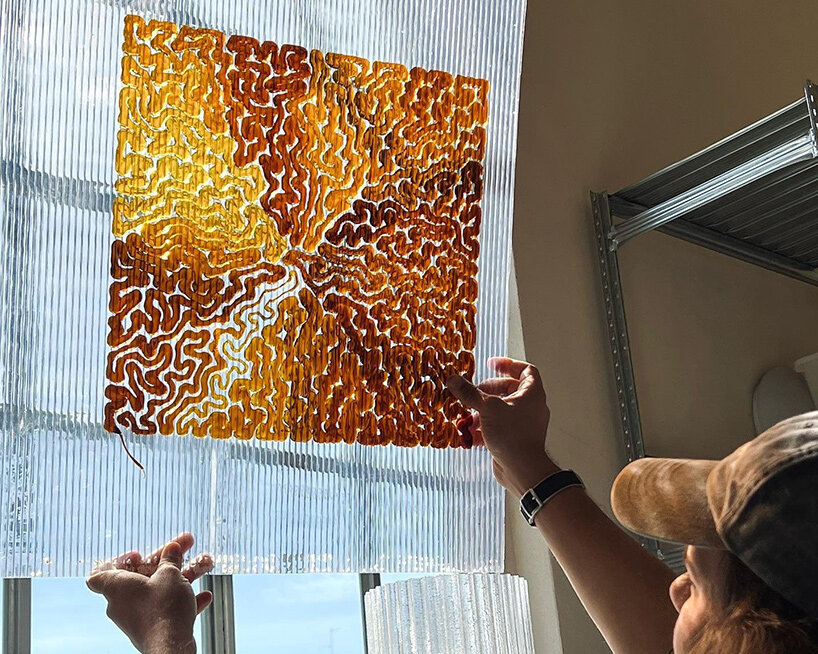
Among the exhibition’s centerpieces is The Woven Insect Canopy, a striking installation where palm sheaths coated in the insect-produced resin are suspended within sculptural steel supports. Their fibrous, interwoven surfaces are illuminated subtly from within by integrated LED lighting, casting intricate patterns across the gallery walls.
This series includes distinct works such as Awakening, Regeneration, and Bifurcation, with the latter standing an impressive 140 centimeters in height. As light passes completely through the shellac-coated fibers, it reveals the intricate, interwoven textile structure hidden beneath the smooth amber surface. These works powerfully gesture toward an interior architecture shaped entirely by biological processes. A substance originally secreted by an insect simply to create a protective shelter on a tree branch has thus been elevated into a profound component of human interior design.
Who Makes the Materials We Live With?
At the core of Merhav’s practice is a deep-seated exploration of mutualism—beginning with the delicate ecological relationship shared between lac insects and the host trees that sustain them. While the insects depend entirely on their botanical hosts for vital nourishment, the cycle of cultivation requires human stewardship to manage both tree health and insect reproductive cycles responsibly.
Human participation introduces yet another layer to this intricate web, connecting the rural farmers who maintain these fragile woodland environments with the contemporary designers and makers who process and sculpt the harvested resin. While this ecological network is undeniably complex, Merhav’s research successfully draws critical attention to the diverse group of participants required to bring a single, sustainable material into existence.
For Merhav, these glowing amber sculptures represent just one step in a much longer, ongoing exploration of how interspecies relationships can actively inform the future of design. Although the work remains experimental—with the material’s inherent fragility and the strict demands of thermal fabrication continuing to shape its evolving possibilities—her lamps, vessels, and installations offer a tangible glimpse into an alternative manufacturing future. An insect produces a polymer to secure its survival on a distant branch; generations later, a contemporary designer studies that very architecture and discovers an entirely new way for humanity to build.