October arrives not merely as a marker on the calendar, but as the gateway to the year’s second transitory season—a period that signals the inexorable descent into the darker half of the year. It is a time when the world sheds its vibrant summer cloak, replaced by an autumnal palette of ochre, umber, sienna, and cadmium. As the days grow shorter and the cold drizzle of the season forces life indoors, the natural environment begins to mirror a internal shift. We watch as myriad leaves spiral to the dampened ground, and a profound change stirs within the depths of the human psyche. The imagination begins to smolder, and the mood turns introspective, even somber, as we revel in the funereal tone set by the approaching celebration of Samhain. It is in this atmosphere that we find ourselves intrinsically drawn to the darker side of art, pulled toward the macabre and the supernatural like moths toward the flickering flame of a candle.
The Malevolent Conjuring: Goya’s Witchcraft
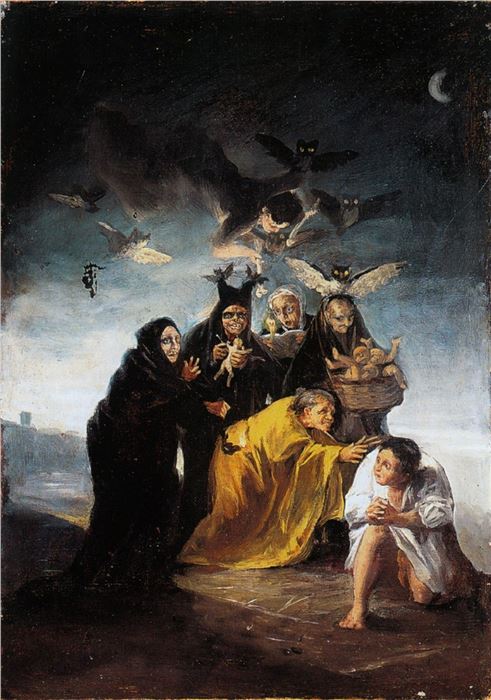
Perhaps no artist captured the unsettling intersection of human fear and the supernatural as viscerally as Francisco Goya. His 1797–1798 work, The Incantation (El conjuro), currently housed in the Lázaro Galdiano Museum in Madrid, remains a masterclass in atmospheric dread. In the painting, a coven of witches congregates on a desolate, windswept clifftop under an overcast sky, watched over by a parliament of owls. The scene is one of mirthful malevolence, where a hexad of figures performs a ritual that defies rational explanation.
At their cloaked feet, an innocent victim cowers in futile supplication, a stark contrast to the power displayed by the coven. Each member of the group plays a distinct, malicious role in the conjuring: one figure chants from the pages of a weathered grimoire; another clutches a basket containing squirming infants; a third, distinguished by the pair of bats adorning her hood, meticulously sticks pins into a doll, suggesting a focus on sympathetic magic. A fourth figure gesticulates wildly as she utters her dark incantations. The elder of the group, draped in a striking golden cloak and appearing ostensibly blind, reaches her misshapen hands toward the unwilling sacrifice. Perhaps most unsettling is the sixth figure, caught in the midst of a nocturnal transformation from a strigid bird into a sorceress, holding a pair of bones as if keeping time for this perverse, silent carol.
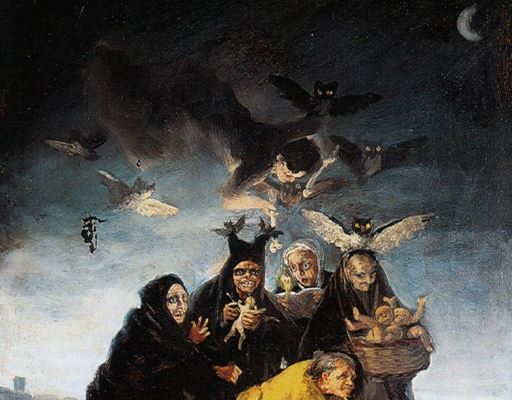
El conjuro is one of six works centered on the theme of witchcraft that were commissioned by the Dukes of Osuna in the summer of 1798. These pieces were intended for the couple’s newly constructed palace in the Madrilenian barrio of La Alameda. Art historians frequently theorize that the series, which also features the famed Witches’ Sabbath, was painted at the specific behest of the Duchess, reflecting the era’s complicated fascination with folklore and the occult.
Mirror Gazing and the Victorian Occult
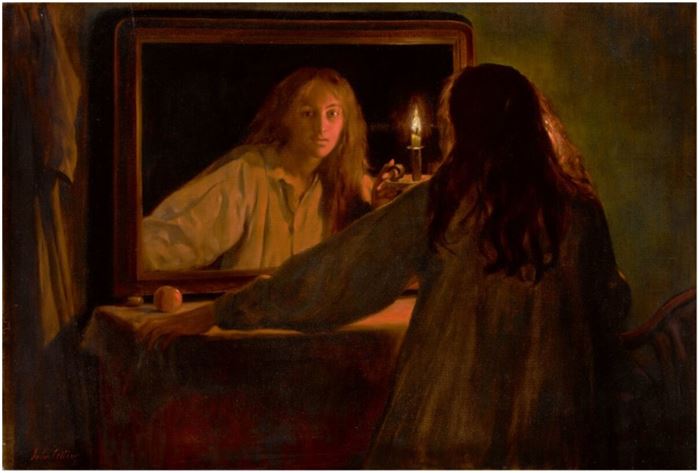
As the candlelight burns low in its holder, we move from the external ritual of the clifftop to the intimate, interior terror of John Collier’s 1895 oil painting, All Hallowe’en. In this scene, a young woman stands clad only in a nightshirt, gazing intently at her own reflection in a mirror. Her hair is disheveled, suggesting she has been recently roused from sleep—perhaps by a haunting dream or an inexplicable sound echoing through the nocturnal stillness of her home. However, the subject is not engaged in vanity; she is performing an ancient occult practice known as mirror gazing, or catoptromancy.
Popularized during the Victorian era, catoptromancy involves staring into the reflective surface of a mirror until the mind begins to hallucinate or project images that do not exist in the earthly realm. These ghostly echoes are interpreted by the gazer as messages from beyond or premonitions of the future. While this piece lacks the overt voluptuousness found in many of Collier’s more celebrated works, All Hallowe’en perfectly captures the specific, chilling mood of late October. It serves as an evocative reminder of how Victorian society, despite its rapid industrialization and scientific progress, remained deeply tethered to the superstitious and the supernatural.
Memento Mori and the Vampire’s Bite
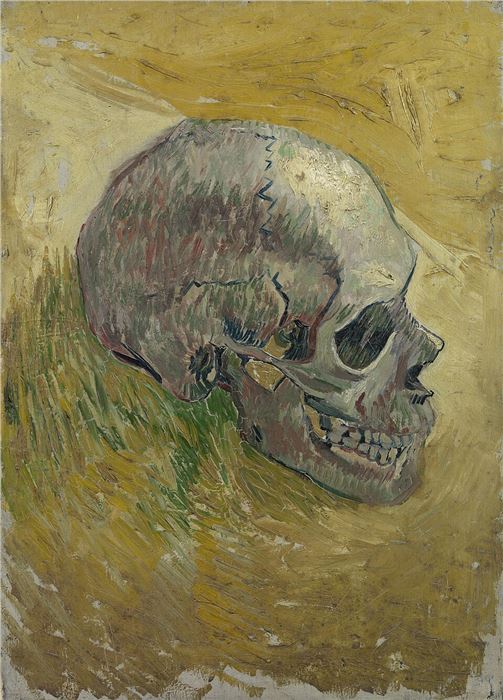
The contemplation of the macabre often leads the mind toward the inevitability of death. This is captured with haunting simplicity in Vincent van Gogh’s 1887 painting, Skull. Set against a swirling, turbulent backdrop of ochre, viridian, and giallo di Napoli, the lonely skull serves as a poignant and prophetic memento mori. It is a timeless meditation on existence that feels as relevant today as it did when the Dutch master first applied paint to canvas.
Interestingly, the physical condition of the painting reveals its own story of mortality. The craquelure—the fine network of cracks—visible around the ramus of the jaw is a result of Van Gogh painting over a previous, discarded work. He utilized a slow-drying zinc white as a base, a technical choice that has caused the surface to age in a way that feels strangely fitting for a study on death; in time, as the painting suggests, death eventually claims all, even the layers of art beneath the surface.
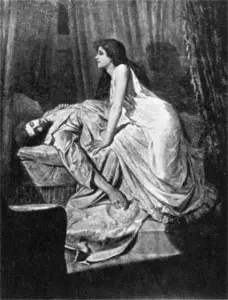
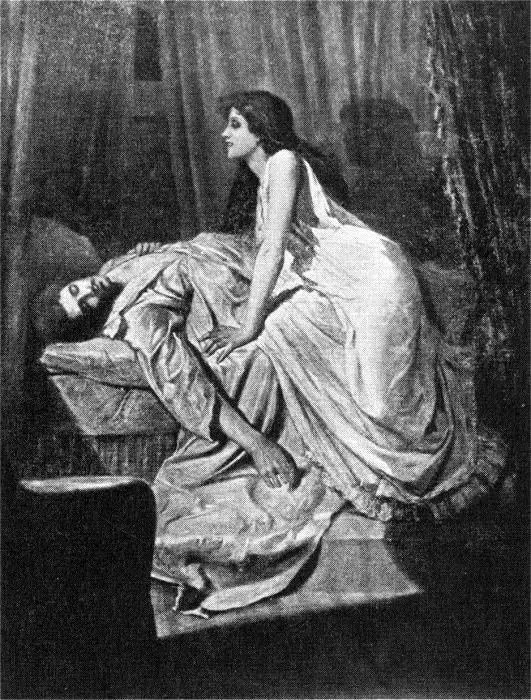
If the skull represents the quiet end of life, Philip Burne-Jones’s 1897 work, The Vampire, represents the predatory nature of the undead. In a dark, shadowed bedchamber, a vampiress is poised over an unconscious man. She is seemingly enraptured by the satiation that follows the prick of her razor-sharp teeth. Her eyes are three-quarters closed, and a faint, satisfied smile plays upon her delicate mouth, highlighting the contrast between the victim’s helplessness and her predatory grace.
The history of The Vampire is as dramatic as its subject matter. Painted by the son of the famed Pre-Raphaelite artist Edward Burne-Jones, the work became the direct inspiration for a poem of the same name by Rudyard Kipling, who happened to be the artist’s cousin. The two works were exhibited together at the tenth summer exhibition at the New Gallery in London, just a month before the publication of Bram Stoker’s Dracula.
The exhibition of the painting caused a considerable scandal, rooted in both its depiction of sensuality and its thinly veiled personal history. Burne-Jones had been deeply infatuated with the star stage actress Mrs. Patrick Campbell. After bestowing upon her numerous lavish gifts—including furs and fine jewelry—he realized his affections were not reciprocated. In what many interpreted as an act of artistic vengeance, Burne-Jones modeled the face of the vampiress directly on his unrequited love.
Beyond the gossip, the work is technically proficient, displaying a masterful control of light and shadow. The cascading bedsheets, which blend the victim’s nightshirt with the vampiress’s gown, create a visual unity that enhances the tension of the scene. The contrast between the victim’s limp posture and the taut, predatory stance of the woman creates a palpable atmosphere of danger. Though the whereabouts of the original painting remain unknown today, its legacy endures as a testament to the way artists can channel personal pain into a chilling, eternal narrative.
Autumn often feels as though it is destined to die an early death, but its essence can be captured through the strokes of a brush or the focus of a lens. Art provides the unique ability to immortalize, to steal the transitory moments of the season and entomb them in a medium that allows them to persist. By preserving the visual, we keep the soul of the season intact, ensuring that even as the leaves fall and the light fades, the imagination remains ignited.