When filmmakers Jamie Courville and her husband, Chris Reynolds, first moved to Gowanus in 2009, they were drawn to an unexpected aesthetic: the stark, desolate beauty of a postindustrial wasteland. The move came just a year before the Gowanus Canal was officially designated a Superfund site, triggering a massive federal cleanup initiative. Back then, the neighborhood felt wild, unpolished, and full of raw potential. The area’s decaying warehouses and defunct factories offered cheap, expansive loft spaces for artists and filmmakers, while apartments were relatively affordable despite their worn edges. Courville and Reynolds rented a spacious 1,100-square-foot home for roughly $2,000 a month, surrounded by a gritty landscape that felt entirely distinct from the hyper-gentrified trajectories of nearby Williamsburg or Long Island City.
Yet, the very reason Gowanus had remained a haven for creatives long after surrounding Brooklyn neighborhoods had transformed was obvious to anyone who walked near its banks: the noxious, flood-prone canal running through the heart of the district. Filled with decades of sewage, heavy metals, toxic sludge, and a staggering array of pathogens, the waterway was an environmental catastrophe. Karen Gibbons, an artist who moved to the neighborhood in the early 1980s, recalled that she used to swear she would never raise children there. Real estate realities, however, often override initial hesitations. Like many residents, Gibbons and her husband ultimately raised three children in the neighborhood, captivated by the spacious lofts and the distinct culture of the area.
Virtually anywhere else, a federal Superfund designation would have sent real estate investors running for the hills. In Gowanus, however, the label served as an open invitation. It signaled to developers that the federal government would finally step in to remediate the century-old cesspool that had historically stymied large-scale investment. Commercial pioneers quickly caught on. Whole Foods arrived, opening a massive retail store featuring a rooftop greenhouse on a bleak corner of Third Avenue and 3rd Street. Trendy eateries and nightspots followed shortly after, including the bar Lavender Lake in 2011, Dinosaur Bar-B-Q in 2013, and the Royal Palms Shuffleboard Club in 2014. Sensing a massive financial windfall, developers who had been quietly acquiring parcels for decades began petitioning the city for spot rezonings to construct luxury housing.
Recognizing that change was not only coming but already well underway, then-Local City Councilmember Brad Lander argued that the community needed to seize control of the planning process to shape its future rather than watching it unfold unfettered. Drawing on his background as an urban planner and community organizer, Lander outlined an ambitious vision for a revitalized Gowanus: a socially and economically diverse neighborhood featuring thousands of newly built affordable apartments, permanently protected workspace for local artists, revitalized public housing developments, and a continuous public esplanade along the banks of the canal. The goal was to build a neighborhood from the remediated soil up that served ordinary New Yorkers rather than catering exclusively to the ultra-wealthy. In 2016, Lander initiated a comprehensive five-year rezoning framework for the 82-block industrial district. The proposal not only cleared the way for residential towers but also secured an unprecedented package of neighborhood benefits.
Around the same time, Courville and Reynolds began chronicling the neighborhood’s dramatic metamorphosis. Following the demolition of a redbrick building at Douglas Street and Third Avenue in 2013, they started filming the physical dismantling of the old Gowanus and the subsequent rise of new construction. Over the years, their footage captured everything from heavy barges hauling toxic sludge out of the canal to heated public meetings, political rallies, and neighborhood gatherings leading up to the 2021 City Council vote that formally approved the rezoning. Their project eventually amassed over 400 hours of footage, culminating in the documentary Gowanus Current. As Courville observed, what happened in the neighborhood transcended traditional notions of gentrification; it was a complete erasure of the old landscape to build an entirely new one.
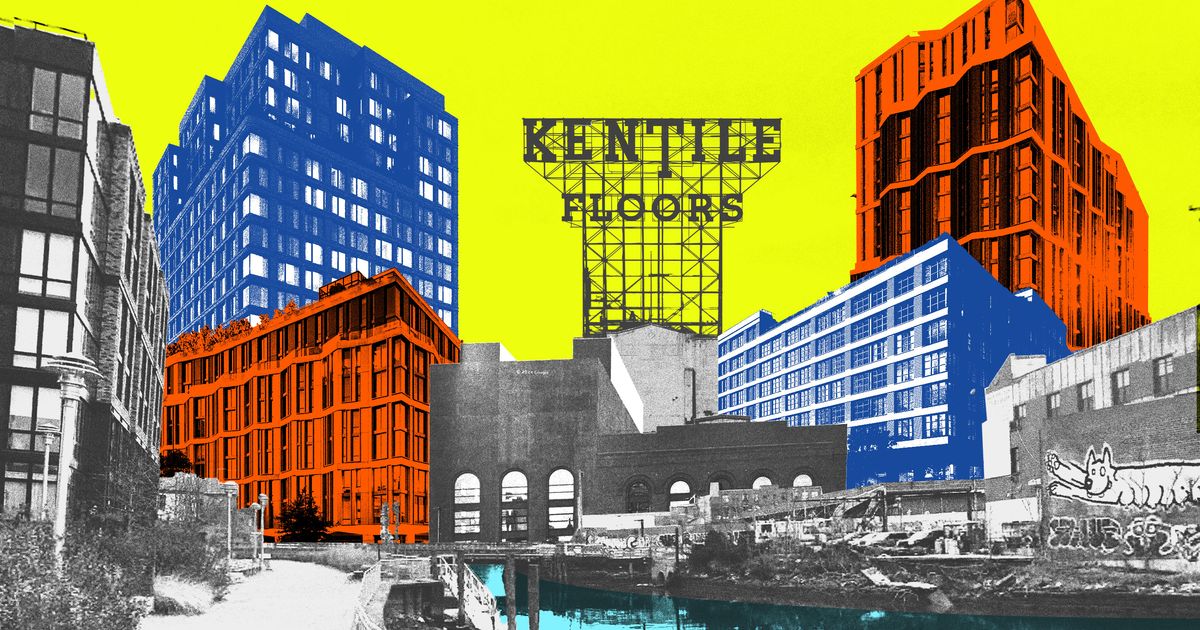
Today, the transformation is impossible to miss. Across the 82 blocks covered by the rezoning, virtually every street features either a newly completed residential building, an active construction site, or a vacant lot slated for imminent development. Projections indicate the neighborhood will absorb roughly 9,000 new housing units by the end of the decade. While urban planners and optimists have occasionally romanticized the area’s future—with one executive comparing it to a "mini Copenhagen" featuring a canal clean enough for swimming—skeptics remain deeply unconvinced. Urban transformations in New York rarely unfold with the smooth predictability of Northern European social democracies. Instead, public benefits must be fought for through complex bureaucratic channels, all while the neighborhood remains a patchwork of brownfields laden with subterranean coal tar and chemical solvents.
The market realities, however, have moved swiftly. Among the first wave of residential towers to open following the 2021 rezoning was 544 Carroll Street, situated on the corner of Fourth Avenue. Brian Ezra, a founding partner of developer Avery Hall, noted that the neighborhood’s location directly adjacent to affluent enclaves like Park Slope and Carroll Gardens made large-scale development an absolute certainty. Aiming at the upper tier of the luxury rental market, the building features high-end finishes, with available two-bedroom units commanding nearly $8,000 a month and a duplex penthouse that hit the market for an eye-watering $25,000 a month.
Andrea Parker, executive director of the environmental advocacy group Gowanus Canal Conservancy, acknowledged that maintaining the status quo was never a realistic option. Without a comprehensive rezoning, she noted, the area would have seen an ad hoc expansion of luxury housing and boutique recreation devoid of necessary infrastructure or meaningful community investments. The rezoning negotiated by Lander and Michelle de la Uz, executive director of the Fifth Avenue Committee, marked a series of historic firsts. It represented the first municipal rezoning to secure direct funding for public housing repairs—committing $200 million to NYCHA complexes—and the first to mandate a racial impact study, which projected that the influx of new housing would ultimately make the neighborhood less white. Furthermore, the mandatory inclusionary housing policy requires that 25 percent of units in new developments be reserved as affordable housing for households earning between 40 and 80 percent of the area median income.
Despite these policy wins, the physical remediation of the neighborhood has faced persistent delays. The multi-phase dredging and capping of the 1.8-mile canal has fallen significantly behind schedule, with estimated costs ballooning from an initial $500 million to roughly $1.5 billion. Essential combined sewage overflow tanks designed to prevent raw sewage from flowing into the waterway are not slated for completion until 2029, a delay that could potentially necessitate secondary dredging operations. Meanwhile, affordable housing projects like Gowanus Green—a planned 957-unit, 100 percent affordable development on a former manufactured gas plant site at Fifth and Smith streets—spent years stalled by complex disputes over environmental cleanup standards, though recent state approvals have finally cleared the path for phased remediation and construction.
Even before the canal is fully cleaned, developers are aggressively marketing waterfront access. At 420 Carroll, the first residential project completed under the new rezoning, leasing director Jason Hill emphasized the property’s rare positioning near the turn basin, which will eventually grant residents dual waterfront exposures. Similar nautical branding has emerged across the neighborhood, with firms like Tavros Capital and Charney Companies establishing the Gowanus Wharf complex, encompassing projects like Union Channel, Nevins Landing, and a Bjarke Ingels Group–designed development at 175 Third Street. While early luxury projects like 365 Bond were widely mocked a decade ago for renderings showing residents cavorting along a toxic waterway, today those scenes have largely materialized as real, if somewhat sterile, public esplanades.
Yet, living through the neighborhood’s physical transformation has proven arduous for long-term residents. The remediation process has frequently released foul odors, causing headaches and nausea among locals due to the excavation of coal tar and naphthalene-laden sludge. The federal Environmental Protection Agency noted that even at safe concentrations, chemical compounds can trigger strong sensory reactions. At one point, municipal agencies had to resort to odor-suppressing foam, protective tarps, and pine-and-cinnamon-scented deodorants to mask the stench.

Complicating matters further, environmental testing mandated by the rezoning uncovered a hidden legacy of subterranean contamination far older than the canal itself. In late 2023, public records requests revealed that toxic trichloroethylene (TCE)—a carcinogenic industrial solvent widely used in 20th-century metal degreasing and dry cleaning—was vaporizing through the soil and rising into the basements of several local buildings. Testing at the Royal Palms Shuffleboard Club detected chemical vapors significantly above state guidelines, while similar issues were discovered at a nearby former box factory converted into artists’ studios. Because state environmental agencies cannot legally compel private property owners of existing buildings to conduct indoor vapor testing without their consent, only a small fraction of contacted property owners agreed to participate in voluntary sampling, leaving the true extent of the underground vapor plumes largely obscured.
For prospective renters, however, the allure of modern amenities and proximity to prime Brooklyn neighborhoods frequently outweighs concerns regarding underground chemical vapors or lingering construction noise. Ethan Russell, a commercial film producer who relocated to a luxury rental in the neighborhood with his family, noted that the severe lack of housing inventory and astronomical rents in nearby Park Slope made Gowanus a pragmatic choice. Enjoying modern conveniences like central air conditioning, a second bathroom, and shared building amenities, Russell expressed little concern about environmental factors while living on an upper floor.
Similarly, local arts organizations have worked to preserve a foothold for the creative community that originally defined the neighborhood. Arts Gowanus successfully negotiated for more than 100 permanently affordable art studios within new developments, featuring rents significantly below market rates and strictly capped annual increases. Independent cultural venues like the music space Public Records and Powerhouse Arts have also established roots in the area, signaling that a degree of the neighborhood’s experimental identity may endure.
Nevertheless, longtime residents observe the sweeping changes with mixed emotions. While new parks, public esplanades, and affordable housing opportunities have successfully retained some community members who might otherwise have been priced out, the profound cultural shift remains unmistakable. The randomness, grit, and industrial mystery that once defined Gowanus have steadily given way to a landscape of sleek residential towers, high-end amenities, and luxury rental prices that firmly anchor the neighborhood to Brooklyn’s upscale real estate market.