Perched high above the shimmering waters of the San Francisco Bay, the historic Verdier Mansion in the city’s iconic Russian Hill neighborhood has officially hit the market with an asking price of $25 million. Spanning an impressive 9,545 square feet of interior space, the 120-year-old Gothic Revival residence combines dramatic architecture, panoramic views of landmark city sights, and a storied past that intertwines with the upper echelons of San Francisco society, underground entertainment, and modern pop culture.
Russian Hill itself derives its name from a Russian cemetery discovered on its summit during the tumultuous days of the Gold Rush. Today, the neighborhood is globally renowned for its remarkably steep streets, intricate public stairways, and sweeping, unobstructed vistas of the bay. Nestled quietly beside the historic Vallejo Street steps, the Verdier Mansion occupies a prime piece of this legendary landscape, offering commanding views that stretch out toward Coit Tower and the majestic orange spans of the Golden Gate Bridge.
The sprawling six-story residence—which is thoughtfully equipped with elevator service providing direct access to every single level—was originally constructed in 1906. Commissioned by mining entrepreneur Robert G. Hanford and designed by architect Houghton Sawyer, the grand home was built as a lavish gift for Hanford’s then-mistress, Gabrielle Guittard Cavalsky. The Cavalsky and Guittard families were prominent local fixtures, having famously established the historic Guittard Chocolate Company nearly four decades earlier in 1868.

Following its glamorous turn-of-the-century beginnings, the mansion transitioned through a succession of colorful and eclectic eras. The home earned its enduring moniker from its subsequent owner, Paul Verdier, a prominent heir to the illustrious City of Paris department store dynasty. After the Verdier family eventually moved out of the expansive estate, the property experienced a period of urban neglect, during which squatters infamously took over the vacant halls.
As the decades progressed, the building transformed to reflect the changing cultural tides of San Francisco. It functioned for a time as a local theater before entering one of its most notorious chapters as a high-end, exclusive brothel operated by the legendary Sally Stanford, who would later pivot into local politics and serve as the mayor of Sausalito. During World War II and the ensuing post-war years, the residence also operated as a military officers’ club. Lore surrounding this era suggests that a young naval officer and future President of the United States, John F. Kennedy, was among the notable military figures who visited the property.
The mid-20th century brought a structural fragmentation to the historic building. In 1952, real estate entrepreneur Catherine Doliani purchased the grand estate and undertook a major conversion, dividing its massive interior spaces into several distinct apartment units. For decades, the property functioned as multi-family housing, losing much of its original unified architectural grandeur in the process.

It was not until the early 1990s that the estate underwent a triumphant restoration. Acquired by Dr. Thomas Grotz and his wife, Lena, the multi-family conversion was meticulously undone. The couple embarked on a massive, vision-driven project to return the property to its original status as a magnificent single-family home comprising six bedrooms and six bathrooms. Their extensive preservation and modernization efforts included the installation of a striking new spiral staircase that honors the verticality of the six-story structure, alongside a thoroughly updated, contemporary kitchen designed to meet the demands of modern luxury living.
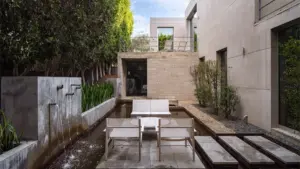
The architectural baton was passed once again in 2006, when Myron Scholes—a Nobel Prize-winning economist and esteemed Stanford professor—sold the palatial house to its current owners, former securities executive John Skeen and his wife. Over the course of their two decades in residence, the Skeens have continued to refine the property, carefully updating the sophisticated interiors and revitalizing the surrounding landscaping to ensure the historic estate remains at the absolute pinnacle of San Francisco luxury real estate. Now, after twenty years of stewardship, they have placed the property on the market for $25 million. Gregg Lynn of Sotheby’s International Realty San Francisco Brokerage currently holds the exclusive listing for the historic compound.
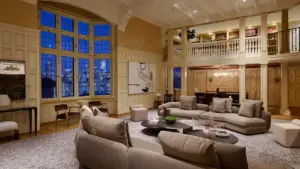
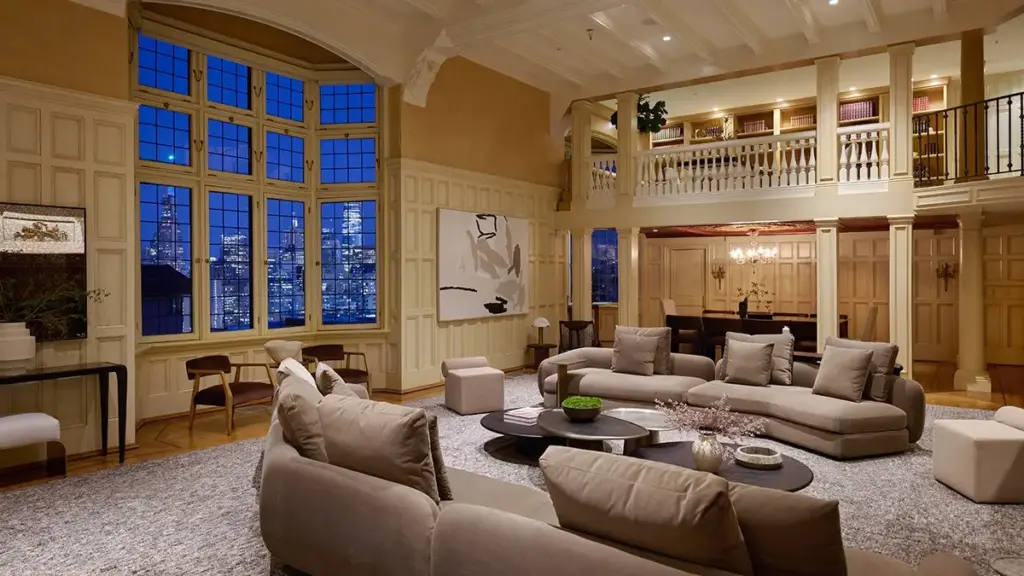
Beyond its incredible lineage and cinematic pedigree—which most recently included a featured appearance in the second season of the Netflix science fiction series The OA—the mansion boasts an array of breathtaking architectural details. Entering the principal rooms reveals soaring ceilings that reach nearly 16 feet in height, complemented by elaborate, period-authentic raised-panel woodwork that underscores the craftsmanship of a bygone era.

Among the standout interior spaces is a formal dining room defined by a meticulously carved and gilded ceiling, lending the room an undeniable sense of regal grandeur. Elsewhere within the sprawling layout, a limestone-clad reception room and a sophisticated mezzanine library offer refined, intimate settings for quiet reflection or formal entertaining. Practical luxuries match the home’s aesthetic scale, highlighted by a professional-grade climate-controlled wine cellar capable of housing an extensive collection, and a remarkable, roughly 91-foot-long garage that provides secure parking for up to six vehicles—a rare and coveted amenity in the densely packed terrain of Russian Hill.
With its seamless blend of 1906 Gothic Revival architecture, modern luxury updates, and a narrative arc that spans the Gold Rush, high society, and Hollywood, the Verdier Mansion stands as an enduring monument to the rich and evolving history of San Francisco real estate.