The Louisiana State Penitentiary—universally known as "Angola" after the former slave plantation that once occupied its sprawling grounds—lies at the desolate dead end of Highway 66. Past the heavily guarded gate, the road continues, for those permitted entry, winding through 18,000 acres of penal farmland punctuated by imposing gun towers, vast barbed-wire enclosures, and incarcerated men manually picking crops along the institution’s notorious "farm line." As America’s largest maximum-security prison, Angola has long been notorious for its heavy reliance on solitary confinement and its harsh conditions, operating quietly on the backs of the forgotten.
Yet, out of this profound isolation, remarkable creativity has emerged. Gary Tyler, a fiber artist and activist, knows the grueling reality of Angola intimately. He arrived at the facility in 1974 when he was just seventeen years old, wrongfully convicted of shooting a white student during a violent segregationist mob’s attack on a school bus. Bound on three sides by treacherous bayous, bluffs, and swamps, the prison offered little physical escape, making internal mental flight essential for survival. Tyler recalls that his grandmother had been a quilter, and inside the prison, fabric could occasionally be found, bartered, or traded. Time, above all, was abundant. Over more than four decades behind bars, which included two harrowing stints on death row, Tyler honed his craft, eventually becoming renowned among local artisans. Craftswomen from across the American South would travel to Angola simply to seek out the man behind the intricate textiles making the rounds outside the prison walls.
"All that time, I never thought of myself as an ‘artist,’" Tyler said during the opening of "Rebirth," a powerful solo exhibition of his quilted and appliquéd works currently on view at the Grand Rapids Art Museum in Michigan. "I said, ‘Call me a hobbyist.’ Artists were people in galleries, people with an audience."
"Rebirth" is one of three striking solo presentations currently hosted at the museum through January 2027, all dedicated to showcasing art created by or focusing on individuals who have experienced incarceration within the United States. Together, these exhibitions offer a sobering, multi-faceted look at the carceral system, human resilience, and the fragile nature of dignity.

The second featured exhibition highlights the work of Ray Materson, whose show is subtotals "Metamorphosis." Materson works in a unique, highly specialized medium that he entirely invented while serving a prison sentence for a drug-fueled robbery committed with a toy gun: palm-sized embroideries meticulously stitched by hand utilizing only the threads pulled from unraveled socks. His miniature textile pieces bridge the gap between traditional American folk art and Renaissance portraiture.
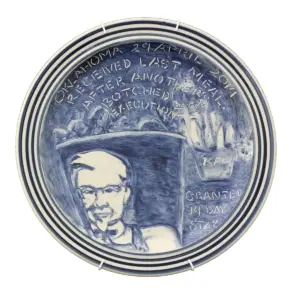
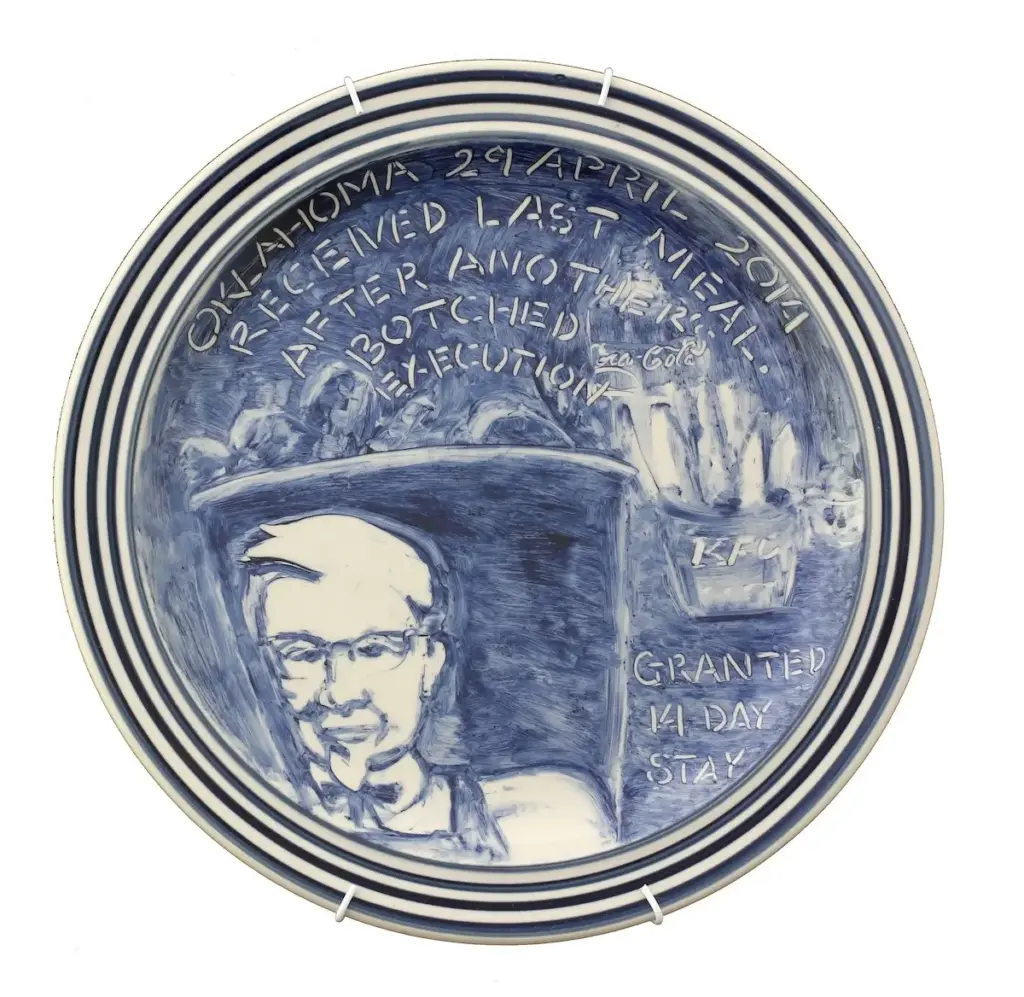
The third component of the museum’s programming is The Last Supper, a monumental 1,000-piece ceramic installation by the late artist Julie Green, being displayed in its entirety for only the second time in history. For twenty years, right up until her passing in 2021, Green painstakingly illustrated final-meal requests made by death row inmates across the United States. Each meal is painted in stark cobalt blue onto individual ceramic plates and subsequently re-fired in her kiln.
The resulting collection documents the grim traditions of capital punishment: an overflowing bucket of Kentucky Fried Chicken, fresh lobster, juicy steaks, burgers with fries, or a slice of pecan pie. Sometimes, the plates record nothing at all, as inmates can refuse their final meal or have their selections outright denied, though these choices are generally preserved as matter-of-fact public records. At a quick glance, Green’s plates could easily be mistaken for fine Staffordshire dinnerware, but a closer look at the inscribed final requests can abruptly ruin an observer’s lunch.
"It’s not so much that these shows are timely," observed Jennifer Wcisel, curator of collections at the Grand Rapids Art Museum. "It’s that the question of what incarceration means to American life is never absent. It’s ongoing."
The exhibition arrives at a moment when state-sanctioned punishment and state violence are increasingly visible in public discourse. The public visibility of penal severity has arguably not been so openly advertised since the pre-Civil Rights era. Tennessee’s botched attempt to execute Christa Pike, the sole woman on the state’s death row, was subsequently followed by a candid magazine interview featuring the attending physician, who publicly suggested the state should simply try the execution again. Meanwhile, proposals from high-ranking federal officials have included calls for the military’s first execution in six decades—to be carried out by a firing squad and livestreamed to the public. The cultural landscape has similarly reflected these themes; the White House previously launched an online arcade game where players could control a pixelated Border Patrol agent rounding up digital "border crossers."

Against this backdrop, the artwork on display does not attempt to match the sheer volume of societal cruelty. Instead, it aspires to cultivate empathy, or at least serve as empathy’s essential catalyst: curiosity. It forces viewers to confront uncomfortable questions about the true aims of public execution and the arbitrary ways dignity is doled out within the carceral apparatus.
The Last Supper powerfully argues that dignity within the penal system is a fickle and easily revoked allowance. Texas, for example, officially abolished special last-meal requests in 2011 after white supremacist inmate Lawrence Russell Brewer ordered an extravagant, multi-course feast and then completely refused to eat any of it. Set against Green’s terrible, tender plates, the incident exposes the contradictions of the system. Brief, poignant biographical notes painted onto the ceramic works—such as the notation that "he never had a birthday cake so we ordered a birthday cake for him"—inevitably give way to endless rows of plates simply marked with the grim words: "Standard prison fare." The installation functions essentially as dinnerware designed for a haunted house.
The artwork also serves as a stark cartography of America’s patchwork, contradictory legal principles regarding capital punishment. Following the U.S. Supreme Court’s 2002 ruling barring the execution of individuals with intellectual disabilities, the high court left individual states to define the exact criteria for qualification within broad limits. One plate in Green’s collection records a condemned inmate’s tested IQ of 61—well below the general benchmark of approximately 70—alongside a bureaucratic request that his final menu not be released to the media. Another plate records an inmate’s poignant request that their final meal be saved and refrigerated until after the execution had already taken place.
Everything on view in Grand Rapids functions as a form of portraiture, provided the definition of the term can stretch wide enough to cover a human spirit granted recognizable shape, even when abridged to something as simple as a birthday cake. Tyler and Materson work with a representational directness that operates in the opposite artistic register from Green. Their pieces show actual faces. Furthermore, their work freely indulges in fantasy—the vital province of the living. One of Tyler’s quilts depicts a former inmate known as "Big Toe" wandering through a conceptualized landscape called the Greek Alps, proudly wearing full theatrical armor salvaged from The Life of Jesus Christ, a play produced by the very drama club Tyler founded inside the prison.
Traditionally, portraiture has been viewed as a tool to reveal the inner heart and character of a subject. For centuries, it was also considered a strict privilege of the powerful, who commissioned likenesses to meticulously control how history perceived them. Incarceration completely inverts that dynamic: within the prison walls, the powerful do the constant watching. Yet, the exhibition asks, what does state surveillance ever truly capture of its human subjects? True insight cannot simply be extracted or taken by force; it must be willingly given.

Materson’s intricate embroideries wander across a vast thematic landscape, ranging from baseball games to outer space. The most striking pieces, however, brilliantly blend imagination with documentation. In his undated work Self-Portrait, Materson depicts himself sitting before a mirror, meticulously stitching the very piece of art the viewer is currently observing. Down a receding visual tunnel, a progressively smaller Materson stitches an even smaller Materson, creating an impression of infinity. Notably, the thick black frame that physically cages his embroidered face is woven from the exact same thread as the rest of the composition, suggesting that confinement is not an insurmountable or impossible barrier.
A prominent quilt featured later in Tyler’s exhibition depicts a great blue crane, the kind that regularly roosted in the surrounding Angola wetlands and would occasionally touch down inside the prison yard itself. Tyler was finally released from custody in 2016, following decades of tireless campaigning by civil rights activists, including Rosa Parks. The crane captures that pivotal moment of liberation. Tyler has described how his soul sprang skyward the very moment he took his first step outside the gates—and how it has yet to descend.
For others trapped within Angola, however, the reality involves much harder landings.
Tyler’s 2025 work, Convict Poker, vividly captures an infamous spectacle at the Angola prison rodeo: a Black man suspended midair, violently bucked by a massive charging bull. As the last event of its kind remaining in the country, the prison rodeo is held twice a year and opened directly to a paying public. While spectators are legally prohibited from placing monetary wagers, the ultimate gamble belongs entirely to the incarcerated men who volunteer to participate. In the brutal game of convict poker, a raging bull is suddenly loosed onto a mock card game set up in the arena, and the last man remaining seated wins a cash prize. Documenting a recent event on social media, an attendee wrote online: "The announcer said they didn’t run that fast from the PoPo. Watch til the end, prisoners were flying…"
Tyler himself never participated in the rodeo during his decades inside. Yet, he expresses no personal judgment toward those who do. Notably, one of Tyler’s handmade quilts was once raffled off at the very same rodeo, successfully raising $30,000 for the prison’s hospice program. The men who volunteer for the event, Tyler explains, are often driven by a desperate willingness "to jeopardize their lives or go through a sense of degradation just to entertain an audience because nobody wants to be forgotten."

"These are men who may never go home," Tyler notes. "The announcer mentions their names, and that they are serving life sentences; understand?"