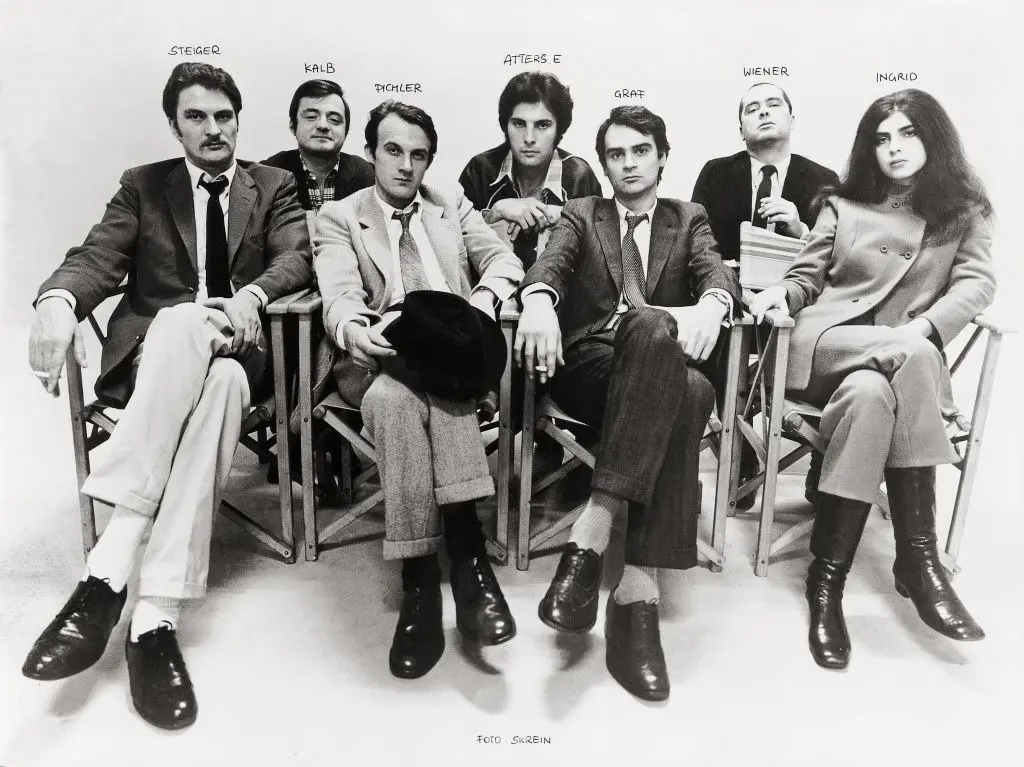
For decades, Wiener occupied a unique and vital space within the Austrian avant-garde. While her male counterparts in the Viennese Actionist movement often dominated public discourse with aggressive, body-based performances, Wiener forged a parallel path of rebellion through subtle yet revolutionary subversions of traditional craft. Working across textiles, photography, painting, and collage, she challenged the rigid social norms of post-World War II Austria, transforming domestic mediums like weaving into vehicles for political and personal expression. Her passing marks the end of an era for a generation of artists who fundamentally reshaped the European cultural landscape in the tumultuous decades of the 1960s and 1970s.
Born Ingrid Schuppan on October 2, 1942, the artist discovered her calling and her lifelong creative community during her formative years at a textile training school. It was there that she forged a fateful friendship with Waltraud Höllinger, who would later achieve international renown as the pioneering performance and media artist Valie Export. Within the structured confines of the textile school, the two young women did not merely learn the technical mastery of weaving; they found in one another kindred spirits and coconspirators eager to break free from the conservative constraints of Austrian society.
As the 1960s unfolded, Wiener and Export began pushing the boundaries of their medium, famously creating tapestries based on the vibrant, idiosyncratic designs of another close friend, the visionary artist Friedensreich Hundertwasser. These early collaborative textiles were exhibited and successfully sold under Hundertwasser’s name, laying the groundwork for a career defined by artistic synergy and shared authorship.
Wiener’s collaborative ethos reached a sophisticated peak by the mid-1970s, when she embarked on a groundbreaking partnership with Export and the acclaimed Swiss artist Dieter Roth. Together, the trio sought to invent an entirely new paradigm for tapestry, attempting to weave only what could be seen directly behind the warp threads—a conceptually radical approach that treated the traditional loom not as a tool for replication, but as a lens for capturing fleeting visual reality. Although this utopian objective proved nearly impossible to fully realize in practice, the conceptual framework of a fluid, non-rigid, and spontaneous weaving style became a permanent cornerstone of Wiener’s artistic vocabulary.
Between 1974 and 1997, Wiener and Roth maintained a remarkably fruitful creative dialogue, coming together repeatedly to produce an additional five collaborative tapestries. Wiener’s expansive network also bridged diverse creative disciplines, connecting her with literary and cinematic figures such as the experimental writer Konrad Bayer and filmmaker Ferry Radax. Demonstrating her versatility across mediums, Wiener and Bayer both participated in Radax’s landmark 1959 surrealist film Sonne halt!, cementing her place at the very epicenter of Austria’s burgeoning avant-garde scene.
Her personal life was similarly entwined with the radical cultural currents of her time. Wiener later married Oswald Wiener, a prominent writer, philosopher, and fellow Viennese Actionist who passed away in 2021. In 1969, the couple made the decision to relocate to Berlin, where they immersed themselves in the city’s vibrant countercultural ecosystem. There, Wiener lent her considerable culinary skills to Exile, a restaurant the couple opened that quickly evolved into an iconic legendary gathering place for the international art and music crowd. The establishment drew a glittering clientele of cultural luminaries, counting legendary figures like musician David Bowie and actor Peter O’Toole among its regular patrons.
In later years, Wiener and her husband relocated to the vast, untamed landscapes of Canada. The stark natural beauty and expansive wilderness of her new surroundings profoundly influenced her artistic vision, sparking a series of inner, deeply surreal psychological landscapes. These visions formed the foundation of her dream-inspired watercolors, known as Traumzeichnungen (dream drawings), wherein she meticulously recorded nocturnal narratives, stray thoughts, and surreal revisions of everyday life onto paper.
Throughout her life, Wiener’s artistic output remained remarkably diverse. Her tapestries frequently integrated unexpected fragments of her everyday reality—incorporating ordinary objects such as cutting boards, discarded shopping lists, newspapers, electrical cables, and even fresh cucumbers directly into the woven surface. Furthermore, she frequently wove handwritten texts directly into her visual compositions, embedding her private emotions, passing thoughts, and intimate observations into the very fabric of her work. Alongside her complex tapestries and dream-drawings, she left behind a rich legacy of photography and mixed-media collages.
Although Wiener was a foundational figure in the post-war Austrian art scene, her recognition in her home country experienced a significant revival around the turn of the millennium. The Charim Gallery played a pivotal role in reintroducing her historic contributions to contemporary audiences when they included her work in their 2001 exhibition, Diesseits und Jenseits des Traums: 100 Jahre Jacques Lacan (This Side of the Dream and the Other: 100 Years of Jacques Lacan).
Recalling the discovery, the gallery noted in its social media tribute that while searching for compelling artistic positions for the Lacan centenary exhibition, psychoanalyst August Ruhs introduced them to Ingrid Wiener’s dream drawings. The gallery owners were immediately captivated by the uncanny psychological depth and technical brilliance of the works. Shortly thereafter, Charim Gallery began formally representing the artist, mounting a series of acclaimed solo and two-person exhibitions that brought renewed critical attention to her decades-long career.
Reflecting on the loss of the artist and the deep personal bond formed over decades of partnership, Miryam Charim, the owner of Charim Gallery, shared a heartfelt statement. "We are deeply saddened by the passing of Ingrid Wiener," Charim said. "Over the years, our artistic collaboration with Ingrid developed into a close personal friendship. Ingrid was far more to us than an artist represented by the gallery. It is painful to lose Ingrid."
In honor of her enduring legacy, Charim Gallery is currently moving forward with plans for a major comprehensive exhibition scheduled for early next year. The upcoming showcase is set to highlight Wiener’s extraordinary artistic trajectory, with a particular focus on her historical and conceptual collaborations with Valie Export, ensuring that her revolutionary contributions to textiles, conceptual art, and the Viennese avant-garde continue to inspire future generations.