Have you ever pet a porcupine? Well, no, probably not. But consider this: have you ever been within a few inches of a live wire, feeling the electric buzz of proximity prickling across your skin? Or have you listened to a vintage Nina Simone LP, the sheer power of her voice spiked with the organic pops and crackles of the vinyl? Have you ever shaken hands with the devil himself? The experience of drinking a Mane of Needles is a decently familiar sensation, yet it remains an unexpected struggle to find something precise to compare it to. It is smooth and silky, powerful and bitter, complex and elegant, but it is deeply suffused with a tingly, restless energy. It is remarkably refined, yet it crackles with an untamed edge.
The Mane of Needles is a fascinating outer leaf on the sprawling family tree of the Negroni. A classic Negroni, for the uninitiated, is what happens when you combine gin, Campari, and sweet vermouth. It stands proudly as the unchallenged king of the bitter cocktails and represents a pinnacle of human achievement, mixological or otherwise. It is also an extraordinarily versatile template, allowing bartenders and enthusiasts to riff on it through a few main avenues. One primary method is to change the base spirit—giving us drinks like the Mezcal Negroni or the Boulevardier, which is made with American whiskey instead of gin and remains one of the Negroni’s earliest and strongest descendants. The other primary approach is to add secondary components, hanging layers of additional complexity onto the foundational structure. There are millions of these variations, but one absolute favorite among modern mixologists is the Autumn Negroni, which was originally invented back in 2011 at the now-defunct Chicago speakeasy, The Violet Hour. That particular iteration layers even more deep bitterness onto the classic cocktail much like putting on a thoughtfully curated fall outfit.
Collide these two distinct conceptual ideas, and you arrive at the Mane of Needles. The drink starts with a foundation of rye whiskey, chosen specifically for its assertive spice and broad, oaky shoulders, which is then combined with the customary Campari and sweet vermouth. To this robust baseline, the recipe introduces orange bitters, the herbal French liqueur Bénédicte, and a measured touch of Fernet-Branca—an addition which, even when measured out at a mere quarter of an ounce, serves as the definitive element that gives the Mane of Needles both its identity and its name.

This would be a very good drink even without the inclusion of the Fernet. The orange bitters contribute a dry and zesty citrus character, while the French herbal liqueur brings a late-palate honeyed complexity that is thoroughly warmed with rich baking spices. But it is the devilish Fernet, with its aggressive menthol and distinctive saffron notes, that sharpens all the flavors into metaphorical needles, elevating the drink from merely good to truly great. Fernet-Branca is undeniably a brash and bitter amaro, but when it is utilized judiciously as it is in this recipe, it introduces little prickly sparks right to the mid-palate and finish. It is the flavor equivalent of the persistent orange dots you see floating in your vision after a brilliant fireworks show every time you blink. It takes the strong, resonant chord of bitterness inherent in the cocktail and raises its spine, acting very much like the black cat of the cocktail world—a drink that is remarkably easy to appreciate, provided you have an affinity for bitterness, and exceptionally difficult to forget. It truly feels a little like petting a porcupine, assuming you have ever dared to try such a thing.
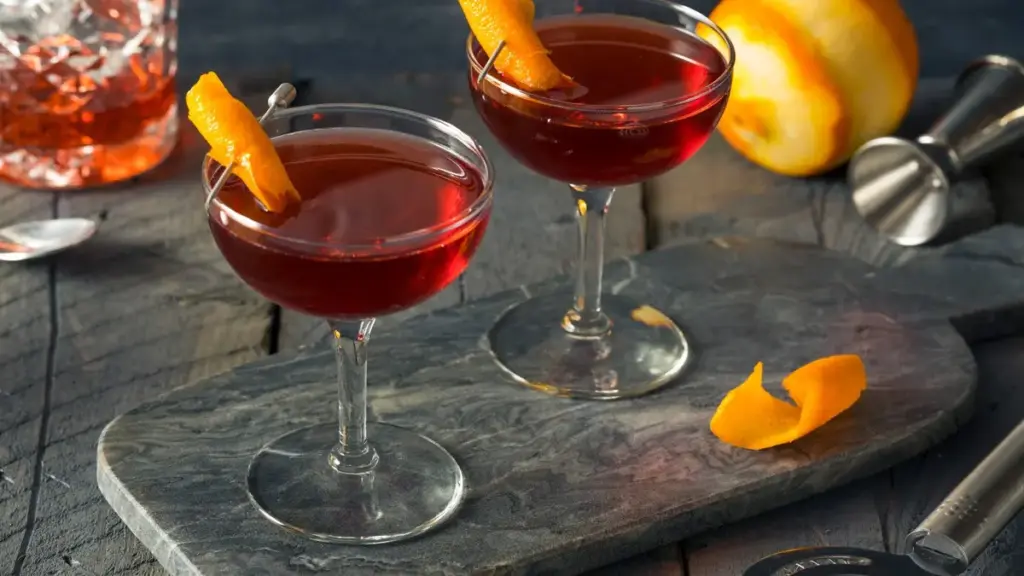
When preparing the drink behind the bar or at home, the method remains straightforward. All ingredients are added to a mixing glass filled with ice, stirred briskly for roughly 10 to 15 seconds, strained neatly into a coupe or traditional cocktail glass, and finally garnished simply with a fresh orange peel.
Examining the individual components reveals specific choices that dictate the character of the final pour. In terms of ratios, this is inherently a very boozy drink. The individual measures combine to total approximately 3.85 ounces of liquid, and because of the high-proof nature of the constituent ingredients, it packs a punch equivalent to almost 3.5 ounces of standard vodka. When the drink was actively served at the bar, the bartenders opted to mix all the ingredients together in a large batch ahead of time, and then pour out 2.75 ounces of the pre-mixed batch, which equates to roughly a 70 percent scale of the single-serving recipe. For anyone planning on making multiple rounds for guests, batching is strongly recommended. Otherwise, home bartenders are left to choose between two paths: either deal with the substantial size of the full-scale drink, or start with 1.5 ounces of rye and attempt the tedious task of cutting every other measurement down by 30 percent as well. It is recognized as an inherently cumbersome instruction, but it is a necessary consideration for balance.

The choice of rye is another critical element. The cocktail was specifically formulated using Bulleit Rye, which proves to be a remarkably strong and reliable choice, though George Dickel works wonderfully as well. The high-rye mashbill—specifically the 95 percent rye and 5 percent barley blend sourced from MGP—truly shines in this application. While a traditional Kentucky rye can be used, the corn content typically found in those mashbills tends to stick out awkwardly against the bitter and herbal components of the drink.
Similarly, the vermouth utilized here needs genuine power and structural integrity to hold its own against such a formidable lineup of other intense ingredients. For this reason, the recipe reaches for Carpano Antica, a sweet vermouth known for its rich, full-bodied, and assertive flavor profile that refuses to get lost in the shuffle.
The orange bitters present in the formulation were originally Angostura Orange, which remains an excellent choice as long as they are applied sparingly and the drinker does not object to their unique aromatic profile. Honestly, the overall flavor intensity of the Mane of Needles is so massive that almost any quality orange bitters will likely suffice. The drink fundamentally requires a bright, zesty citrus note accompanied by a pithy bitterness, and virtually all commercial orange bitters possess those characteristics to a greater or lesser degree, allowing makers the freedom to use whatever brand they personally prefer.