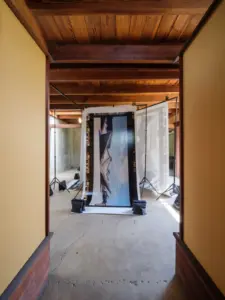
In the late summer of 2010, the Belgian Pavilion became the undisputed talk of the Venice Architecture Biennale. Curated by Rotor, a young and ambitious Brussels-based design collective, the pavilion offered a beautifully sincere, irony-free study of the ways that architecture ages, shifts, and is slowly worn down by the rigors of daily use. In the midst of an international Biennale that was traditionally obsessed with gleaming new buildings and gymnastic, gravity-defying forms, Rotor’s presentation stood out as a subtly radical display, shifting the focus from idealized beginnings to the messy reality of the built environment’s life cycle.
The notoriety and critical acclaim Rotor gained with that standout job ultimately helped the collective secure its most prestigious and demanding commission to date: organizing a massive, exhaustive retrospective of the Office for Metropolitan Architecture (OMA). Opening in October at London’s Barbican Art Gallery and running through February 19, the exhibition offered a sweeping look at one of the most influential practices of the past half-century. Working on a project of this magnitude alongside Rem Koolhaas—who founded OMA in London back in 1975 alongside Madelon Vriesendorp, Elia Zenghelis, and Zoe Zenghelis—could not have been an easy task. Though OMA officially picked Rotor to organize the show, Koolhaas remains constitutionally incapable of taking a hands-off approach to anything bearing his firm’s name.
Nearly all of the wall text in the exhibition, appropriately titled OMA/Progress, was written by Rotor, yet it frequently includes sharp annotations scrawled in Koolhaas’s unmistakable handwriting. Considering the generational age difference between the curators and their subject—most members of Rotor are under the age of 40, while Koolhaas is 67—it is difficult not to view the resulting collaboration as something of an Oedipal production, a younger generation attempting to measure, categorize, and subtly talk back to a towering intellectual ancestor.
Of course, observers might quickly interject that OMA is not simply Rem, and vice versa. At the present time, the firm operates with seven partners, including Koolhaas himself. From its earliest years, OMA—as its intentionally bland, collective moniker indicates—has gone to great lengths to promote the idea that it is fundamentally a collaborative office. As Koolhaas put it in a recent interview regarding the collaborative ethos of his practice, "It’s not purely my voice. It’s more of an orchestration." One of the small, lingering pleasures of walking through the exhibition is taking the time to read the fine-print credits on some of the older projects, serving as a quiet reminder of all the brilliant architectural talent OMA has cultivated, nurtured, and eventually sent out into the wider architecture world over the decades. Those distinguished alumni include prominent figures such as Winy Maas, Dan Wood, Amale Andraos, Bjarke Ingels, Farshid Moussavi, Alejandro Zaera-Polo, and Minsuk Cho, among many others. At the same time, however, Koolhaas undoubtedly remains among the brightest single stars in the global architectural sky, carrying a blazing self-regard that more than matches his formidable output.
One of the exhibition’s primary strengths lies in the sidelong, conscientiously indirect way it approaches these complex themes. If it can often be genuinely tough for architectural historians to parse the exact authorship of a given OMA building, the exact same dynamic is true of the exhibition itself. Rotor establishes its overarching control over the proceedings not through top-down gestures of authoritarian curatorial power, but rather by means of a strategically messy, agglomerative strategy that mirrors the chaotic production of the office it profiles.
Koolhaas is permitted to contribute directly to this museum-world version of a Wikipedia page dedicated to OMA’s evolution, but he is merely one of many would-be historians and internal critics tweaking the text as the narrative unfolds.
The first two rooms of the Barbican show feature densely arranged presentation boards that OMA itself originally produced for many of its most famous and widely discussed projects. It serves as an acknowledgement by Rotor that OMA, a famously self-critical office, has in essence been actively curating its own output for years. But as visitors soon discover, that initial hall of mirrors is something of a false start. After making your way through it—and trudging past a specially designated OMA gift shop—you suddenly come face-to-face with a piece of unadorned, beat-up drywall that officially announces the exhibition, complete with a gallery guard stationed right there to take your ticket.
The wall text encountered at this second, true entry point begins with a surprisingly banal and self-effacing statement of curatorial purpose. "The problem with architecture shows is that they can’t show what they promise: architecture," it reads, directly reviving a classic complaint about architecture exhibitions that has been endlessly rehashed in critical circles in recent years. The statement continues: "This exhibition gives an outsider view of the insides of a particular architecture office. OMA/Progress is a portrait that consists mostly of found materials, materials that exist for reasons other than this exhibition."
Yet, in a characteristically contradictory twist, prominently displayed in the very next room is a personal memo from Koolhaas to his architectural associates, which the curators explicitly point out was "found pinned on the kitchen wall of the OMA office in New York." Dated back to 1998, the memo includes a stern admonition to the staff: "It is crucial that each of you take responsibility for the preservation, maintenance and, if necessary, repair of models, drawings and other evidence of architectural research."
There are certainly moments throughout the exhibition when this curatorial strategy—raising an ambitious idea only to immediately undermine it, much as Koolhaas and OMA have done so habitually over the decades—can feel a bit too clever by half. But in the subsequent galleries, as the exhibition snakes its way across two expansive floors of the Barbican, Rotor’s approach ultimately manages to produce a deft, fitting portrait of contemporary architecture’s most complex and influential firm. The resulting presentation captures a practice that can somehow seem aggressively self-satisfied and deeply self-flagellating at the very same time.
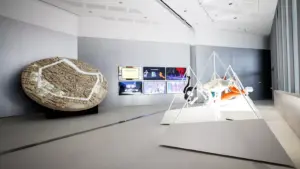
The show itself is exhaustingly, overwhelmingly thorough. As critic Rowan Moore aptly observed in The Observer, "Don’t expect to understand or even see it all. Nobody will, not even the people who made it." Galleries are dedicated to OMA buildings that move, such as the famous, mechanically innovative house in Bordeaux; to ambitious projects that were suddenly put on ice by the global economic crisis, including a vertiginous condo tower planned for Twenty-second Street in Manhattan; and to structural designs heavily dominated by the truss, such as the CCTV headquarters in Beijing and the Wyly Theater in Dallas. There are inside jokes scattered throughout, including squared-off stools made from the exact same blue foam that OMA routinely uses for its intentionally crude, working study-models. There is even a massive slideshow that endlessly shuffles through every single digital image—amounting to 3.5 million files in total—stored across every single one of the firm’s internal servers.
Tucked away within the exhibition is also a small section that the curators have playfully dubbed the "secret room." Its walls are entirely plastered with miscellaneous documents rescued directly from OMA’s administrative files and office recycling bins. Among the most poignant items on display is a written request submitted by an anonymous young staffer nearly a full year in advance, asking for just two days of hard-earned vacation. Beside it hangs a routine Request for Quotation (RFQ) mailed out by Harvard University on June 30, 2008, dryly noting that formal proposals are due back in "July 2008," underscoring the relentless, breathless turnaround times demanded by institutional clients.
That manic pace—alongside the inherent structural complexity of contemporary architectural practice—is something that OMA has enthusiastically embraced from its earliest days, incorporating it directly and strategically into its design work. As if to visually illustrate that core idea, the exhibition includes the presentation boards for an ill-fated OMA proposal for Universal Studios in Los Angeles, which had been originally commissioned by media executive Edgar Bronfman, Jr.
The accompanying description of the scheme, written by the firm itself, explicitly compares the Universal job to other monumental pieces of architecture built for corporate America, most notably Mies van der Rohe’s iconic Seagram Building in New York, an earlier commission undertaken for the Bronfman family. The OMA text notes: "It soon became apparent that the commission was less straightforward than it seemed. Where in ’54 Seagram was a single entity with a clear identity that would be relatively stable during the five-year minimum that any architectural enterprise takes from beginning to end, that was no longer the case: by the mid-’90s, the substance and nature of any corporation was in constant flux, if not turmoil."
This is precisely the volatile, fast-paced corporate culture for which OMA has always designed its buildings, and it is the exact environment that Rotor has so energetically and inventively tried to recreate within the cavernous halls of the Barbican. Forget the crystal-clear, utopian Modernist dictates that once drove masters like Mies van der Rohe; continuous flux and systemic turmoil have firmly established themselves as the true muses for our modern age. Whether or not that fundamental shift truly counts as human progress remains an open question, but it certainly seems to be just the way OMA likes it.