Researchers in South Korea have developed an innovative manufacturing technology that could pave the way for a new generation of smaller, significantly lighter electric vehicle (EV) batteries capable of delivering substantially longer driving ranges on a single charge. Scientists at the Korea Advanced Institute of Science and Technology (KAIST) have successfully addressed a notoriously persistent weakness of anode-free batteries, a promising energy storage design that completely eliminates conventional internal components such as graphite to drastically reduce overall battery size and weight.
While these advanced batteries possess the theoretical capacity to store considerably more energy within a smaller spatial footprint, their practical lifespan has historically been severely limited by the formation of sharp, microscopic lithium structures during the critical charging cycle. The research team tackled this formidable materials science challenge by cleverly adapting precision manufacturing techniques traditionally reserved for the semiconductor industry. This cross-disciplinary approach allows lithium ions to accumulate much more evenly across the current collector while simultaneously encouraging the robust development of a highly durable protective layer, marking a major milestone in advanced energy storage research.
The breakthrough was officially announced on September 22 by KAIST, under the leadership of President Choongsik Bae. The collaborative scientific effort was spearheaded by Professors Jinwoo Lee and Hee-Tae Jung of the university’s Department of Chemical and Biomolecular Engineering. The high-profile project also brought together specialized researchers and resources from Kyungpook National University, led by President Heo Young-woo, and the National NanoFab Center, headed by President Park Heung Soo. By applying extremely precise microfabrication methods typically utilized in the mass production of complex semiconductor devices, the collaborative team engineered an ingenious approach that successfully extends the operational life span of anode-free batteries without introducing significant penalties in their physical size, thickness, or overall weight.
Why Anode-Free Batteries Could Transform Electric Vehicles
To fully understand the significance of this technological leap, it is helpful to examine the fundamental architecture of energy storage systems. In conventional commercial lithium-ion batteries currently powering most modern consumer electronics and electric vehicles, lithium ions are securely stored within a dedicated anode structure composed primarily of materials such as graphite when the battery is in a charged state. Anode-free batteries, however, operate on a fundamentally different mechanical and chemical principle. Instead of relying on a separate, bulky internal anode material to host the lithium, these advanced configurations allow lithium ions to accumulate directly onto a remarkably thin sheet of copper foil during the charging phase.
Removing the conventional graphite-based anode completely eliminates heavy, space-consuming material that would otherwise contribute significantly to the battery’s overall weight and thickness profile. This architectural simplification makes it theoretically and practically possible to pack substantially more energy storage capacity within the exact same physical volume. For the automotive industry, this breakthrough opens the door to designing electric vehicles that can travel significantly farther on a single charge without requiring the massive, heavy battery packs that currently constrain vehicle design, manufacturing costs, and overall efficiency.
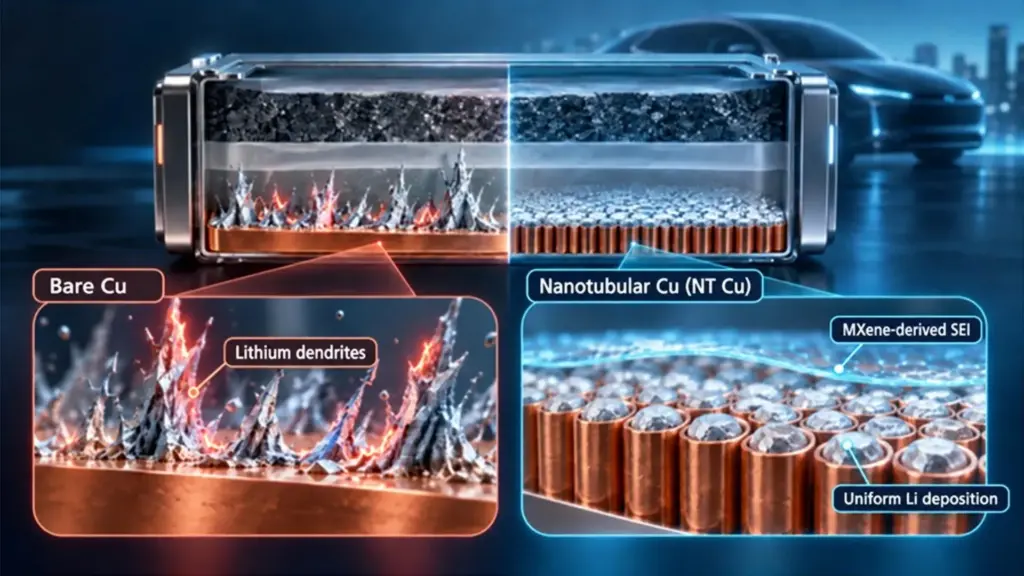
However, this highly promising design has long been accompanied by a serious and frustrating technical drawback that has kept it largely confined to research laboratories. As an anode-free battery repeatedly undergoes the rigorous cycles of charging and discharging, incoming lithium does not always spread out evenly across the smooth surface of the copper current collector. Instead, the active material frequently tends to accumulate aggressively in irregular, branching, or needle-like formations known scientifically as dendrites.
These sharp dendrite structures severely interfere with normal battery performance, causing internal short circuits and accelerating capacity loss, while the delicate protective layer surrounding the accumulating lithium can simultaneously become unstable and prone to structural failure. Together, these interrelated problems cause the battery to chemically and physically deteriorate at an accelerated rate. Consequently, this severely restricted lifespan has long remained one of the single greatest technical barriers preventing anode-free batteries from making the transition into widespread commercial viability and large-scale industrial mass production.
Previous scientific attempts to resolve or mitigate this persistent issue have included supplying additional quantities of active lithium to compensate for the material inevitably lost during continuous operation, or covering the underlying electrode surface with a thicker protective chemical coating. While these stopgap approaches can certainly help compensate for gradual degradation or temporarily shield the delicate electrode surface, they invariably introduce additional inactive material into the system. The resulting increase in overall thickness and weight completely undermines the primary performance advantage that makes anode-free battery technology so attractive to engineers and automakers in the first place.
Borrowing Semiconductor Technology To Prevent Lithium Spikes
Rather than resorting to adding substantial amounts of extra material that would compromise the energy density of the battery, the KAIST-led research team chose a more sophisticated path focused squarely on fundamentally altering the physical structure of the copper foil where the lithium accumulates.
The researchers engineered a meticulously arranged pattern of microscopic tubes distributed evenly across the entire surface of the copper foil. The underlying conceptual framework resembles taking a vast, unorganized parking lot and dividing it neatly into thousands of individual, well-defined parking spaces. Instead of allowing incoming lithium to collect haphazardly and dangerously in concentrated areas, these tiny engineered structures provide a uniform distribution of preferred nucleation sites where the lithium can settle safely and predictably.
To manufacture these incredibly small physical features with absolute precision, the team turned away from traditional battery fabrication methods and adapted an advanced semiconductor manufacturing technique known as secondary sputtering lithography, commonly abbreviated as SSL. This sophisticated industrial process makes it possible to fabricate remarkably tiny, nanoscale structures with an exceptionally high degree of reproducibility and structural control.
Each of the fabricated microscopic tubes measured approximately 300 nanometers across and roughly 150 nanometers in height. Despite their exceptionally diminutive dimensions, the presence of these engineered structures dramatically increased the total available surface area of the copper foil for lithium deposition to approximately four times that of an ordinary, flat sheet of copper.
This vastly expanded active surface area helps distribute the incoming lithium flux much more evenly across the electrode, successfully dampening the highly localized, concentrated buildups that routinely lead to the formation of damaging spikes and dendrites. This innovative approach drastically improves the physical and chemical conditions necessary for stable lithium deposition to occur smoothly, all without relying on the addition of large amounts of heavy, extraneous material that would otherwise degrade the battery’s lightweight profile.
An Ultrathin Protective Coating Helps Batteries Last Longer
Demonstrating remarkable thoroughness, the researchers pushed their methodology a step further by applying an exceptionally thin coating of MXene, a revolutionary class of two-dimensional transition metal carbides and nitrides, directly onto the patterned copper foil. This advanced coating was manufactured to a thickness of approximately 10 nanometers, a dimension roughly equivalent to just a few thousandths of the thickness of a human hair.
Rather than functioning as the battery’s final, static protective barrier, the nanoscale MXene layer acts as a highly reactive chemical foundation that actively encourages a stronger, more resilient protective layer to develop naturally during regular battery operation. Much like a specialized chemical primer prepares a raw surface to receive and bond with paint, it helps bring together the necessary chemical ingredients in a controlled manner to create a stable solid electrolyte interphase coating.
Specifically, within the LiPF6-based liquid electrolyte utilized during the experimental testing phase, the specialized MXene surface actively promotes the localized formation of a robust protective interfacial layer characterized by remarkably high concentrations of lithium fluoride, known commonly as LiF.
This chemically stable layer plays a vital role by strictly limiting unwanted, degrading side reactions between the highly reactive lithium metal and the surrounding liquid electrolyte, while simultaneously physically restricting the outward growth of damaging lithium spikes. By successfully stabilizing the delicate electrode surface, this dual-action strategy addresses two of the most significant fundamental causes of rapid deterioration in anode-free battery configurations.
To thoroughly investigate and confirm how this crucial protective layer develops at the atomic level, the scientific team examined the treated electrode surfaces and internal cross sections while exercising rigorous precautions to limit their exposure to ambient air. Their detailed microscopic observations confirmed beyond doubt that a uniform nanoscale protective layer forms seamlessly along the engineered MXene surface, while also shedding crucial light on the complex chemical processes responsible for its creation.
The rigorous scientific investigation involved the deployment of several highly advanced analytical methods and characterization facilities, including X-ray photoelectron spectroscopy for chemical state analysis, time-of-flight secondary ion mass spectrometry for high-resolution compositional profiling, and transmission electron microscopy to visualize nanoscale structural changes directly.
A Promising Step Toward Smaller, Longer-Lasting EV Batteries
Reflecting on the implications of the breakthrough, Professor Jinwoo Lee stated that the study clearly demonstrates how ultrafine fabrication techniques originally developed for semiconductor manufacturing can be successfully harnessed to create both uniform, highly controlled sites for lithium deposition and a stable protective interfacial layer, all without requiring any drastic changes to the bulk electrolyte formulation or the addition of excess lithium inventory.
He further elaborated that these encouraging experimental findings could significantly accelerate the broader commercial development of high-energy anode-free battery systems. By successfully improving operational lifespan while keeping additional weight and internal volume to an absolute minimum, this pioneering technology could ultimately support the widespread development of much more compact, efficient, and lightweight energy storage systems for the next generation of electric vehicles.
The foundational research was carried out by KAIST researchers Eunji Kim, Hyunju Jung, and Jinuk Kim, who served as the co-first authors of the published study. The complete research findings were officially published online on September 1 in the prominent international scientific journal Advanced Functional Materials.
Financial backing for the project was provided by the Nano & Material Technology Development Program administered through the National Research Foundation of Korea, operating with support from the Ministry of Science and ICT under grant RS-2026-25542167. Additional institutional and technical support was furnished by the Global Semiconductor Advanced Fab Utilization Project through the National Nano Fab Center and the Semiconductor-Secondary Battery Interfacing Platform Technology Development Project, also hosted at the National Nano Fab Center.