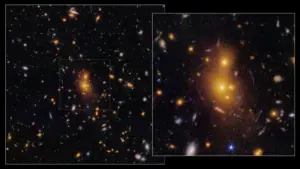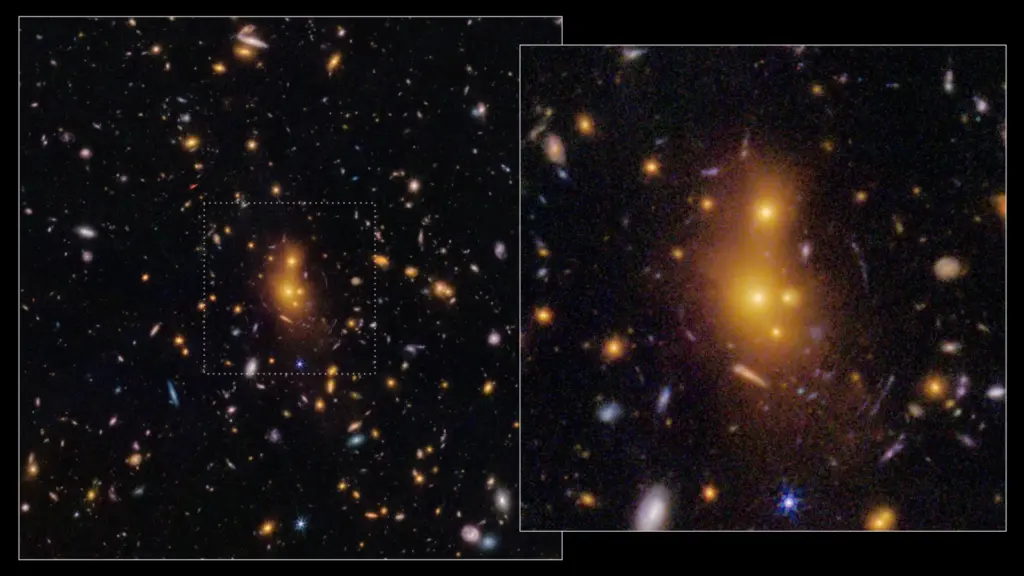
A massive galaxy cluster dating back to an era when such enormous structures were only beginning to take shape is challenging scientists’ understanding of how the universe evolved. New observations from NASA’s James Webb Space Telescope (JWST) reveal that the cluster contains an unusually dense concentration of matter, suggesting that some cosmic structures may have developed much faster than current cosmological models predict.
The galaxy cluster, known as XLSSC 122, has become the focus of three recent studies led by researchers at IPAC, Caltech’s science and data center for astrophysics and planetary science. Their findings establish XLSSC 122 as the most distant galaxy cluster known to exhibit strong gravitational lensing, a phenomenon that allows astronomers to measure the mass of otherwise invisible matter. The groundbreaking research was presented at a press conference on June 17, 2026, during the 248th meeting of the American Astronomical Society, marking a significant milestone in observational astronomy.
Located approximately 10.4 billion light-years from Earth, XLSSC 122 stood out to astronomers because of its surprising maturity. Although it existed during a period when galaxy clusters were still assembling, it already displayed the size and organized structure typically associated with clusters in the modern universe.
The James Webb Space Telescope has now uncovered another remarkable feature that elevates the cluster’s scientific importance. XLSSC 122 happens to lie directly in front of one or more galaxies that are even farther away across the cosmos. The cluster’s powerful gravity bends and distorts the light traveling from those background galaxies, creating a rare and visually striking effect called strong gravitational lensing. This fortunate cosmic alignment has given scientists an exceptionally precise way to measure how mass is distributed throughout the distant cluster.
"When we got those first images back from JWST, we said, ‘wow, look at this, there’s strong lensing coming from this cluster!’" said Kyle Finner, a staff scientist at IPAC and lead author of the first paper examining the cluster. "XLSSC 122 has now set the record for the most distant galaxy cluster displaying strong lensing, which is a valuable tool for astronomers seeking to peer deep into cosmic history."
An Ancient Galaxy Cluster Challenges Cosmic Predictions
The newly detected gravitational lensing has allowed researchers to examine the distribution of mass in an ancient galaxy cluster in greater detail than ever before. XLSSC 122 dates to a period known as "cosmic noon," roughly 10 billion years ago, when the universe was experiencing its most intense era of star formation and rapid galactic evolution.
During this transformative time, galaxies across the universe were producing stars at rates up to 100 times higher than those observed in the present-day universe. Galaxy clusters were also becoming increasingly common as smaller systems gradually combined through gravitational attraction into larger, more massive structures.
Yet XLSSC 122 appears to have developed in an unexpected way that breaks established rules. The new measurements show that a remarkably large amount of its total mass is packed tightly into its central region. According to standard cosmological models, the growth and centralization of massive cosmic structures should have been much more gradual, making such a concentrated and advanced cluster particularly surprising at this early stage of cosmic history.
"XLSSC 122 is one of the first clusters we know of that formed in the universe, and it has a mass concentration that doesn’t agree with our cosmological model predictions," noted Finner, highlighting the tension between theory and observation.
To investigate this deep mystery further, Finner and his collaborators conducted two additional JWST studies, which were first authored by Zachary Scofield and Hyungjin Joo at Yonsei University. Together, the three comprehensive papers provide a much more complete picture of this unusual cluster and offer groundbreaking new insights into galaxy cluster formation during the chaotic era of cosmic noon.
James Webb Reveals Hidden Dark Matter
Astronomers originally identified XLSSC 122 back in 2014 through a targeted X-ray survey carried out by the European Space Agency’s XMM-Newton spacecraft. Later observations with the Hubble Space Telescope helped establish its tremendous distance of approximately 10.4 billion light-years and confirmed that the cluster appeared unusually developed for its chronological age.
However, Hubble’s instruments did not reveal clear, definitive evidence of strong gravitational lensing. That limitation changed dramatically when JWST captured distinctive curved arcs of light surrounding the cluster’s center, providing the first undeniable signs of this optical phenomenon in XLSSC 122.
"Before JWST, we couldn’t do this level of science in the early, distant universe," said Finner, emphasizing the telescope’s unprecedented resolving power.
The gravitational distortions captured by the telescope are caused primarily by something astronomers cannot directly observe: dark matter. Although XLSSC 122 contains visible stars, swirling dust, and glowing hot gas, these familiar forms of ordinary matter account for only a small fraction of the total gravitational lensing effect. Most of the massive distortion comes from dark matter, an invisible substance that has not been directly detected through light emission or absorption, but whose immense gravitational influence is supported by extensive astronomical evidence across the cosmos.
Scientists estimate that dark matter is approximately five times more abundant than ordinary matter, which makes up stars, planets, and everything we can physically touch. Its pervasive gravity helps hold rotating galaxies together and shapes the universe’s enormous, web-like network of galaxy groups, clusters, and filaments.
Because dark matter plays such a foundational role in building cosmic structure, determining how it was distributed billions of years ago offers a powerful way to test the theoretical models describing the universe’s development since the Big Bang, which occurred approximately 13.8 billion years ago.
"Strong lensing is a way to measure the dark matter without actually seeing the dark matter," explained Finner. "It gives us a sensitive probe of our cosmological models."
A Wider View Reveals a Galaxy Cluster Merger
In their second dedicated paper, the researchers investigated XLSSC 122 using another form of gravitational lensing known as weak lensing.
While strong gravitational lensing produces obvious, dramatic distortions—including the striking luminous arcs captured by JWST—weak lensing causes much smaller, subtle changes in the apparent shapes of distant background galaxies. These minute effects are extremely difficult to identify in individual galaxies, requiring astronomers to rely on advanced statistical methods across large fields of view to detect them reliably.
The two complementary techniques provide vital information that painters of the cosmos use to see the full picture. Strong lensing is especially useful for measuring the dense mass concentrated near a cluster’s center, while weak lensing can reveal how matter is distributed across its vast outer regions and periphery.
"Weak gravitational lensing can constrain mass much further out, so you can get a better picture of the surrounding cluster area," said Finner.
By combining these precise mass measurements with complementary X-ray and radio observations obtained from other space- and ground-based telescopes, the scientists determined that XLSSC 122 is still actively undergoing a major merger. Its constituent galaxies are continuing to collide and come together as the larger, consolidated cluster takes its ultimate shape.
The broader analysis also reinforced the earlier finding that an unusually large amount of mass is densely concentrated near the very center of the cluster, deepening the puzzle for theorists.
Ancient Starlight Offers New Clues to Dark Matter
The team’s third and most recent paper revealed yet another important feature of XLSSC 122: faint, diffuse light produced by ancient stars that are no longer bound to any individual galaxy.
Known scientifically as intracluster light, this ghostly glow comes from stars that have been violently stripped and scattered into the vast spaces between galaxies. Webb’s unprecedented observations represent the earliest known detection of intracluster light in a distant cluster, providing another independent way to examine the complex development of galaxy clusters in the early universe.
The widespread distribution of this faint light strongly supports the conclusion that XLSSC 122 is currently undergoing an active merger. As galaxies interact, brush past each other, and collide, gravitational forces pull some stars away from their original galactic homes and spread them throughout the broader cluster environment. In XLSSC 122, however, many of these displaced stars appear not to have settled into its dense central region yet.
The researchers also uncovered an intriguing connection between these wandering, untethered stars and the mysterious dark matter.
Near the cluster’s crowded center, the spatial distribution and shape of the intracluster light closely match the distribution of dark matter inferred independently from strong gravitational lensing. This remarkable correlation suggests that the faint glow of stars scattered between galaxies could potentially serve as a visible, reliable proxy indicating where invisible dark matter is concentrated.
If astronomers observe the exact same physical relationship in other distant clusters, particularly those originating from the early universe, intracluster light could quickly become a valuable new observational tool for mapping dark matter across deep cosmic history.
"In this cluster, the intracluster light essentially traces the dark matter," said Finner. "That light tells us that the cluster is in a merging state."
Could More Ancient Galaxy Clusters Challenge Cosmology?
The next ambitious goal for Finner and his dedicated colleagues is to identify and investigate dozens of additional galaxy clusters from similarly early periods in the universe’s history to see if XLSSC 122 is an anomaly or part of a wider trend.
Finding these distant, elusive objects requires a different observational approach from studying them in detail. Although the James Webb Space Telescope is exceptionally powerful, its relatively narrow field of view makes it better suited to examining selected targets of interest rather than searching enormous, wide expanses of the sky.
Instead, astronomers must first identify promising candidate clusters through wide-area X-ray and radio surveys, similar to the historical observations that originally revealed XLSSC 122 over a decade ago.
One particularly promising technique relies on the Sunyaev-Zel’dovich effect, which occurs when ultra-energetic particles residing inside massive galaxy clusters scatter radiation originating from the cosmic microwave background—the faint, lingering thermal afterglow of the Big Bang.
This high-energy interaction can create distinctive regions that appear as subtle "holes" or shadows in observations of the cosmic microwave background. By systematically searching for these unique signatures, astronomers can locate ancient galaxy clusters that might otherwise remain entirely hidden.
Finding more objects like XLSSC 122 could have major, far-reaching implications for modern cosmology. If other ancient clusters also contain unexpectedly concentrated dark matter and display unusually advanced development for their age, scientists may need to revise some of their most basic assumptions about how quickly large cosmic structures could form in the early universe.
For now, XLSSC 122 provides a crucial and rigorous test of existing theoretical models, but a much larger sample size will be strictly necessary to determine whether its unusual properties are rare cosmic outliers or part of a broader, yet-unrecognized pattern in the early universe.
"It’s still early in the JWST era," concluded Finner, "and if we can start to get data on tens or hundreds of these types of objects at this stage in the universe, then we can really start putting our cosmological models to the test."