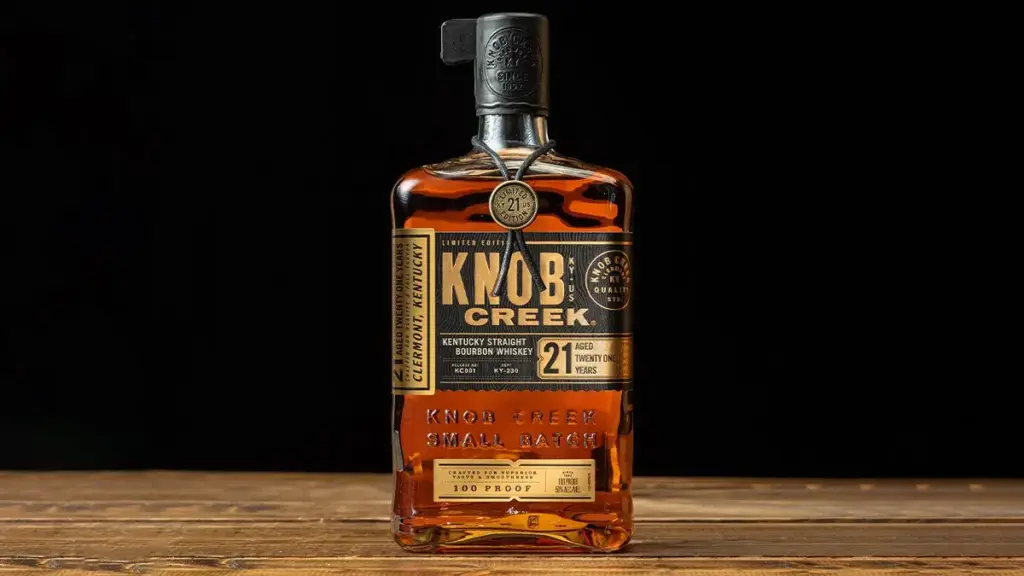
There is a timeless mantra in the world of whiskey that is always worth repeating: older does not necessarily mean better. That adage is particularly true when it comes to American bourbon, though there are always notable exceptions to the rule. Proving that time in the barrel can yield magnificent results when handled with immense care, Knob Creek’s oldest age statement to date is officially making its triumphant return. The brand has announced that its highly anticipated limited-edition 21-year-old expression is back for 2026, marking fantastic news for dedicated collectors and enthusiasts who manage to track down a bottle.
When Knob Creek 21 was first introduced to the market last year, it was met with a healthy degree of skepticism from industry critics and everyday whiskey lovers alike, including this writer. The skepticism is rooted in the fundamental science of spirit maturation. Bourbon ages in a significantly warmer climate—primarily the sun-baked rickhouses of Kentucky—than Scotch whisky does in the cooler, more temperate conditions of Scotland. Furthermore, by legal definition, straight bourbon must be aged in brand-new, heavily charred American white oak containers, rather than the reused casks frequently favored in other spirits categories.
This strict regulatory requirement means the interaction between the maturing distillate and the wood is remarkably active and aggressive. As a result, a bourbon that is left to mature for more than roughly fifteen years in Kentucky can easily cross the line. Instead of developing complex maturity, it can quickly go overboard, transforming into an overly bitter, heavily tannic oak bomb that completely strips away the underlying grain and sweet corn characteristics.
Fortunately, that was definitively not the case with Knob Creek 21. Instead of succumbing to the dreaded over-oaked fate that plagues many ultra-aged American whiskeys, the expression emerged as a remarkably balanced spirit. Many critics and tasters felt that this extra-aged release actually managed to surpass the flavor profile and complexity of the brand’s well-regarded 18-year-old expression, proving that master blenders can sometimes successfully navigate the hazardous waters of extended maturation.
To understand the magnitude of a 21-year release, it helps to look at the brand’s foundational standard. Knob Creek’s core, flagship bourbon is a reliable 9-year-old whiskey bottled at a sturdy 100 proof, long celebrated as a robust option for neat sipping or mixing into classic cocktails. The brand itself operates as a prominent pillar of the Jim Beam Small Batch Collection, a prestigious portfolio created decades ago that also houses notable sibling brands such as Baker’s, Booker’s, and Basil Hayden.

In recent years, the brand decided to push its creative boundaries by introducing limited-edition, higher-age-statement expressions to its lineup. This strategy began with the rollout of 12-year, 15-year, and 18-year-old expressions. Much to the delight of the broader Jim Beam fan base, these older limited releases were widely praised for retaining the signature house style while offering deeper layers of complexity that come with extended years in the barrel.
If there is one minor critique to be leveled against the 21-year-old release, it centers on its bottling strength. The expression is bottled at 100 proof, which matches the exact alcohol-by-volume strength of the brand’s standard, much younger core lineup. Discussing the technical realities of the liquid last year, Jim Beam global ambassador Tim Heuisler explained that the bourbon emerged from the barrel at approximately 110 proof after more than two decades resting in the oak rickhouses. More remarkably, due to the intense evaporation known as the angel’s share, only about a quarter of the original liquid remained in the barrel by the time it was deemed ready for dumping.
While 100 proof makes for an exceptionally approachable pour, one cannot help but imagine that the bourbon might taste even more dynamic and intense if it had been bottled closer to its natural cask strength. Granted, 110 proof is not an astronomically high cask strength by today’s standards of hazmat-level releases, but the whiskey remains a stellar and sophisticated pour nonetheless.
While it was not possible to sample the newest 2026 batch firsthand, the official tasting notes compiled during last year’s inaugural release paint a vivid picture of what drinkers can expect. The palate is led unmistakably by the classic, signature Beam peanut note that anchors the distillery’s flavor profile. This foundational nutty characteristic is surrounded and complemented by a rich array of complex flavors, including dark chocolate, ripe blackberry, warming maple syrup, aged leather, cured tobacco, bruleed vanilla, and toasted coconut. It is an intricate flavor journey that showcases how well the distillate absorbs and transforms the flavors imparted by the wood over two decades.
Priced at $250, the retail cost has thankfully not increased for this year’s release. Market observations indicate that bottles are currently trading and resting on shelves close to that suggested retail price point. Because Knob Creek 21 is designated as a strictly limited release, availability is naturally constrained, but interested buyers can still track down bottles at select specialty liquor stores across the country as well as through major online spirits retailers such as Total Wine.