The art market, much like the broader economic climate, often reflects the temperaments of its participants through their spending habits. At Frieze London this past October, a clear pattern emerged among the global collecting class: buyers were measured, deliberate, and increasingly polarized in their acquisitions. Rather than rushing into the fray, collectors took their time, resulting in a market that prioritized the two extreme ends of the price spectrum.
Deals that successfully crossed the finish line clustered firmly at the high and low tiers. Pace Gallery, for instance, demonstrated the enduring demand for established contemporary talent by placing nearly all of five vibrant canvases by Marina Perez Simão, with each piece commanding approximately $250,000. Conversely, at the more accessible end of the spectrum, Proyectos Ultravioleta found success with the poignant, historical work of the late Guatemalan Maya Kaqchikel painter Rosa Elena Curruchich, offering her paintings at a approachable £10,000 (roughly $13,400) apiece. Harlesden High Street took this accessibility further, clearing its entire stand with prices ranging between £2,000 and £8,000 ($2,700 to $10,700). For market analysts and fair advisers, the message was clear: the market is currently rewarding the very top—where blue-chip status guarantees liquidity—and the very bottom, where emerging or historically significant affordable work offers a low barrier to entry. Everything in between, it seems, is being asked to make its case with significantly more patience.
This climate of deliberate acquisition sets the stage for a closer look at six specific works currently being offered through MutualArt’s partner galleries across New York, Italy, North Carolina, San Francisco, and Montreal. Each piece engages with the concept of the "figure," though rarely in the traditional sense of a portrait as a direct likeness. Instead, these works explore the figure as a construct: celebrity, emblem, cartoon villain, borrowed masterpiece, fable, and, ultimately, the elusive self-portrait. It is a sequence of masks that spans the distance between the most public face in postwar culture and the most intimate reaches of the private interior. While prices for two of these works are publicly disclosed, the rest are available upon inquiry, placing the dialogue between the collector and the gallery at the heart of the acquisition process.
From Icon to Object: The Architecture of Memory
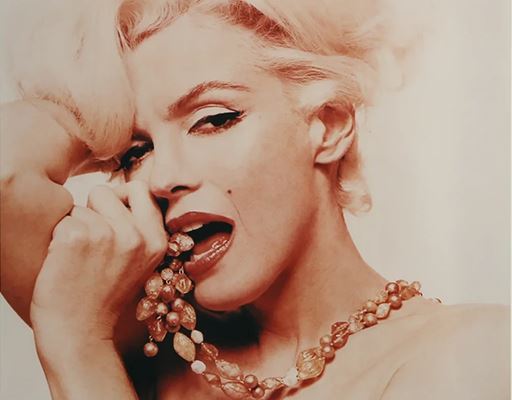
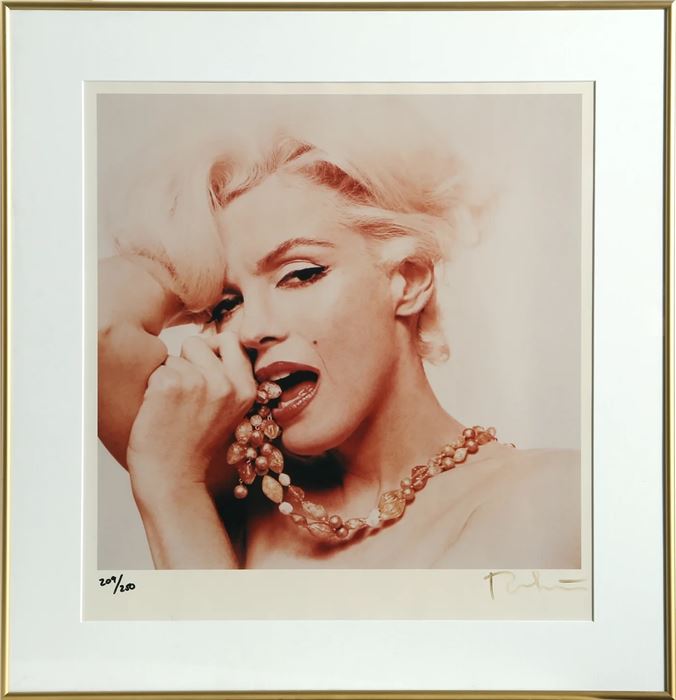
The journey begins at the most public pole of our cultural consciousness: the face of Marilyn Monroe. Offered through Ro Gallery in New York, Bert Stern’s Marilyn Biting Thumb (1974) is a nearly square Ektacolor photograph that requires no introduction. The image is drawn from the famous "Last Sitting," a series of sessions commissioned by Vogue in 1962, captured just six weeks before the star’s untimely death. While the original negatives were shot in 1962, this specific print is dated 1974, signed, and numbered 209 from an edition of 250. It serves as a bridge between the historical moment of the shoot and the long, myth-making afterlife of the image itself.
Bert Stern, who passed away in 2013, cemented his legacy through these images, but the figure in the frame has long since transcended the photography, passing into the realm of public memory. Ro Gallery, a staple of both the primary and secondary markets with a vast inventory of over seven hundred works on MutualArt, lists this iconic print for $4,500. For collectors, the value here is rooted in the ubiquity of the image; it is an editioned object that occupies a space of total cultural recognition, making it a cornerstone for those building a collection focused on the intersections of celebrity and history.
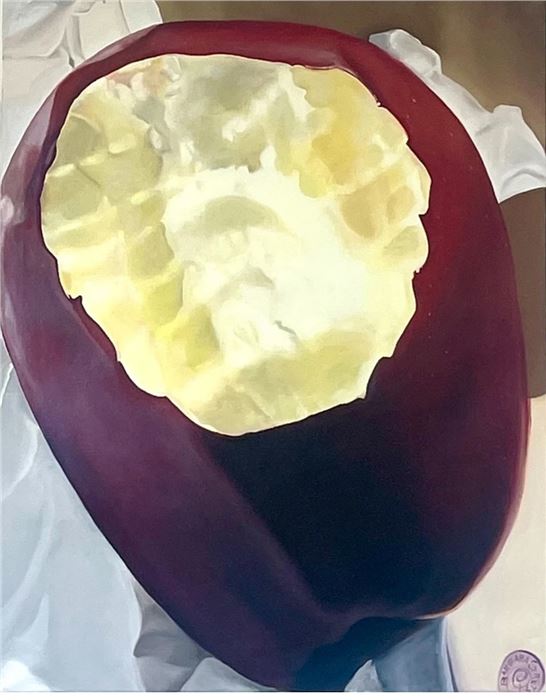
If the bite Monroe turns on herself represents a moment of raw, human vulnerability, the next work in our selection shifts that energy toward a symbolic, hyperrealist study. In Santa Margherita Ligure, Cella Art & Communication offers Mela morsa by Barbara Stretti. A dark-red apple, cropped tightly and rendered with the exacting, photographic precision of the hyperrealist tradition, fills the canvas. The title is a simple, literal translation—"bitten apple"—and it refuses to provide any narrative beyond its own visual presence. By scaling the fruit to monumental proportions, Stretti transforms a familiar emblem of temptation into an icon. Where the Stern photograph relies on the fame of its sitter, Stretti’s painting relies on the universal resonance of a symbol. The total absence of a human figure here renders the act of the "bite" sharper, more deliberate, and strangely haunting.
Stretti, a graduate of NABA in Milan, balances her practice between hyperrealism and fluid, abstract painting—a dichotomy of control and chance that defines her approach. Cella Art & Communication, which has operated out of the Hotel Laurin since its rebranding in 2017, currently prices the work at €2,000 (approximately $2,240). With a selection of Stretti’s work on MutualArt ranging from €600 to €2,500, the gallery provides a accessible entry point for new collectors looking to engage with high-level technical skill without the premium of an established secondary market pedigree.
Villains, Dreams, and Fables
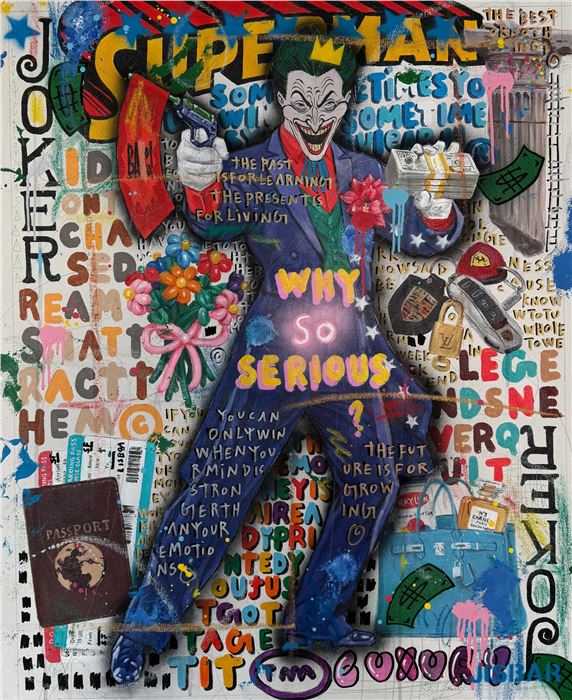
Moving from the hyperreal to the pop-culture landscape, the French painter Jisbar (Jean-Baptiste Launay) presents a different kind of figure: the borrowed persona. His mixed-media canvas Super Joker is built around one of the most recognizable villains in modern cinematic and comic-book history. Jisbar, who emerged from the Parisian street-art scene, has successfully transitioned into a pop-painting career that has seen him collaborate with major luxury brands like BMW and Ducati.
His American presence is anchored by Gallery 444, a family-owned institution on San Francisco’s Union Square that has championed his work since 2018. The Joker, as interpreted by Jisbar, is less a person than a vessel for decades of cultural baggage. Here, the line between homage and appropriation dissolves, positioning the work at the far, exuberant end of the pop-art spectrum. It serves as a reminder that in the contemporary market, "the figure" is often a ready-made—a character we inherit from the screen rather than one we encounter in the flesh.
This blur between the original and the reinterpreted is a territory also occupied by Keiko Genka. Her acrylic canvas, Van Gogh’s Dream, frames its subject not as a reproduction, but as a reimagining of the Dutch master’s world. Genka, a Japanese artist who graduated from NC State in 1997, is represented by Gallery C in Raleigh, North Carolina. Founded in 1985 by Charlene Ferrell Newsom and situated in the historic Russ-Edwards House, Gallery C provides a domestic, contemplative setting that perfectly complements Genka’s introspective style.
The work enters into a long, storied tradition of artistic homage, where motifs are borrowed and bent to suit the artist’s own interior concerns. Unlike the aggressive pop-appropriation seen in other works, Genka’s approach is one of soft, painterly synthesis. The recent auction success of her painting Violet Vista at Leland Little suggests a growing market interest, even as her primary market remains carefully cultivated through her long-standing gallery representation.
Continuing the theme of the borrowed figure, Helia Chitsazan turns to the oldest storytelling device of all: the fable. Her oil on canvas, The Wolf and the Sheep (2023), is perhaps the most intimate object in this selection. Small in scale, it is designed for a domestic environment—a hallway or a bookshelf—where its narrative can be savored. By invoking the classic tropes of predator and prey, Chitsazan uses the language of the fable to explore roles that are invented rather than portrayed.
Born in Tehran in 1995 and an MFA graduate from the School of Visual Arts in New York, Chitsazan has quickly established a presence at Fou Gallery. Since her 2023 solo exhibition, After Midnight…, her work has gained traction for its ability to navigate different scales, from the small, fable-like canvas to much larger, more imposing works like Please Take a Seat. The gallery’s inventory of her work from 2023 and 2024 offers collectors a look at an artist who is clearly defining a visual lexicon of character and archetype.
The Final Mask: The Self
The progression of figures—from the star, the apple, the villain, the master, and the fable—finds its natural conclusion in the most personal mask of all: the self-portrait. Holly MacKinnon’s Self IV (Front Door) (2025) acts as a threshold between the internal and external worlds. The title itself is a structural statement: the numbering indicates a series, while the parenthetical "front door" suggests a figure poised at the limit of the private room.
Based in Montreal and represented by Duran Contemporain, MacKinnon is known for creating "dreamy, imagined environments" that are nevertheless weighted with emotional tension. Her practice, which balances the sophisticated with the childlike, is deeply rooted in the concept of the self as a constructed, evolving entity. With over forty works listed on MutualArt, MacKinnon’s market is broad and diverse, offering collectors various options in terms of scale and complexity. As with many of the works featured here, the price for this specific canvas is available upon inquiry, allowing the gallery to curate the acquisition process to the collector’s specific requirements.
The trajectory from the Monroe photograph to MacKinnon’s self-portrait highlights a fundamental truth of the current market: we are witnessing a fascination with how figures are staged, borrowed, and invented. The mood at Frieze London made it clear that while conviction is being rewarded at the highest price points, there is a vibrant, accessible tier of the market where such conviction is equally potent. For those drawn to these interpretations of the figure—whether as a star, a myth, or a reflection—the path forward lies in the direct, decisive conversations with the galleries themselves, all of which remain accessible via MutualArt for those looking to engage with these narratives further.