Architectural exhibitions aimed at a general audience have always been notoriously difficult to pull off successfully. Small-scale representations—such as photographs, physical models, detailed drawings, and, increasingly, dynamic video presentations—can only ever approximate the sensory experience and scale of a full-size built work. Much like traditional art objects, these representations need to captivate the casual museum visitor while simultaneously acknowledging the thicket of real-world constraints, including program parameters, site specifics, and strict budgets, that fundamentally shape architectural form.
When the projects on display possess a explicitly socially or environmentally conscious dimension, the curatorial challenge becomes even more formidable. Such displays often lack the immediate "wow factor"—the sheer visual panache of extravagantly innovative or purely elegant architectural works and objects that routinely make museum visitors stop dead in their tracks. Furthermore, a persistent danger lurks: providing the necessary contextual and technical information required to truly appreciate these socially driven projects risks making the exhibition resemble a walk-in book rather than an engaging visual gallery experience.
Undaunted by these systemic and presentational hurdles, two leading art and design institutions in New York, the Museum of Modern Art (MoMA) and the Smithsonian Cooper-Hewitt, National Design Museum, have boldly embraced this type of socially engaged exhibition over the past few years. Both institutions have taken risks to organize ambitious design shows that directly confront problematic living conditions, urban crises, and environmental challenges around the globe.
Expanding the Scope of Design at Cooper-Hewitt
When the Cooper-Hewitt mounted Design for the Other 90% at its palatial quarters on upper Fifth Avenue in 2007, it generated an immense amount of media attention and drew a substantial audience of 100,000 visitors. Recognizing the resonance and importance of the theme, the museum designated Cynthia Smith, who had organized that initial show, as the official Curator of Socially Responsible Design in 2009. Smith, an industrial designer with a deep background in public service, naturally followed up with a comprehensive sequel titled Design with the Other 90%: CITIES.
This major follow-up exhibition opened for a successful three-month run in October 2011 at the United Nations headquarters while the Cooper-Hewitt’s permanent building underwent extensive expansion. The exhibition displayed 65 innovative projects hailing from 25 different countries, focusing intently on the pressing realities of slums and informal settlements proliferating across the Global South. It drew 150,000 visitors, a demographic that notably included numerous United Nations diplomats and international staff. Reflecting on the unique venue, Smith noted that the United Nations proved to be a fantastic location for reaching a global audience.
MoMA’s Deepening Commitment to Socially Conscious Urbanism
MoMA’s exhibitions in this urgent arena have proven to be even more popular with the general public. Rising Currents: Projects for New York’s Waterfront, an exhibition devoted entirely to exploring architects’ theoretical, imaginative solutions to rising sea levels driven by global climate change, hit an extraordinary high of 881,520 visitors over its six-and-a-half-month duration in 2010. Shortly after, Small Scale, Big Change: New Architectures of Social Engagement, which closely examined innovative design created for underserved communities scattered across five continents, opened in October 2010 and drew an impressive 311,188 visitors during its three-month stay.
Building on this momentum, MoMA installed Foreclosed: Rehousing the American Dream, scheduled to remain on view through July 30. With this targeted exhibition, the museum has further deepened its socially conscious identity under the steady aegis of Barry Bergdoll, who has served as the chief curator of architecture and design since 2006. Bergdoll, who also maintains a position as a professor of architectural history at Columbia University, might initially seem like an unlikely candidate to lead MoMA away from the safer, monographic exhibitions dedicated to masters like Frank Lloyd Wright or Mies van der Rohe with which the institution has historically been identified.
Yet Bergdoll is quick to point out historical precedent, noting that MoMA’s very first architecture exhibition, the legendary Modern Architecture: International Exhibition of 1932, actually featured a significant social housing component. Over the decades, similar socially oriented subjects have reappeared sporadically within the museum’s galleries.
The Museum as an Incubator for Ideas
Nevertheless, the frequency of these do-good exhibitions has clearly stepped up in recent years. As Joseph Rosa, the director of the University of Michigan Museum of Art, observes, the modern museum today is rapidly evolving into more of an incubator for critical ideas, with curators and thinkers increasingly focusing on socially minded critiques of contemporary culture. Bergdoll explains that his overarching goal is to pose crucial questions that are rarely addressed in normal, commission-based architectural practices. At the same time, he emphasizes that the shows still involve architects whose work commands professional interest, allowing MoMA to continue its traditional role in culling and showcasing the finest design talent available.
Like the earlier Rising Currents exhibition, the Foreclosed project positioned MoMA firmly in an activist role by actively commissioning speculative solutions developed through a rigorous, collaborative workshop process. Bergdoll, who organized the project alongside Reinhold Martin, Director of Columbia University’s Temple Hoyne Buell Center for the Study of American Architecture, carefully isolated five distinct geographical areas across the United States—stretching from Florida to California—where the devastating banking mortgage crisis of 2007 and 2008 left a wake of stalled developments and swaths of publicly held land now ripe for creative reuse.
For each of the five selected sites, identified through extensive research conducted by the Buell Center, Bergdoll and Martin assigned a multidisciplinary team led by visionary architects and supported by experts in finance, housing, urban planning, and infrastructure. Each collaborative team created bold proposals meant to provoke entirely new ways of thinking about housing design and dense community living. Through this initiative, Bergdoll aims to actively engage the general public in understanding how architects fundamentally think about space and society.
Speculative Solutions for Subdivisions
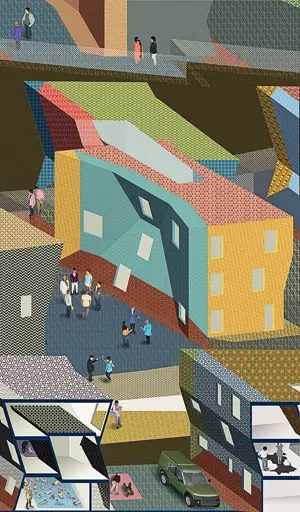
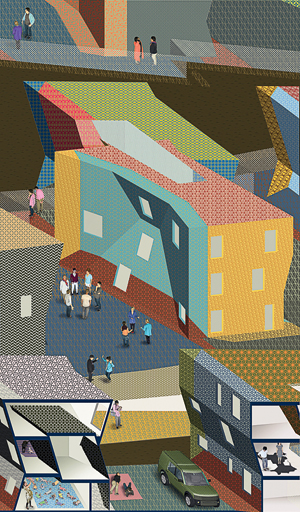
Among the participating Foreclosed teams—which notably include prominent practices such as Studio Gang, MOS, WORKac, and Visible Weather—Zago Architecture took on the challenge of redesigning a failed residential subdivision pocked with unbuilt, vacant lots in an unincorporated section of Rialto, California, located just east of Los Angeles.
Principal Andrew Zago developed a quixotic and intensely colorful scheme presenting a diverse array of alternative housing types, including duplexes and interconnected row houses. These residential forms were carefully rearranged across the site to consciously avoid the deadly repetitiveness and isolation characteristic of the traditional subdivision house-yard-driveway model.
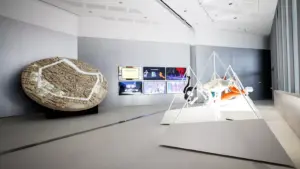
As is typically the case with socially and environmentally oriented exhibitions, Foreclosed incorporates a substantial amount of nonvisual, analytical material. In fact, an entire gallery within the exhibition is devoted solely to presenting the complex economic and social data that underpins the program’s core arguments.
Curators and designers continually grapple with these presentation hurdles. Granger Moorhead, who expertly designed the Cooper-Hewitt exhibition during its residency at the United Nations, tackled the persistent problem of grainy photographs and variously fabricated architectural models by completely abandoning any lingering notion of a slick, traditional "museum-quality" aesthetic. Instead, Moorhead and his team opted for a raw, direct approach, noting that they tried to present the heavy content in an informal, collaged way that speaks directly to the urgency of the issues at hand.
Balancing Curatorial Agendas
With such thorny and demanding matters to consider, major design institutions wisely seek a healthy balance in their upcoming programming. Looking to the near future, the Cooper-Hewitt plans to pivot toward an upcoming exhibition dedicated to graphic design. Meanwhile, MoMA has scheduled two distinct architecture shows next: one focusing on the proto-Modernist master Henri Labrouste, and the other marking the museum’s very first comprehensive retrospective of the influential work of Le Corbusier. As the ancient Latin adage reminds us, ars longa, vita brevis.