A powerful new computer simulation is allowing scientists to explore one of the most mysterious periods in cosmic history, when the universe emerged from total darkness and the first generation of stars and galaxies began to radically transform the cosmos.
Developed by an international team of researchers at MIT, Harvard University, and other leading academic institutions, the advanced simulation—appropriately named Lumina—recreates the evolution of the early universe across a breathtaking region roughly 1.6 billion light-years wide. By tracing two billion years of critical cosmic history, the model reveals how primitive galaxies formed, how blinding radiation spread through deep space, and how the universe gradually cleared to become transparent to light.
The pioneering research, published in the Monthly Notices of the Royal Astronomical Society (MNRAS), provides an unusually detailed and vivid picture of cataclysmic events that unfolded billions of years before our own solar system even existed.
How the Universe Entered Its Cosmic Dark Age
The story of our cosmos begins with the Big Bang, an event that left the universe in an extremely hot, dense state filled with a roiling soup of electrons and other subatomic particles. This primordial plasma, described by astrophysicists as initially smaller than a single atom, expanded rapidly and steadily cooled as the universe grew in volume.
Eventually, particles slowed down enough for free-roaming electrons to combine with atomic nuclei, producing electrically neutral hydrogen. Around 380,000 years after the Big Bang, the universe entered a strange and silent period known to astronomers as the cosmic "dark age."
Although the universe had by then become transparent to much of the residual radiation left over from the Big Bang, stars had not yet ignited to illuminate the vast expanses of space. Instead, a thick haze of neutral hydrogen filled the cosmos, capable of absorbing certain types of radiation—including the high-energy ultraviolet light that would eventually emerge from the first newborn stars.
Lumina allows modern researchers to investigate how this primitive, opaque environment slowly evolved over eons, eventually giving rise to the complex web of galaxies, stars, and other large-scale structures that helped bring the long dark age to a definitive end.
How the First Stars and Black Holes Transformed the Universe
The sheer scale of the Lumina simulation is unprecedented, covering an immense region measuring 500 megaparsecs, which is equivalent to approximately 1.6 billion light-years across. Within that vast computational volume, Lumina simultaneously tracks dark matter, gas, individual stars, and radiation in the form of photons, successfully capturing both the subtle behavior of matter across cosmological distances and the localized formation of individual galaxies.
One of the simulation’s most significant achievements is its ability to recreate two major transitions in the early universe: hydrogen re-ionization and helium re-ionization.
Hydrogen re-ionization began as the very first stars and nascent galaxies produced increasing amounts of ultraviolet radiation. This energetic light stripped electrons away from neutral hydrogen atoms, a transformative chemical process known as "re-ionizing" the gas. As more and more hydrogen became ionized, the universe grew progressively transparent to ultraviolet light, allowing radiation to travel freely across much greater distances than ever before.
This dramatic transformation helped clear out the widespread neutral hydrogen that had long dominated the early cosmos. Lumina reproduces this complex process in remarkable detail, showing how radiation from the earliest generations of stars gradually altered the physical conditions throughout space.
Crucially, the simulation also follows helium re-ionization, a separate phenomenon that requires substantially more energetic radiation to successfully strip electrons from helium atoms.
The results point to distinctly different primary sources driving these two major transformations. Early stars and galaxies appear to have been primarily responsible for ionizing hydrogen, while actively feeding supermassive black holes supplied the intense, high-energy radiation needed to ionize helium.
This marks the first time a single simulation has successfully captured both processes working in tandem, offering astronomers a much more complete and cohesive view of how the early universe fundamentally changed over time.
"Lumina does everything from small-scale star and galaxy formation to large-scale reionization of hydrogen and helium, in a volume that is 100 times larger than previous best simulations," says study author Mark Vogelsberger, a professor of physics at MIT.
The researchers are making Lumina available to the wider scientific community, allowing its bold predictions about early cosmic structures to be rigorously compared with observations from existing and upcoming space- and ground-based telescopes. Such direct comparisons will help researchers better understand the intricate physical events that shaped the universe’s very first galaxies and stars.
Building a Virtual Universe With Half a Trillion Elements
Lumina gets its name from the Latin word meaning "lights." Its underlying software architecture builds directly upon IllustrisTNG, a widely acclaimed earlier simulation developed by scientists at MIT and partnering institutions, including several key members of the current Lumina research team.
IllustrisTNG models how galaxies form and evolve by following the gravitational and hydrodynamic interactions of dark matter, gas, and other physical processes from the Big Bang all the way to the present day.
To create Lumina, the researchers heavily upgraded the existing software so it could reproduce galaxy formation in comparable physical detail across an exponentially larger region of space. They also incorporated a sophisticated radiation transport model that calculates precisely how light, including harsh ultraviolet radiation, travels through the expanding universe and interacts with surrounding matter.
Together, these major technical improvements allow the simulation to track both the localized birth of galaxies and the enormous environmental changes that radiation produces across vast cosmic distances.
The resulting model contains approximately half a trillion individual computational elements, including discrete particles of dark matter and high-resolution cells representing cosmic gas. It provides roughly 30 times the spatial resolution of IllustrisTNG while covering a region 100 times larger in total volume than previous leading simulations.
Recreating billions of years of complex interactions across such a staggering number of elements naturally requires extraordinary computing resources. To accomplish this, the research team utilized Frontier, one of the world’s most powerful and advanced supercomputers, located at the Oak Ridge National Laboratory in Tennessee.
"At peak scale, the calculation brings together the equivalent of more than 100,000 CPU cores and around 15,000 GPUs," says Xuejian (Jacob) Shen, an MIT co-author of the study. "Making all of those processors communicate efficiently while continuously evolving trillions of interacting pieces of information is itself an extraordinary feat of computer engineering."
Watching the First Galaxies Emerge From Darkness
Lumina officially begins its run approximately 45 million years after the Big Bang, during a dark era when neutral hydrogen universally dominated the cosmos.
The researchers initialized the simulation using boundary conditions meticulously derived from contemporary scientific understanding of that epoch. They then allowed the supercomputer model to calculate how gas and dark matter interacted across its half a trillion elements as simulated cosmic time marched forward.
At the exact same time, Lumina actively tracked how radiation appeared, spread outward, and interacted with ambient matter, including the intense ultraviolet light produced by newly emerging stars.
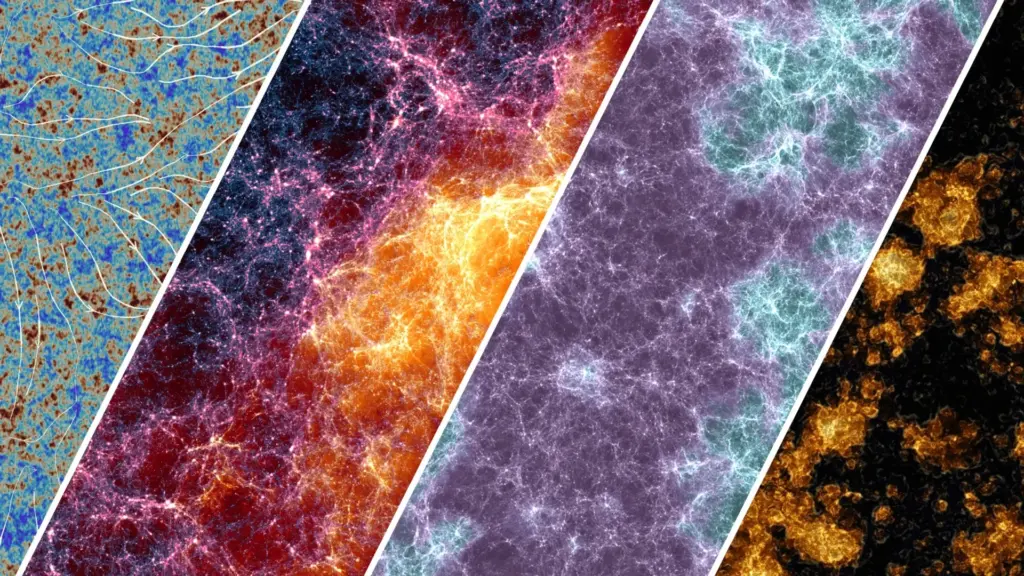
The result of this massive computational effort is a rich virtual universe that scientists can freely explore at dramatically different scales, shifting effortlessly from the large-scale arrangement of matter across enormous cosmic distances down to the minute structural development of a single galaxy.
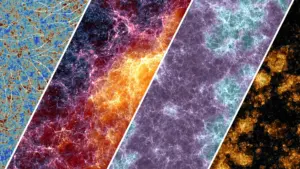
On the project’s official website, the research team has released striking videos showing these complex processes in action. One visualization offers a seamless "zoom-in" from the entire simulated region down to an individual disk-shaped galaxy. Another presents a sweeping time-lapse of the complete volume, illustrating how hydrogen re-ionization spreads across the universe over the course of 2 billion years.
"On the one hand, it’s evolving dark matter as well as the gas in the universe, and on the other, it’s also tracking how radiation travels," explains Oliver Zier, a former postdoc in the Vogelsberger Lab and first author of the study. "We see dark matter and gas start to clump in these over-densities. And when we zoom in, we can see gas is falling into these dark matter haloes. Zooming in more, we see this is where the first galaxies form. And the first stars form in those first galaxies. Those stars then create radiation. The simulation then tracks that radiation, and we can zoom way out to see how that radiation travels out from stars, through the universe, until at some point it ionizes some neutral hydrogen."
This unprecedented ability to seamlessly move between vastly different scales is heralded as one of Lumina’s defining strengths. Researchers can closely examine the delicate formation of individual galaxies while simultaneously observing how their combined radiation affects the universe on a macroscopic scale.
"Other simulations cannot zoom in as far as this," Vogelsberger notes. "The difference between the smallest and largest scales that we simulate is larger than in any other simulation."
A New Way to Explore the Universe’s Earliest History
Looking ahead, the research team plans to use Lumina to investigate the complex large-scale arrangement and clustering of matter in the early universe. The simulation could also prove instrumental in predicting the faint patterns of gravitational waves generated by ancient, colliding galaxies and primordial black holes.
Another major scientific opportunity will come from directly comparing Lumina’s virtual universe with real observational data. New and upcoming ground- and space-based telescopes are expected to collect increasingly deep information about enormous populations of distant galaxies, providing scientists with fresh, empirical ways to test their theoretical understanding of the early cosmos.
Because Lumina simulates such a vast volume of space, it naturally generates extensive populations of simulated galaxies that can be directly and accurately compared with these upcoming observational surveys.
"One of Lumina’s major advantages is its sheer size," Shen emphasizes. "It produces enormous populations of simulated galaxies, finally allowing us to make comparisons with the very large galaxy samples that upcoming surveys will observe."
By bringing together detailed galaxy formation physics, dark matter dynamics, gas hydrodynamics, and the intricate movement of radiation, Lumina offers researchers a powerful new tool for reconstructing the universe’s earliest chapters. Ultimately, the simulation may help explain not only how the first galaxies took shape, but also how their glowing stars and voracious black holes fundamentally transformed the surrounding cosmos.
The study’s MIT authors include Mark Vogelsberger, Xuejian (Jacob) Shen, and Teodora-Elena Bluichi. Additional key contributors include first author Oliver Zier, Rongrong Liu, Sonja Koehler, and Lars Hernquist of the Harvard and Smithsonian Center for Astrophysics; Aaron Smith of the University of Texas at Dallas; Rahul Kannan of York University in Canada; and Volker Springel and Rüdiger Pakmor of the Max Planck Institute for Astrophysics in Germany.
The underlying research received partial financial support from NASA and the National Science Foundation, alongside high-performance computing resources provided by the Oak Ridge Leadership Computing Facility at Oak Ridge National Laboratory, which is supported by the Advanced Scientific Computing Research programs within the Office of Science at the U.S. Department of Energy.