Injured After Brooklyn Building Collapses Next to Active Construction Site**
Late Wednesday afternoon, the peaceful routine of a Flatbush neighborhood was shattered in a matter of seconds when a three-story mixed-use building suddenly collapsed, leaving two people dead, several others trapped in the rubble, and emergency crews scrambling through a chaotic and dangerous scene.
Novella Spence was in her Flatbush Avenue apartment when the disaster struck just before 4 p.m., awakened abruptly by her child’s frantic cries.
"Mommy, the building is falling," the 51-year-old recalled her daughter saying, describing the immediate panic that swept through her home. "I run to the window and look. It looks like 9/11. There was mist from the crumble, and the side of the building was gone."
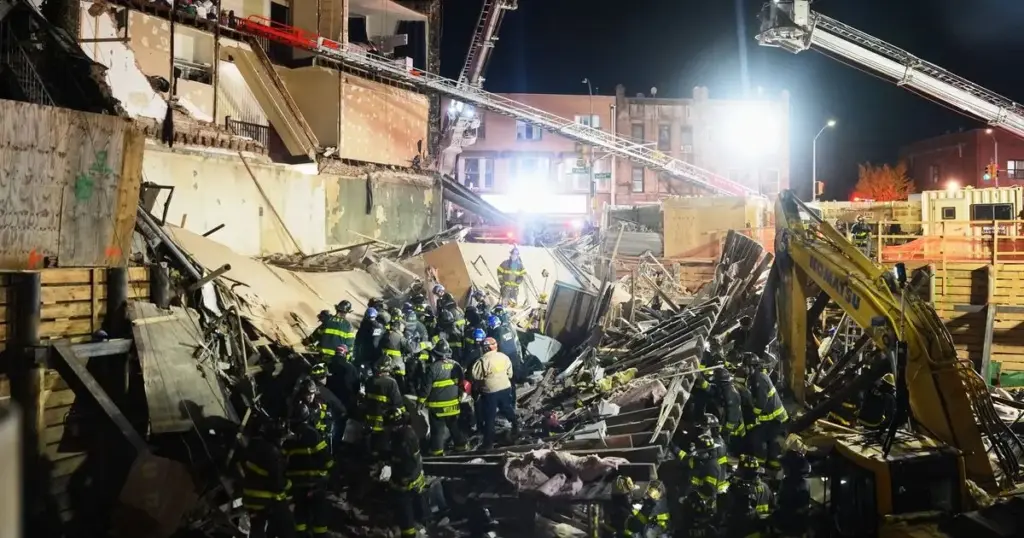
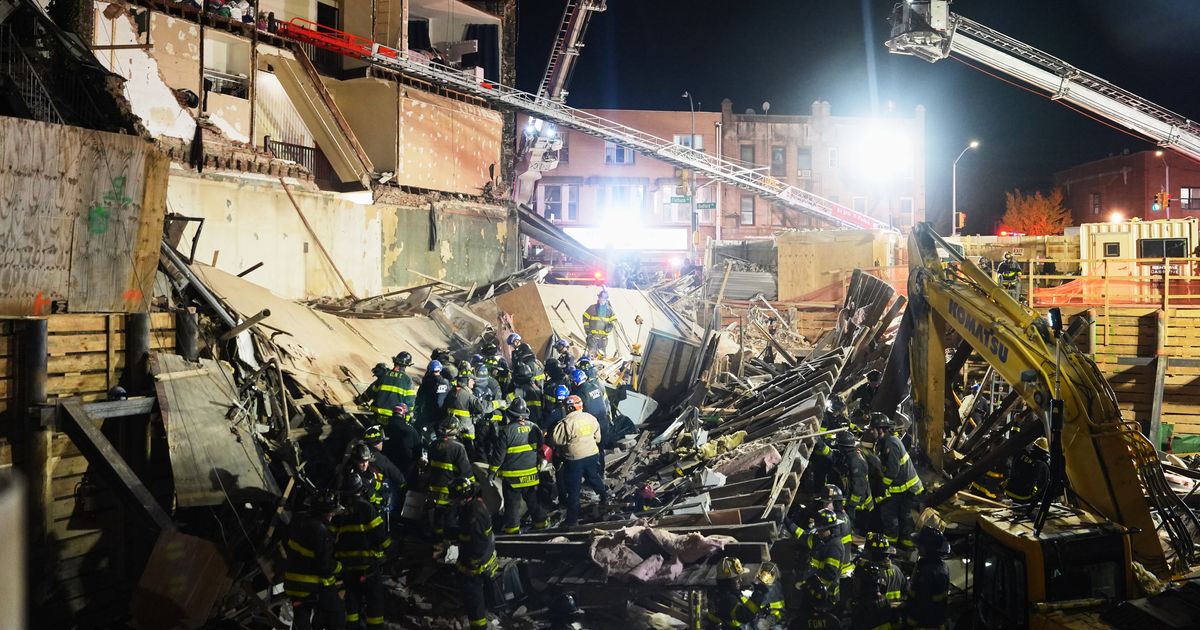
The structure at 1321 Flatbush Avenue—which housed a medical-uniforms store on the ground floor and a three-bedroom apartment directly above—had catastrophically failed, sliding into an open construction site located immediately next door at 2625 Bedford Avenue, according to Fire Department of New York officials.
While the building itself caved inward and downward into the adjacent excavation zone, its neighbor on the opposite side, 1323 Flatbush Avenue, miraculously remained standing. However, the force of the collapse cleanly peeled away the party wall shared between the two structures, laying bare an uncanny, dollhouse-like cross-section of the surviving building’s interior. The back wall of a residential closet was entirely ripped away, yet the winter jackets inside remained completely untouched and neatly lined up on their hangers, offering a surreal contrast to the devastation unfolding just feet away.
Marre Valcourt, a 49-year-old hairstylist working across the street at Maribel’s, a local salon, had been stationed in the back of the shop when the sound reverberated through the street. She stepped outside moments later to witness the unfolding horror.
"I was shaking," Valcourt said. "I see people crying, because the building is full of people."
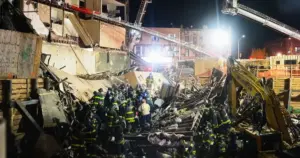
The human toll of the disaster quickly became apparent as first responders rushed to the scene. According to the NYPD, two people were confirmed dead as a result of the collapse. Four individuals sustained critical injuries, while at least 12 others suffered minor injuries. The hazardous and unstable conditions also posed a direct threat to the emergency crews attempting to rescue survivors; one firefighter was injured during the grueling rescue and stabilization operation.
In total, approximately 250 fire and emergency medical services personnel descended on the neighborhood, transforming the commercial corridor into a sprawling staging ground for rescue operations. By 7 p.m., a dense grid of emergency vehicles lined the blocks stretching from Foster Avenue well beyond Newkirk Avenue. Hundreds of local residents gathered behind thick lines of yellow police tape, watching anxiously in the gathering dusk, many holding up their phones to capture the unprecedented scene.
Shelley Nunez, a 44-year-old resident who lives nearby, recalled hearing a sudden, heavy "boom" echoing through her apartment that afternoon, quickly followed by the rising wail of sirens.
"This neighborhood has a lot of ambulances, so I didn’t think much of it," she said, explaining that she initially assumed the commotion was the result of a relatively commonplace urban incident, such as a severe car crash. "Until friends started calling and saying, ‘Hey, a building collapsed.’"
While official investigations into the exact mechanical and structural sequence of the disaster are still in their earliest stages, structural experts, neighborhood residents, and municipal records point toward an increasingly familiar and alarming culprit in New York City real estate development: excavation and foundation work on an adjacent lot.
The collapsed structure stood directly beside the open construction site at 2625 Bedford Avenue. Until recently, the lot had been occupied by a low-slung building that housed an adult-day-care service. Property records indicate that the site was acquired in 2024 for $4 million by two corporate entities, FF1632 and JS1024, linked to investors Judy Swimer and Faigy Fischman. Building permit applications filed with the city show that developers were initially approved to construct a three-story structure on the plot, but had subsequently been seeking permits to expand the ambitious scope of the project into a nine-story mixed-use building, with Robert Fischman of W6 Facility X, LLC listed as an owner on applications.
Local regulatory records reveal that the construction site had a troubled safety history prior to the collapse. In April, the contractor working on the Bedford Avenue project had been formally cited and hit with a stop-work order after inspectors found crews carrying out unauthorized demolition work while under active restrictions. Construction activities at the site had only recently resumed after the company paid a $10,000 fine to resolve the violation.
For long-term residents of the neighborhood, the disaster felt like an inevitable tragedy waiting to happen amid a relentless wave of speculative real estate development.
"Buildings are being purchased and demolished to put up new buildings, but sometimes they’re not paying attention to the types of buildings around them," said Crystal, a 30-year-old neighborhood resident. "A lot of these buildings are from way back to the Flatbush days, so you gotta be really careful."
Spence echoed that sentiment with palpable anger, calling the collapse a "cataclysmic catastrophe" that never should have taken place. She voiced strong skepticism that the building had failed due to natural structural fatigue, speculating that ongoing heavy machinery work at the adjacent property played a direct role in compromising her block.
"I don’t think it fell on its own. They had to hit something to make it fall," Spence said, adding that intense construction noise had been a constant presence on the block for months. "They’ve been doing work for months. All you hear is drrrr."
Even as the massive emergency response unfolded with flashing lights illuminating the evening sky, the daily rhythms of the neighborhood ground forward in surreal juxtaposition. Inside Maribel’s hair salon across the street, business continued as usual despite the chaos just outside the glass windows.
Milca Mondesir, a 37-year-old resident of nearby Avenue D, was sitting in a chair near the back of the salon while Valcourt styled her hair. Looking out at the blocked-off streets and emergency personnel, she reflected on the state of the neighborhood’s aging infrastructure, describing the local housing stock as "crusty," "dirty," and perpetually plagued by rodent issues.
"You’d never expect that to happen," Mondesir said, surveying the scene, "but not shocked that it did."
As municipal agencies continue their search-and-recovery operations and structural engineers evaluate the stability of surrounding properties to prevent any secondary collapses, city officials are expected to intensify scrutiny on the Bedford Avenue development site and its permitting history.
This is a developing story and has been updated. If you have any information related to this story, please email [email protected].