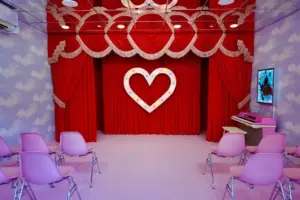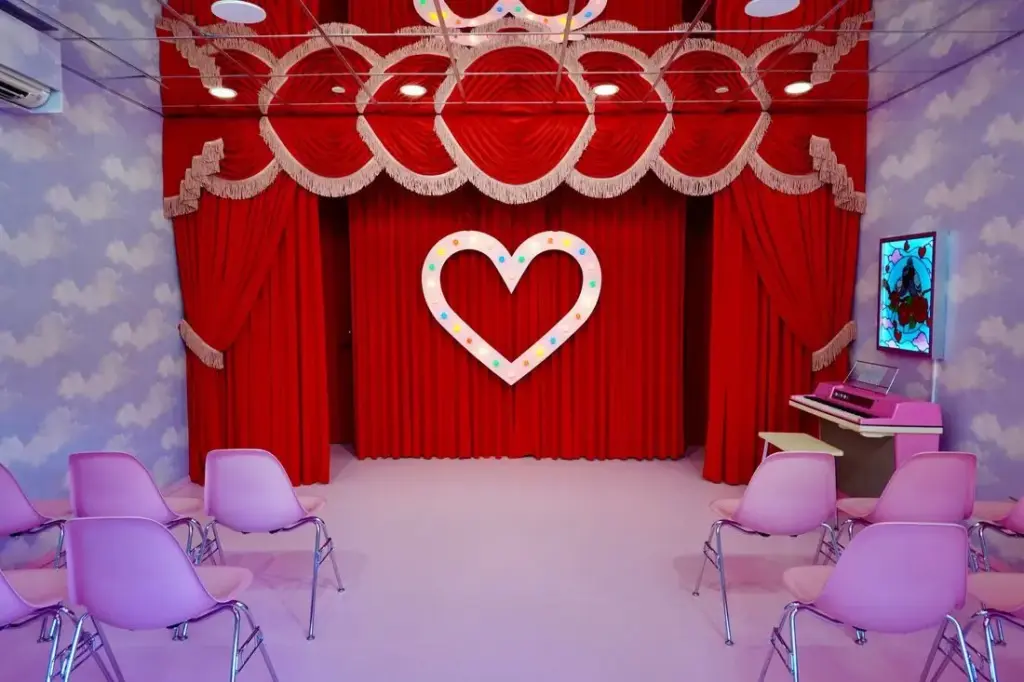
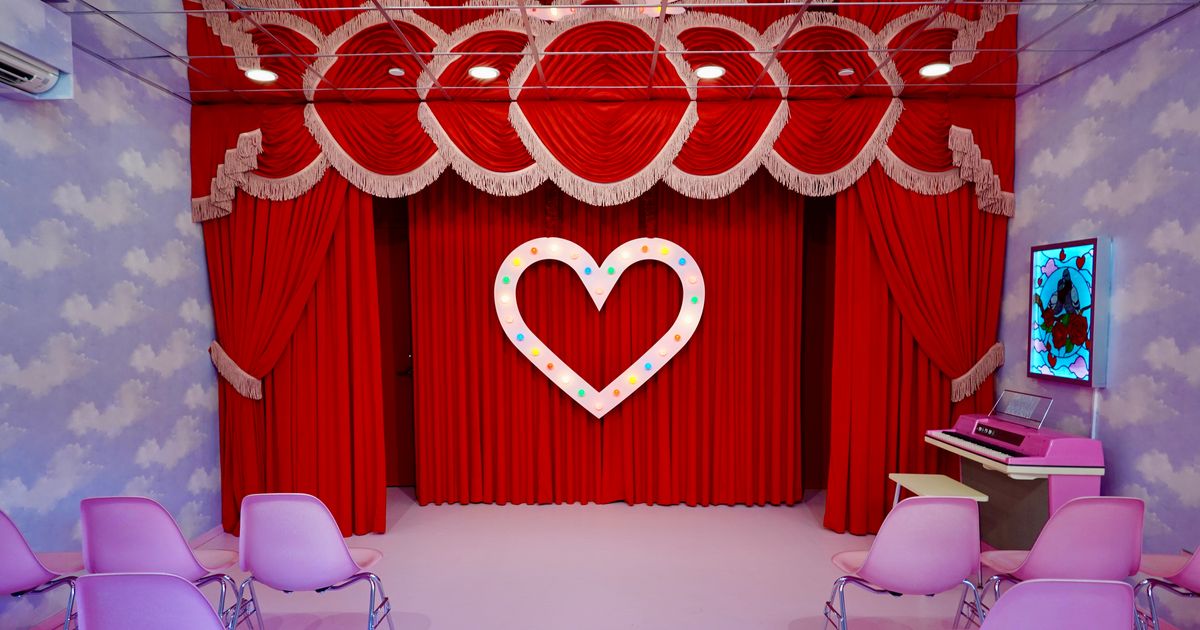
On a late-summer Sunday, the boundary-pushing filmmaker John Waters stepped inside a compact storefront on the Lower East Side that bore a striking resemblance to a stylized set from one of his own cinematic productions. Tucked neatly between a graffiti-adorned apartment door and a neighborhood menswear boutique, the 400-square-foot venue immediately immersed visitors in high-octane maximalism. The space featured a vibrant flamingo-pink facade, a bold pink-and-red floor pattern, whimsical pink fiberglass chairs, wallpaper printed with scudding clouds, and heavy red velvet drapery. Dappled spots of light danced across the interior, cast by a whirling, mirrored mobile of canoodling pigeons suspended from the ceiling.
Waters had not arrived to scout a location or direct a scene. Instead, a couple had extended a special invitation for him to preside over their wedding ceremony. This marked a high-profile moment for the newly opened New York outpost of Sure Thing, a growing enterprise known for its quickie, Las Vegas–style wedding chapels that deliberately reject traditional solemnity in favor of campy, theatrical joy.
The Anti-Millennial-Gray Ethos
Sure Thing was originally conceived by its co-founders as a loving tribute to the over-the-top, cherub-laden chapels that blossomed around the era of World War II. From its inception, the design philosophy of the business was explicitly steered away from anything resembling conservative religious conventions on one hand, and upscale, muted minimalism on the other.
Victoria Hogan, one of the co-founders, explained that the aesthetic is driven by a desire for unabashed vibrancy. She wanted everything to feel genuinely gaudy and over-the-top, pointedly avoiding the ubiquitous "millennial gray" that dominates modern design trends. Hogan’s journey into the unconventional wedding industry began after she graduated from art school. She initially built a business focused on floral design and wedding photography before taking the leap to officiate ceremonies out of a teardrop trailer stationed deep in the desert.
During one of those desert elopements, she met a bride named Amy Lee. Lee eventually transitioned into professional photography and began shooting ceremonies alongside Hogan. The creative partnership clicked, leading them to launch their first permanent chapel in Las Vegas in 2019, complete with a signature pink velvet curtain backdrop.
While an Elvis Presley impersonator is often a staple request for couples seeking the quintessential Vegas experience, Hogan noted that traditional impersonators could occasionally lean into territory that felt borderline creepy. To solve this, Hogan decided to take on the persona herself, donning a costume and creating a distinctive character she fondly dubbed "Lady Elvis."
The concept resonated deeply with the public. Business accelerated rapidly, prompting the co-founders to open a second location in Las Vegas in 2024. By the following year, the enterprise had successfully hosted a staggering 2,500 weddings. Their clientele largely mirrors the traditional demographic of classic Vegas wedding chapels: people who want to bypass the immense stress, logistical nightmares, and financial burdens of a giant traditional ceremony, or those who simply find themselves without a large local network of guests.
Hogan highlighted the profound emotional impact the chapels have had on marginalized communities, noting the frequency with which queer couples shared stories of familial disapproval and a desperate desire to find a space that felt genuinely affirming and special to them. Now, that distinct brand of alternative romance has officially traveled east to Manhattan.
A Century-Old Tradition Evolves
The historical roots of the Las Vegas Strip transforming into a global wedding capital trace back to the 1940s. During this period, the desert town was actively reinvented as a premier resort destination, coinciding with Reno establishing itself as America’s primary divorce capital. Most couples willing to endure the journey to Nevada and pay for a legal split, rather than navigating a quiet separation, often shared a common catalyst: a new partner waiting in the wings who was eager to tie the knot.
Vegas weddings experienced an exponential surge in popularity after Elvis Presley famously married there in 1967. The small independent chapels that cropped up emulated the architectural cues of traditional churches on a budget, but operated with the efficiency of factories. They churned out ceremonies at a rapid pace, catering directly to the post-war American sensibility that viewed a wedding certificate primarily as a signed piece of administrative paperwork rather than a sacred holy sacrament.
Before long, these chapels extended their hours to remain open 24 hours a day, seven days a week. They introduced convenient drive-thru windows that appealed to celebrities seeking absolute privacy, and eventually leaned entirely into the joyful irony of the spectacle. Major corporate entities eventually joined the cultural phenomenon, with brands like Taco Bell establishing operational wedding venues, and Madame Tussauds constructing a meticulous recreation of the iconic chapel from the comedy film The Hangover, allowing couples to exchange vows right beside a wax figure of actor Zach Galifianakis.
Designing for the Digital Era
Located at 122 Allen Street, the newly minted New York location is Sure Thing’s very first venue outside of Nevada. It is also their smallest footprint, meticulously engineered with the demands of digital life and social media firmly in mind. Every surface and sightline has been curated to function as an effortless photo backdrop. The cloud-patterned wallpaper provides an immediate frame for snapshots, a trick mirrored by the ornate baroque foil wallpaper lining the hallway hidden behind the main curtain.
Additional focal points include a neon-pink Wurlitzer organ crowned by a backlit stained-glass panel depicting two affectionate pigeons. The restroom pays enthusiastic homage to the distinct, saturated color palette of the film Amelie, featuring a mint-green toilet and sink set against deep burgundy penny tiles.
Lee devoted obsessive attention to the architectural lighting inside the main space, testing and tweaking until she landed on a precise tone that flatters portrait photography. The goal was to ensure the room was brightly and warmly lit while avoiding any harsh illumination that might make the venue feel sterile or clinical. Care was taken to ensure that even utilitarian elements like doorknobs and electrical outlet covers avoided standard hardware-store aesthetics that might inadvertently shatter the immersive fantasy of the space.
Design inspirations drawn upon for the interior included the 1960s baroque aesthetic of television’s I Dream of Jeannie, the dramatic red velvet textures of David Lynch films, the glittering mirrored disco ball energy of Studio 54, and the eccentric sensibilities of John Waters. To maintain the chapel’s playful local identity, rostered officiants have included Hellvis, a comedic Elvis character with a distinct gothic edge, and Tillie, a fashion-forward, genderless clown dressed in curated vintage attire.
Couples can book the chapel for a 30-minute window, allowing them to invite up to 18 guests, for a flat fee of $666. Alternatively, they have the option to double the fee to secure the space for twice the duration, accommodating a slightly larger guest list and adding a live organist to the proceedings. The durable, glossy flooring ensures that maintenance between bookings is swift, allowing staff to easily sweep away stray clusters of celebratory glitter before the next couple arrives.
From London to the Lower East Side
Even before the venue had been officially photographed or widely publicized, approximately 20 eager couples had already secured their bookings. Among them were Josh Bodley and Tegan Barr, a couple from London who claimed the very first available time slot in late August.
The couple had become engaged beneath the spire of the Empire State Building the previous December. Upon returning home to the United Kingdom, they began pricing local venues, only to discover that the most affordable traditional option available—a neighborhood pub—was quoting an astonishing £9,000.
Barr noted that the traditional route simply did not align with their personalities, nor did a conventional church wedding. Opting to bypass centuries of expensive expectations, they decided to focus entirely on the aspects of the union they actually found enjoyable.
The entire venture—covering custom outfits, hotel accommodations, international flights, and a subsequent honeymoon in Nashville—totaled around $4,000. A tight-knit group of close friends and family members flew across the Atlantic to witness the ceremony, after which the wedding party spilled out into the neighborhood to celebrate. They spent the evening buying rounds of drinks at a local bar on the Bowery, where hospitable strangers spontaneously treated them to tequila shots. Reflecting on the whirlwind experience, Barr remarked that she would happily choose to do it all over again.