Ukraine’s Office of the Prosecutor General has formally charged a high-ranking Russian military commander in absentia for orchestrating a targeted missile strike that caused devastating destruction to the Hryhoriy Skovoroda National Literary Memorial Museum in the Kharkiv region during the spring of 2022. The legal action marks another significant step by Ukrainian authorities to hold individual Russian military leaders accountable for war crimes and the systematic devastation of the country’s cultural heritage.
According to investigative findings published by The Kyiv Independent, the accused Russian lieutenant general is originally from the village of Chuhuiv, located within Ukraine’s embattled Kharkiv Oblast. In his current capacity within the Russian military structure, he commands the 6th Guards Air and Air Defense Forces Army, a formation that has played an active role in conducting air operations over Ukrainian territory since the launch of the full-scale invasion.
The charges center on the deliberate targeting of a civilian cultural landmark devoid of any military significance. In a public statement detailing the legal proceedings against the commander, the Ukrainian prosecutor general emphasized the deliberate nature of the assault.
"The general knew for certain that he was attacking not a military target but a monument of Ukrainian culture," the prosecutor general wrote in the official indictment details. "Despite this, he gave the combat order to destroy it."
The Hryhoriy Skovoroda National Literary Memorial Museum held profound historical, philosophical, and architectural value for Ukraine. The institution was dedicated to Hryhoriy Skovoroda, a celebrated 18th-century philosopher whose teachings and lifestyle were deeply steeped in the Socratic method, humanism, and a profound love of nature and independent thought. The museum itself was housed in the historic estate located in the village of Skovorodynivka where Skovoroda spent the final years of his life, wrote many of his influential works, and ultimately passed away in 1794.
For generations, the estate served as a vibrant pilgrimage site for scholars, philosophers, and admirers of Ukrainian literature from around the world. The physical structure of the museum embodied centuries of regional history, housing rare manuscripts, personal belongings, and artifacts documenting the philosopher’s lasting impact on European and Ukrainian intellectual thought.
The destruction of the Skovorodynivka estate occurred during the intense opening months of the Russian military’s push into eastern Ukraine, when numerous towns and villages across the Kharkiv region were subjected to relentless shelling, airstrikes, and artillery barrages. The museum was one of a catastrophic number of cultural institutions, historic buildings, libraries, and architectural monuments damaged or entirely reduced to rubble during the prolonged siege and subsequent military campaigns across various regions of Ukraine.
Following the devastating strike in May 2022, cultural publications and international news outlets documented the immediate international outcry. As ARTnews reported in a comprehensive roundup of embattled cultural and heritage sites throughout the country, Ukrainian President Volodymyr Zelensky addressed the destruction directly in a national address, expressing profound grief and outrage over the loss.
"Last night, the Russian army deployed one of its missiles to destroy the Hryhorii Skovoroda Museum in Kharkiv Region," President Zelensky said in the wake of the 2022 attack. "A missile—to destroy a museum."
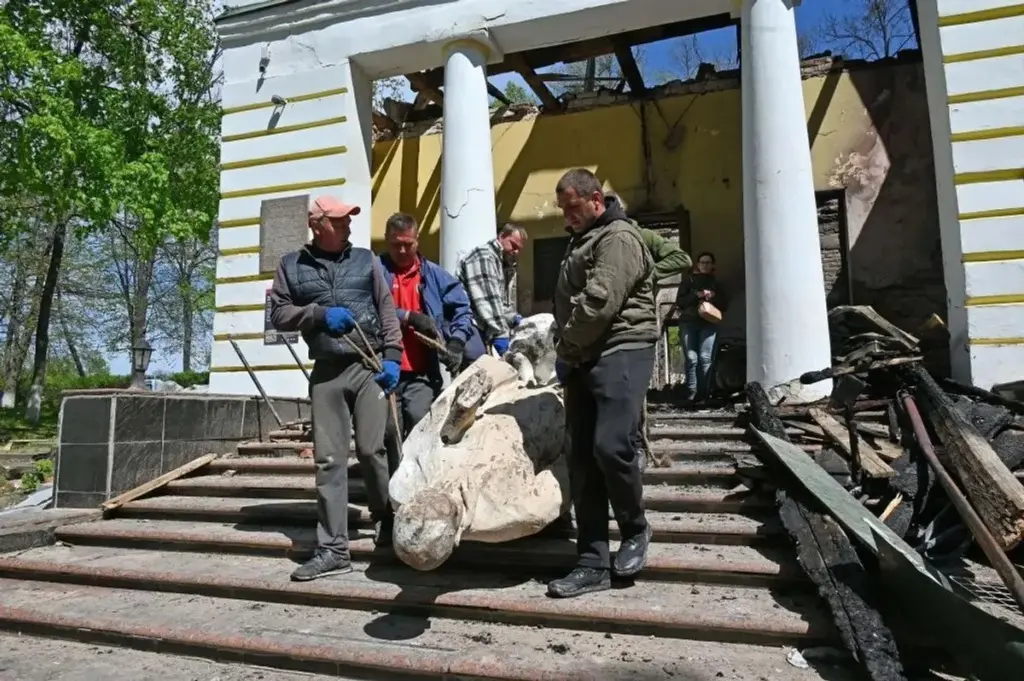
The missile impact triggered a massive fire that gutted the historic wooden and stone structures of the estate, obliterating irreplaceable collections that had been carefully curated and preserved. Fortunately, museum staff had proactively moved some of the most valuable portable artifacts to a secure location prior to the direct hit, but the architectural integrity of the historic estate and several permanent exhibits were completely lost to the flames and concussive force of the explosion.
Legal experts and human rights monitors note that the deliberate targeting of cultural heritage sites during armed conflict constitutes a serious violation of international humanitarian law, specifically protected under the 1954 Hague Convention for the Protection of Cultural Property in the Event of Armed Conflict, as well as additional protocols to the Geneva Conventions. By filing charges in absentia, Ukrainian prosecutors are laying the legal groundwork for future international tribunals and establishing an official judicial record of the individual commanders responsible for executing orders that resulted in widespread cultural devastation.
The case against the Russian lieutenant general highlights a broader, systematic pattern of destruction directed against civilian infrastructure and historical landmarks across Ukraine. According to comprehensive data collected and regularly updated by Ukraine’s Ministry of Culture, the assault on the Skovoroda museum was far from an isolated incident.
As The Kyiv Independent reported, citing official ministerial figures, Russia has repeatedly and extensively targeted Ukraine’s rich cultural heritage since the start of the full-scale war. As of September 2026, statistical monitoring by the Culture Ministry indicates that an astounding 2,161 cultural heritage sites and 2,665 cultural institutions across various Ukrainian oblasts have sustained varying degrees of damage or been entirely destroyed by military action.
These figures encompass a vast array of irreplaceable institutions, including regional art galleries, historical archives, local history museums, theaters, architectural monuments of national significance, and sacred religious structures representing centuries of diverse cultural expression. The ongoing documentation efforts led by Ukrainian cultural authorities, working in cooperation with international heritage organizations and investigative journalists, continue to track the losses in real-time, compiling forensic evidence, satellite imagery, and witness testimonies to ensure that commanders who issue orders to destroy civilian and cultural assets can eventually face accountability in courts of law.