The study, which was recently published in the prestigious scientific journal Nature, was spearheaded by a collaborative international team of physicists. The project was co-led by Professors Changgan Zeng and Guanghui Cheng of the University of Science and Technology of China, operating under the auspices of the Chinese Academy of Sciences. Their vital theoretical and experimental collaboration also featured prominent contributions from Professor Qingdong Jiang of Shanghai Jiao Tong University and Nobel laureate Professor Frank Wilczek of the Massachusetts Institute of Technology, alongside other esteemed researchers.
Empty Space Is Not Truly Empty
In the vernacular of everyday life, a vacuum is understood as a complete void—an empty space devoid of matter, energy, and activity. However, the foundational principles of quantum physics paint a starkly different, far more dynamic picture of the universe at its most fundamental level.
According to the tenets of quantum electrodynamics and the Heisenberg uncertainty principle, even the absolute lowest energy state of a system can never be entirely still. Instead, virtual particles continually flicker into existence and disappear almost instantaneously, generating an ever-present, pervasive background hum of quantum fluctuations.
Far from being mere theoretical abstractions with no real-world consequences, these fluctuations produce measurable physical effects that have been well-documented for decades. Their subtle yet profound influence has been observed through classic phenomena such as the Lamb shift in atomic energy levels, spontaneous emission in quantum optics, and the Casimir effect, which describes the attractive or repulsive force operating between closely spaced conducting plates in a vacuum.
For several years, the research teams led by Professors Zeng and Cheng have dedicated themselves to investigating how these relentless vacuum fluctuations might interact with and influence condensed matter systems. In a previous study, the researchers successfully demonstrated that they could directly manipulate vacuum fluctuations by deploying a magnetic field to reversibly switch the Casimir force between attractive and repulsive states.
That groundbreaking result naturally generated a much broader, more ambitious question within the physics community: Could quantum vacuum fluctuations also be systematically deployed to control macroscopic quantum states of matter?
Turning the Vacuum Into a Control Tool
While the experimental teams in China worked on manipulating electromagnetic boundaries, Professor Jiang’s group approached the overarching problem from a distinct theoretical perspective. They studied how engineered quantum vacuum environments could be designed to influence and alter different states of matter.
Through this theoretical work, the researchers introduced the visionary concept of "vacuumronics," a burgeoning field in which specially engineered vacuum environments are utilized to control electronic and photonic behavior. This theoretical foundation provided the crucial framework necessary for understanding the unexpected superconductivity enhancements observed during the subsequent physical experiments.
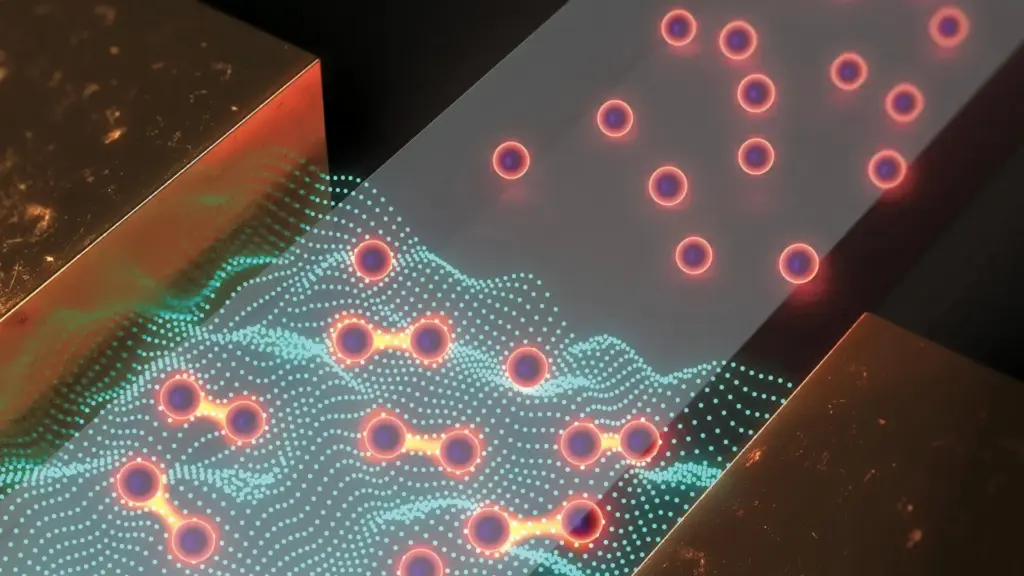
"Vacuum fluctuations in free space are generally too weak to produce observable effects in macroscopic condensed-matter systems," Professor Zeng explained, addressing the primary hurdle that has historically faced researchers in this field. "To overcome this limitation, we introduced a terahertz split-ring resonator. Such a dark cavity can reshape the electromagnetic environment and substantially amplify vacuum fluctuations."
To test this hypothesis empirically, the researchers placed a sample of the superconducting material niobium diselenide ($textNbSe_2$) directly inside the terahertz dark cavity. This intricate procedure established a strongly coupled system in which the superconducting material actively interacted with the specially tailored electromagnetic environment confined within the cavity walls.
The research team then meticulously compared the material’s superconducting behavior when positioned inside the cavity versus outside of it. The results were striking: placing the $textNbSe_2$ device inside the cavity led to a significant, measurable increase in its superconducting critical temperature, which defines the precise thermal threshold below which the material enters its zero-resistance superconducting state.
Superconductivity Gets Stronger
"We observed that the critical temperature can increase by up to 5.4% in a six-layer $textNbSe_2$ device, while the critical current and critical magnetic field are significantly enhanced near the superconducting transition," Professor Cheng noted, detailing the physical measurements that confirmed the team’s suspicions. "This represents the first experimental observation of vacuum-fluctuation-enhanced superconductivity."
To ensure the validity of their findings, the research team conducted an exhaustive series of control experiments designed to rule out alternative explanations. They systematically varied multiple parameters of the experimental setup, including the cavity geometry, characteristic frequency, material thicknesses, dielectric materials, and metallic strips used in the assembly.
The consistency of the data allowed the physicists to definitively rule out conventional explanations involving mechanical strain, material degradation, structural inhomogeneity, and standard metallic screening effects. One of the most compelling pieces of evidence emerged from examining the precise relationship between the observed enhancement in superconductivity and the characteristic frequency of the dark cavity. Rather than changing in a smooth, continuous manner, the enhancement exhibited a distinct resonance-like peak centered at a very specific frequency.
"This result, closely tied to the cavity’s photonic properties, provides strong experimental evidence of the coupling between the superconducting state and dark-cavity modes," Professor Zeng emphasized.
Virtual Photons May Explain the Effect
To decode the underlying mechanisms driving these observations, Jiang’s theoretical team, alongside Professor Wilczek, developed a robust theoretical model rooted in the established Ginzburg-Landau framework of superconductivity.
Their interpretation suggests that the macroscopic superconducting state engages in an active exchange of virtual photons with the engineered dark cavity. This quantum interaction effectively lowers the ground-state energy of the superconducting phase, rendering the superconductivity more stable and structurally robust.
"When the characteristic energy of the cavity mode matched the low-energy superconducting fluctuations, the $textNbSe_2$ device exhibited resonant enhancement, producing the peak in superconductivity enhancement," Professor Jiang explained.
This discovery fundamentally shifts how physicists view the vacuum. Rather than functioning purely as an empty, passive backdrop against which physical laws unfold, the quantum vacuum can be actively engineered to directly influence the physical properties and behavioral traits of matter.
"In most practical physics, the vacuum serves merely as the passive stage on which phenomena play out," Professor Wilczek observed. "This work shows that the background itself can become an actor—engineered to strengthen superconductivity and reshape the behavior of quantum matter."
A New Way To Control Quantum Matter
Crucially, this innovative approach succeeds in strengthening superconductivity without requiring the material to be directly driven by an external energy source, such as intense laser illumination or high-voltage electrical currents. Instead, by reshaping the surrounding vacuum environment, the researchers have established a noncontact, indirect method for tuning a quantum state of matter.
This development could eventually pave the way for engineered vacuum fluctuations to become a versatile, standard control mechanism for managing superconductors and other advanced quantum materials.
"With further optimization of cavity structures and material systems, vacuum-fluctuation coupling may enable more pronounced and widely applicable control of quantum states," Professor Zeng concluded.