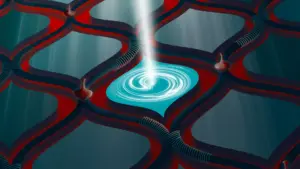
Scientists have officially pushed X-ray generation beyond a fundamental, long-accepted limit in laser physics, unearthing a surprising quantum effect that completely bypasses the constraints of conventional theory. By directing immensely powerful ultraviolet lasers at helium atoms, an international research team successfully produced X-rays carrying substantially higher energies than what standard physics models dictate. This landmark breakthrough relies fundamentally on an unusual, highly coordinated interaction between two electrons, which enables them to release their combined energy simultaneously rather than acting as independent particles.
The discovery is the result of a close collaborative effort between researchers at TU Wien and the University of California San Diego. It builds directly upon a rich legacy of foundational research that helped establish the modern field of attosecond physics. In fact, the advanced laser techniques that made this latest experiment possible were originally developed at TU Wien back in the 1990s—pioneering work that ultimately contributed to achievements recognized globally by the 2023 Nobel Prize in Physics.
For decades, the scientific community has understood a fundamental rule of laser-matter interaction: directing intense laser light at certain atoms can induce them to emit extremely short bursts of much higher-frequency light, a spectrum that includes powerful X-rays. However, established theoretical frameworks have long predicted a strict maximum energy limit for these emissions, a threshold calculated directly from the inherent properties of the incoming laser beam. Beyond this strict boundary—widely known in the physics community as the energy cutoff—the production of X-rays drops off sharply, becoming exceedingly weak and virtually unusable for advanced applications.
The newly published experiment demonstrates conclusively that this familiar boundary can be decisively exceeded when multiple electrons within an atom interact in a specific, highly synchronized manner. The findings detailing this unexpected quantum phenomenon have been published in the prestigious scientific journal Nature Photonics, opening up entirely new avenues for exploring the subatomic realm.
How Lasers Generate Powerful X-Ray Pulses
To understand the significance of this new boundary-breaking experiment, physicists point to the well-established mechanics governing traditional high-harmonic generation.
"The mechanism behind short X-ray pulses has been well known for a long time," explains Prof. Tenio Popmintchev from the Institute of Photonics at TU Wien. "The laser tears a single electron away from the atom. The electron is then accelerated in the laser’s electric field until it eventually collides with the atom again. The energy it loses in the process is emitted in the form of light."
During this intricate physical process, the intense oscillating electric field of the laser drives the newly freed electron completely away from its parent atom before turning around and propelling it swiftly back. When the returning electron slams back into the atom and abruptly releases its accumulated kinetic energy, it generates brilliant flashes of light at frequencies vastly higher than those found in the original, incoming laser beam.
Nobel laureate Ferenc Krausz famously utilized this exact mechanism in his pioneering, ground-breaking experiments during the 1990s. Today, Tenio Popmintchev and his dedicated colleagues conduct their research at the very same TU Wien institute where Krausz carried out his earlier work. Yet, while sharing the same academic lineage, their latest experiment has successfully pushed the process far beyond its previously accepted theoretical boundaries.
"It can be shown that when the electron returns to its atom, it generates a whole range of different frequencies with roughly equal intensity," notes Dimitar Popmintchev, a postdoctoral researcher working within Tenio Popmintchev’s team at TU Wien. "But there is an upper limit. Frequencies above this limit are much weaker; it is simply not possible to exceed a certain maximum frequency."
That long-standing prediction accurately describes the conventional, textbook process involving a single active electron. Eager to push the boundaries of current understanding, the research team set out to investigate whether the ultimate outcome would fundamentally change if two electrons participated actively in the interaction instead of just one.
Two Electrons Break the Expected X-Ray Energy Limit
To test this hypothesis experimentally, the research team deployed intense ultraviolet laser pulses, directing them with extreme precision to interact with helium atoms. Unlike the traditional process, which typically involves freeing a single outer electron, the experimental setup was designed to allow both of helium’s electrons to be stripped away in rapid succession.
The first electron was systematically released and accelerated by the powerful surrounding laser field, closely followed by the liberation of the second electron. Although these two particles were freed at slightly different moments in time, their subsequent physical behavior remained intrinsically connected through complex quantum correlations. This fundamental relationship meant that their chaotic motions could no longer be treated as entirely independent events by the observing scientists.
By carefully and meticulously controlling the characteristics of the ultraviolet driving laser pulses, the researchers successfully orchestrated the trajectories so that both electrons returned to the parent atom at precisely the exact same time.
"Using UV driving pulses, we can arrange for both electrons to return to the atom at exactly the same time," explains Dimitar Popmintchev. "The energy of two electrons is then released all at once. And when more energy is available, a single higher-energy X-ray photon with higher frequency can also be generated."
This remarkable, highly coordinated release of energy makes it entirely possible to produce X-ray photons that comfortably exceed the conventional energy cutoff that has restricted physicists for decades. Rather than relying solely on the kinetic energy delivered by a single returning electron, the newly discovered process successfully draws upon the combined, pooled energy of two interacting quantum particles acting in unison.
An Unexpected X-Ray Signal Confirms the Discovery
The research team quickly found clear, undeniable experimental evidence confirming that this novel two-electron process was indeed generating unusually energetic X-rays.
When the scientists closely examined the complete spectrum of the emitted coherent radiation, they identified a distinct, secondary region of sustained emission occurring at much higher photon energies than standard theoretical models could possibly predict. This additional spectral region, which functions similarly to a secondary plateau, was weaker than the primary emission peak observed in traditional setups, but it extended remarkably well beyond the previously established energy boundaries.
Crucially, this unexpected signal only appeared when the researchers used helium gas in their apparatus. Similar control experiments involving heavier noble gases such as argon and neon failed to produce the same dramatic behavior in their respective outer electron shells under identical experimental conditions.
This distinct difference provides vital, conclusive evidence supporting the researchers’ proposed physical explanation. Helium possesses particularly strong, clean correlations between its two solitary electrons, allowing them to interact in precise ways that make the simultaneous, cooperative release of energy physically possible. The outer electrons of argon and neon, by contrast, did not demonstrate this exact cooperative effect under the specific parameters of the experiment.
A New Window Into Quantum Physics
Beyond simply generating higher-energy X-rays in a laboratory setting, this major discovery could ultimately provide scientists with a powerful, unprecedented new way to investigate deeply how electrons interact with one another inside atoms, molecules, and complex condensed matter systems.
The unusual coherent X-ray emission discovered by the team could potentially serve as an exceptionally sensitive spectroscopic "sensor" dedicated to mapping electron-electron correlations. By carefully studying the exact shape of the emitted radiation spectrum, its maximum achievable energy cutoff, and the ways in which these features shift in response to changes in the polarization of the driving laser light, researchers hope to gain profound new insights into the microscopic behavior of interacting electrons on extraordinarily short timescales.
These fundamental interactions take place over the span of attoseconds, with a single attosecond measuring out to an infinitesimal one billionth of a billionth of a second. Observing and understanding physical processes occurring at such unfathomable speeds is absolutely essential for modern physicists striving to comprehend how electrons move, correlate, and influence one another within complex quantum systems.
Over the long term, the fundamental principle demonstrated in this experiment might eventually be extended far beyond individual helium atoms, reaching into complex molecules and solid-state materials where electrons experience exceptionally strong mutual interactions.
The underlying laser technique driving this discovery—known broadly as high-harmonic generation—originally helped make the entire field of attosecond physics possible. Now, decades later, researchers are finding that the exact same technique can also reveal the intricate, hidden behaviors of multiple interacting quantum particles. These fresh insights could eventually contribute meaningfully to ongoing research in quantum computing, while also helping scientists better understand and engineer advanced nanomaterials equipped with carefully controlled electronic properties.