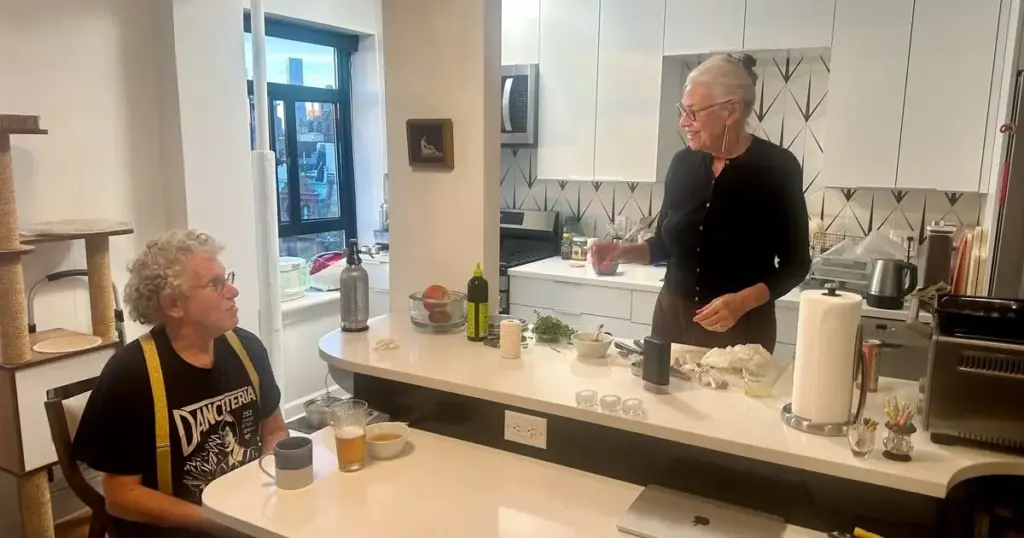
On a typical morning in Brooklyn Heights, Sarah Crichton wakes up at precisely 6:30 a.m. and heads out the door for a long, brisk walk through the historic neighborhood. She leaves her husband, Len Berman, snoozing peacefully upstairs. When she returns from her stroll, she checks in on Len in the bedroom before heading down one flight of stairs to her own apartment, where she begins the morning routine by brewing coffee for two. A short while later, Len wanders down to her place to join her, carrying with him the expectation of their morning round of cards.
The couple, both divorcees in their seventies who originally met on OkCupid in January 2020, maintain a distinct yet deeply integrated domestic setup: they live in separate apartments within the same Brooklyn Heights co-op building. Len owns unit 8J on the eighth floor, while Sarah’s home, unit 7G, is located precisely one floor below.
Their unusual living arrangement is the product of a gradual evolution rather than an initial blueprint. When they first met six years ago, Sarah was living alone in a spacious Boerum Hill brownstone, while Len was subletting a place on the Upper West Side while waiting for his new Brooklyn Heights apartment to undergo a lengthy renovation. When New York City went into full lockdown shortly after they connected, Len moved in with Sarah so they could continue seeing each other during the unprecedented public health crisis.
As their relationship progressed, however, the practicalities of sharing Sarah’s space began to show strain. Len never quite felt at home there, a feeling compounded by the history of the space. As Sarah recalls, her ex-husband had lived in the brownstone, making the environment subtly uncomfortable for a new relationship.
It took two years in total to renovate Len’s apartment, a property he purchased following the conclusion of a 35-year marriage. When he finally moved into his newly designed home in the spring of 2022, he was, by all accounts, intensely excited. Len, a retired IBM research scientist, began spending his days at his own place and staying there overnight. Yet, the physical separation tested their bond; the couple quickly realized how much they missed each other’s constant company, prompting Sarah to begin staying over at Len’s apartment with increasing frequency.
That autumn, they tied the knot, and Sarah began living in Len’s eighth-floor unit nearly full time. While his one-bedroom co-op was perhaps a quarter the size of Sarah’s former brownstone, the romance of the moment carried them through. Sarah describes it as feeling like a cute little aerie where they were deeply in love and happy.
Soon enough, though, the pendulum swung back. It was Sarah’s turn to feel a quiet sense of displacement. The apartment reflected Len so powerfully, serving as the domain of someone who intensely loves his specific interests and had never before enjoyed an apartment of his own to fully express himself. But it did not reflect Sarah.
The first time she laid eyes on Len’s newly renovated home, she recalls it looking very much like the living space of a mathematician. It featured an array of geometric shapes, and the walls served as a literal reflection of his structured, analytical mind—a feature she initially found charming. Len himself acknowledges the aesthetic, noting that his home is filled with geometric elements and possesses an orderly character, though he quickly adds the caveat that the more intensely it becomes his own, the messier it tends to get.
A tour of Len’s eighth-floor apartment reveals an eclectic visual landscape. With its stark white walls, endless expanses of tile, industrial shelving, and heavy-duty storage units ordered directly from the Uline commercial catalogue, the space resembles a cross between a contemporary art gallery and a Costco warehouse. The rooms are lined with wire grid-wall panels typically utilized in retail merchandising for displaying merchandise. Len notes that the system theoretically allows you to move things around effortlessly, though he admits he has never actually moved a thing since installing it.
Among the eclectic items on display across the apartment are a Mad Hatter top hat, a series of small cartoonish paintings, festive Christmas lights, a fly swatter, bungee cords, retractable tape measures, exercise bands, sunglasses, and a large sack of dog biscuits kept perpetually on hand in case a neighborhood dog drops by for a visit. Len’s furniture choices tend toward the strictly ad hoc; his primary workspace consists of a used slab of countertop laid across a pair of aging filing cabinets. Alongside it sits a stainless-steel restaurant utility cart holding a dust buster, an industrial kitchen mixer, and a bucket filled with vintage Altoids containers.
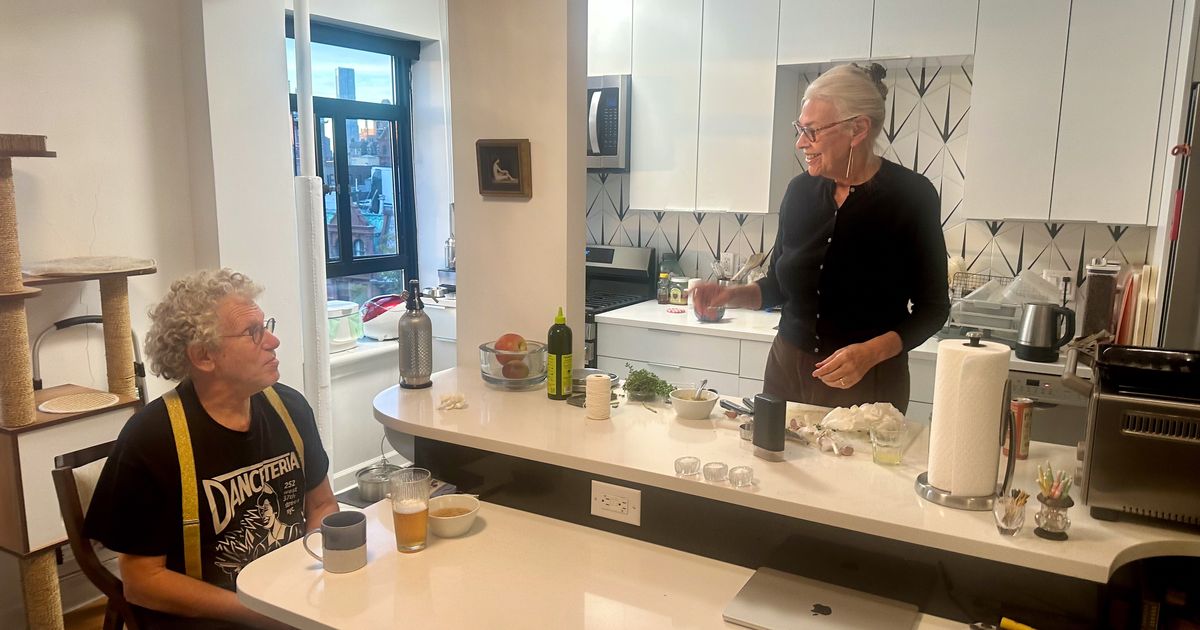
Sarah’s aesthetic sensibilities, by contrast, lean decidedly more traditional. As a book editor, she is naturally drawn to warm color palettes, Central Asian patterned rugs, sleek cherrywood cabinetry, and mid-century modern furniture—what she neatly summarizes as "classic New York." Her living space maintains a significantly lower level of clutter.
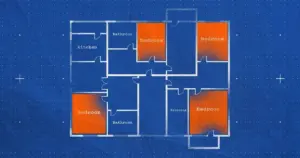
To resolve the tension between their differing domestic styles and give each other room to breathe, the couple initially considered purchasing a larger two-bedroom apartment together or renting a separate studio that Sarah could use exclusively as an office space. But approximately six months after they were married, while browsing real estate listings on StreetEasy, Sarah spotted an open house scheduled for noon at an apartment directly downstairs from Len’s.
They had not yet settled on a definitive plan, but upon walking into unit 7G, Sarah whispered to Len that she wanted it. They bought the apartment that very afternoon.
Because their co-op building is encumbered by an unpredictable land-lease situation, the units sell for roughly half the typical market cost for Brooklyn Heights. Consequently, buying and maintaining the two separate units together costs them less than what they would realistically pay for a standard two-bedroom co-op in the immediate neighborhood.
For a married couple maintaining separate residences, Sarah and Len spend a remarkably high volume of time together. After their morning ritual of coffee and cards in Sarah’s apartment, Len heads back upstairs to work on a science fiction novel he has been writing, while Sarah settles into her own bedroom downstairs, which she has converted into a home office. Her office features a fold-out sofa rather than a permanent bed, ensuring that whenever the couple hosts overnight guests, visitors stay comfortably in Sarah’s apartment.
Around noon, Sarah heads back upstairs to Len’s unit, often remaining there for the duration of the day. She sets up her laptop at the dining table while he works at his desk. As Sarah simply puts it, they get lonely apart. Len echoes the sentiment, noting that he genuinely likes having her around. If she stayed downstairs and failed to come up to make lunch, he admits he would likely just wander down to find her.
Because they routinely eat both lunch and dinner together at Len’s apartment, that is where they keep the bulk of their everyday food supplies, stashing any overflow in Sarah’s kitchen downstairs. And because Sarah’s more formal home features a long dining table and a full array of large pots and roasting pans, they rely on her apartment for major entertaining, including hosting a Thanksgiving dinner for 16 people.
Logistics can occasionally require adaptation. They frequently find themselves carrying pots of food up and down the stairs because the two kitchens are equipped differently. Sarah eventually insisted on getting a Cuisinart food processor for Len’s apartment because she simply could not live without one.
Following dinner and another round of cards, Sarah typically likes to read and watch television in Len’s bedroom before turning in early. They always sleep together in Len’s bed. Len, however, stays up late working at his desk, maintaining a strict boundary against television in the bedroom. If they watch a movie together, they do it downstairs in Sarah’s office space.
The couple typically takes the stairs rather than waiting for the elevator unless they are hauling heavy loads, and they operate under a policy of not knocking before entering each other’s domains. To streamline access, they installed identical locks on both front doors so that a single key opens both units. Len notes that he wanted to avoid carrying two keys, and since Sarah is perpetually misplacing hers, managing a single key was complicated enough.
Each maintains independent bank accounts and pays the mortgage and monthly maintenance for their respective home. However, they split the cost of groceries and share a weekly housekeeper who cleans both apartments, managing these shared expenses through a joint account. Laundry duties are divided pragmatically: Sarah sorts and starts the loads in the building’s basement laundry room, while Len, who considers himself superior at folding, handles the rest of the chore.
This routine has defined their lives for two years. When friends and acquaintances learn of their upstairs-downstairs arrangement, the reaction is rarely one of surprise or skepticism. Instead, Sarah notes that people routinely declare it the most ideal living situation imaginable. Len agrees, emphasizing that the arrangement allows them both to express their individual personalities without inadvertently oppressing the other.
To guard against the obvious risk that separate spaces might eventually foster entirely separate lives, they established one firm rule early in their marriage: they never sleep apart. The concept was tested only once during a minor squabble while staying at a vacation rental in Cape Cod. Len put his foot down immediately, establishing that sleeping separately was not an option. Sarah characterizes separate sleeping arrangements as a crime against the marriage and the relationship itself.
At the same time, they acknowledge the emotional utility of having an escape hatch. When everyday friction occurs, having the ability to retreat downstairs provides a vital release valve. Sarah notes that when someone is upset, they often seek comfort from familiar objects in their immediate environment, and while Len’s apartment does not yet feature many of her personal belongings, it does feature Len and their cat.
That dynamic is slowly shifting as well. Despite their initial commitment to maintaining completely separate identities, Sarah’s domestic sensibilities are gradually encroaching on Len’s territory. She successfully advocated for a television to be installed in the bedroom, lined the hallway with her favorite books, and hung a poster of her late mother featuring Che Guevara in the entryway. When Len recently proposed installing additional industrial wire grid over his living room sofa, Sarah firmly drew the line. "Enough with the grid!" she told him.
She is currently hoping they can find a suitable oversized painting to anchor the space above the couch. Len, characteristically, has alternative technological ambitions for the blank wall, suggesting they use a tripod and a projector to watch movies instead.
As their domestic negotiation continues, neighborhood options occasionally catch their eye. Notably, apartment 8G down the hall is currently listed for sale.