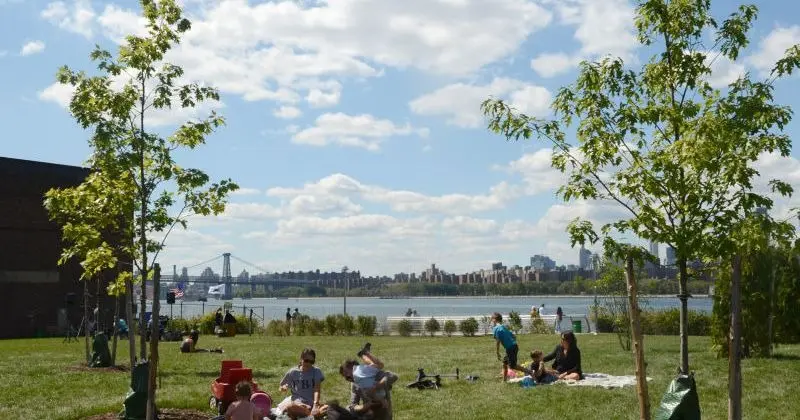
The controversial, large-scale restaurant-and-marina project slated for Greenpoint’s intimate WNYC Transmitter Park has officially been scrapped. First announced in July, the sweeping proposal was met with an immediate and vocal wave of neighborhood opposition that culminated in a decisive community-board meeting, bringing an end to a high-stakes local battle over the future of the waterfront park.
The turnaround came after members of a local subcommittee overseeing waterfront parks for Brooklyn Community Board 1, alongside park volunteers and city park officials, convened to reevaluate the direction of the concession. Their decision was heavily influenced by grassroots pushback, including a community petition warning that the commercial development was entirely too large for the modest park space. The petition quickly gathered 500 signatures from concerned residents, signaling deep-seated local resistance to transforming the neighborhood green space into a commercial hub.
Under a revised resolution discussed during the meeting, the New York City Department of Parks & Recreation will pivot away from the massive marina concept. Instead, the agency will pursue a separate path to address a critical, long-standing need within the park: the installation of a public restroom. City officials may seek out a more modest concessionaire who can incorporate a much smaller, neighborhood-friendly restroom facility into whatever amenity they ultimately operate on-site.
The Financial Burden of a Historic Renovation
From the outset, the rejected plan proved deeply unpopular largely due to its immense scale. That massive footprint was not chosen at random; rather, it was a direct response to a rigid requirement imposed by the Parks Department. Any winning operator bidding on the concession was required to fully renovate the historic 1937 building—the former WNYC radio-broadcasting center that originally gave the park its name.
The structure, which has remained closed for decades and suffers from severe water damage and structural neglect, carries a staggering price tag. According to estimates cited by a local city council member, the city projected that rehabbing the decaying broadcasting station would cost roughly $5 million. The prohibitive cost caused at least one local business to review the numbers and abandon its pursuit of the project.
The proposal that ultimately won the city’s initial favor managed to make the economics work, reportedly relying on docking fees and lucrative party rentals to offset the massive capital investment. However, the proposal faced heavy criticism for being vague on critical details and failing to provide a firm, binding commitment to complete the required building restoration.
Rethinking the Future of the WNYC Building
Under the newly discussed resolution, if the amendment passes, the mandate requiring a full-scale renovation of the historic building will be dropped. That shift is expected to spark a new debate, particularly among historic preservationists. While the ultimate fate of the decaying 1937 structure remains uncertain, the decision ensures that a future private concessionaire will no longer bear the multimillion-dollar cost of remodeling it.
Elissa Iberti, chair of the advocacy group Friends of WNYC Transmitter Park, acknowledged that the compromise may not satisfy everyone. "I don’t think everyone is going to be happy," Iberti said. "But in the end, we’re focusing on what the park needs, and for me, that was not the focus of the plan that came forward."
For community advocates like Iberti, the priorities for Transmitter Park are practical rather than commercial. The park desperately needs functional amenities, such as a public bathroom and a secure storage shed for garden equipment. What it does not need, in the view of local stakeholders, is to be converted into a high-capacity wedding venue or a bustling port-of-call for tourists arriving on sunset cruises.
A Surprising Concession Pivot
During the pivotal subcommittee meeting, stakeholders negotiated the terms of the revised resolution, agreeing to replace the full building renovation requirement with a much lighter obligation: the installation of a plaque or some other commemorative monument honoring the site’s rich broadcasting history.
In a surprising twist regarding the fate of the rejected operator’s contract, Iberti noted that a Parks Department employee focusing on concessions revealed that the agreement had never actually been signed. With the controversial mega-proposal officially off the table, the city is now looking at alternative avenues to finally deliver a public bathroom to the park. Speculation has even turned toward whether Transmitter Park might eventually host one of the city’s newer standalone public restroom initiatives.
Reflecting on the unexpected outcome, Iberti expressed a mix of relief and astonishment at the city’s willingness to reverse course after weeks of intense neighborhood pushback. "I will be completely honest," she said. "I did not think Parks would come back and listen. I think this is sort of unheard of."