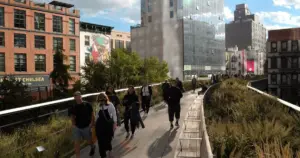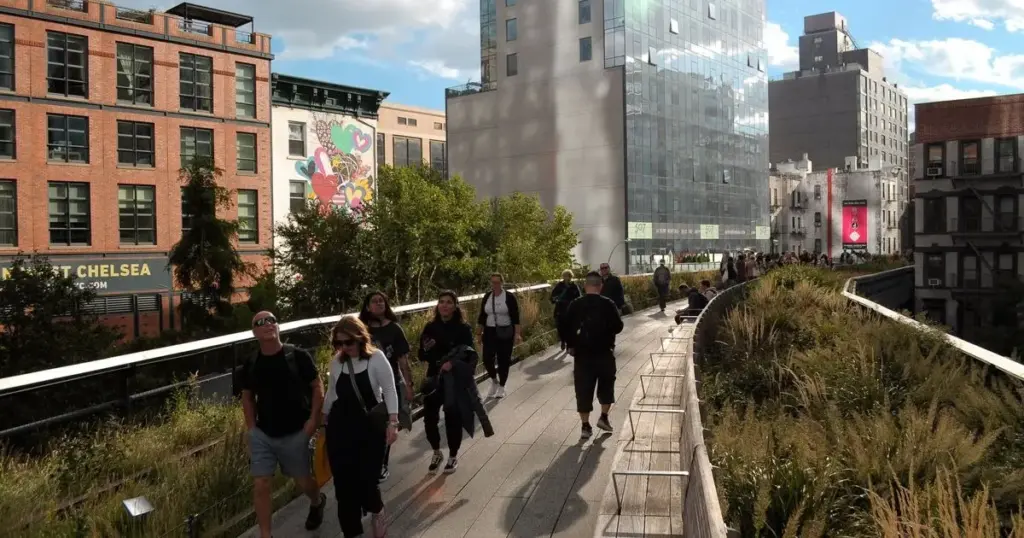
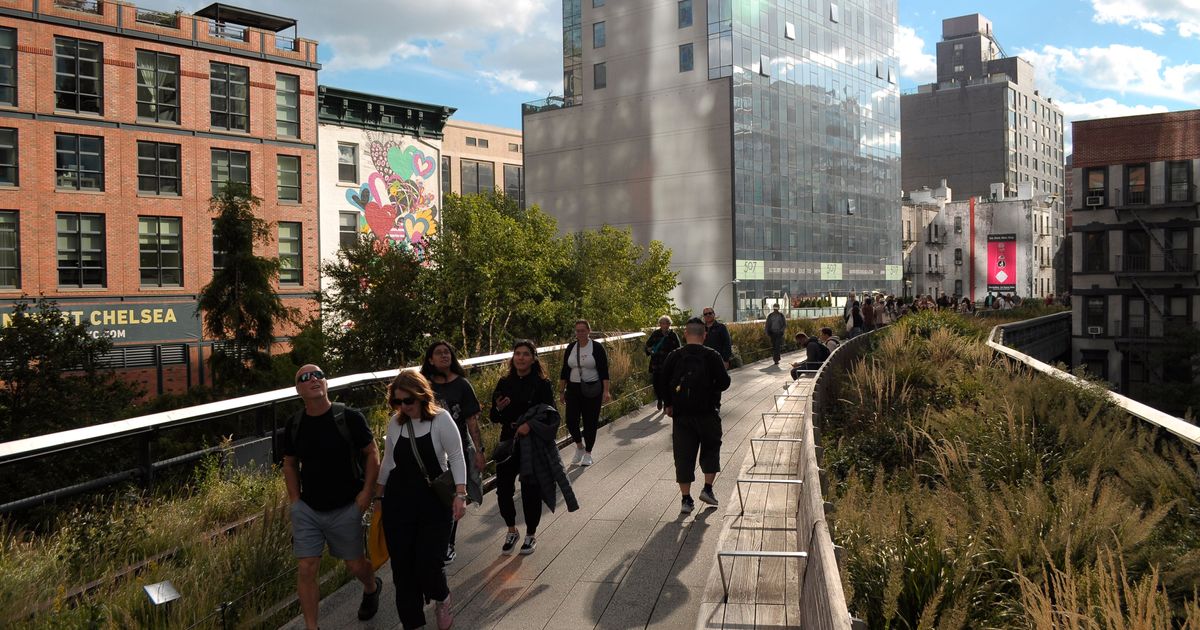
For the first time since it officially opened to the public in 2009, construction on New York City’s beloved elevated park, the High Line, is completely finished.
It has been 17 years since the linear park first welcomed visitors, with subsequent phases unfurling northward along the former railway tracks toward its terminus at 34th Street. Over that span, Chelsea and the entire West Side of Manhattan have undergone a dramatic transformation. Starchitect-designed residential towers now huddle closely around the elevated rail park, and the dense, gleaming enclave of Hudson Yards looms directly at its northern end. Yet, as urban planners and horticulturists often note, gardens generally take significantly longer to mature and develop than the steel-and-glass buildings surrounding them.
Now, the very last stretch of the High Line’s garden—situated within a 34th Street section known as the Rail Yard Preserve—is officially finished. Designed by renowned Dutch landscape designer Piet Oudolf, the final garden is scheduled to open to the public next month, marking a major milestone in the evolution of modern urban landscape architecture.
“When the 34th Street garden opens, the entire High Line will be open and there will not be a construction shed anywhere on it for the first time in anybody’s memory,” Richard Hayden, the High Line’s senior director of horticulture, told the New York Times, which first reported the milestone.
The completion of this final segment brings closure to a massive, multi-phase urban renewal project that forever changed how cities think about obsolete industrial infrastructure. The new 34th Street section features 2,561 square feet of planting beds executed in the same signature naturalistic style that defines the rest of the 1.5-mile-long park, which was also envisioned by Oudolf.
Visitors walking this final stretch will encounter a carefully curated palette of sedges, grasses, and Heuchera villosa “Autumn Bride,” a resilient species of coral bells known for producing delicate white flowers that rise gracefully above velvety, light-green leaves in the late summer and early fall. In total, the landscape architecture firm Field Operations—the design team that partnered with Oudolf on the creation of the rest of the High Line—has planted 52 different types of shrubs and trees in this specific area.
Interestingly, this final garden setting is distinct from the majority of the park in one major way: it will be the only section of the High Line planted directly in the ground. While the rest of the elevated park relies on a specialized system of roughly 18 inches of soil laid across the historic rail structure, the Rail Yard Preserve garden connects with the earth beneath it. Despite this natural grounding, the surrounding environment is far from bucolic. A sprawling parking lot sits directly on one side of the new garden, while a busy urban roadway runs along the other. Yet, this striking juxtaposition—placing calming, immersive greenery right in the middle of a gritty, fast-paced urban industrial setting—remains quintessentially High Line.
The Rail Yard Preserve, encompassing the stretch of the park running from 30th to 34th Streets between Eleventh and Twelfth Avenues, originally featured only minimal plantings and basic maintenance when this northern phase was initially integrated into the park network. According to Friends of the High Line, upkeep in this area previously amounted to little more than basic weeding rather than the deeply considered, "curated intervention" that made the southern and central portions of the park feel remarkably lush and wild. With the completion of this final phase, the 34th Street entrance is not only fully planted out, but it also includes improved visitor signage along Twelfth Avenue designed to make the northern gateway feel much more welcoming and accessible to pedestrians approaching from the West Side highway and surrounding neighborhoods.
The completion of the 34th Street garden is accompanied by the long-awaited reopening of another key feature along the park: the Prairie Terrace at 17th Street. This particular terrace had been shrouded in heavy construction scaffolding for nine full years due to major real estate development occurring immediately alongside it. With the scaffolding finally removed, horticulturists have replanted the area with species specifically selected to thrive under the altered sunlight patterns caused by the newly erected neighboring towers. The refreshed Prairie Terrace now features robust selections including blackhawks big bluestem, great globe thistle, sea holly, and vibrant black-eyed Susans.
Like the park’s other renowned gardens, the new additions continue to channel a distinct sense of urban wildness, offering New Yorkers and international visitors alike a serene respite suspended above the bustling streets of Manhattan. With the last construction barriers removed and the final plantings taking root, the High Line stands complete, marking the end of nearly two decades of continuous transformation on the West Side.