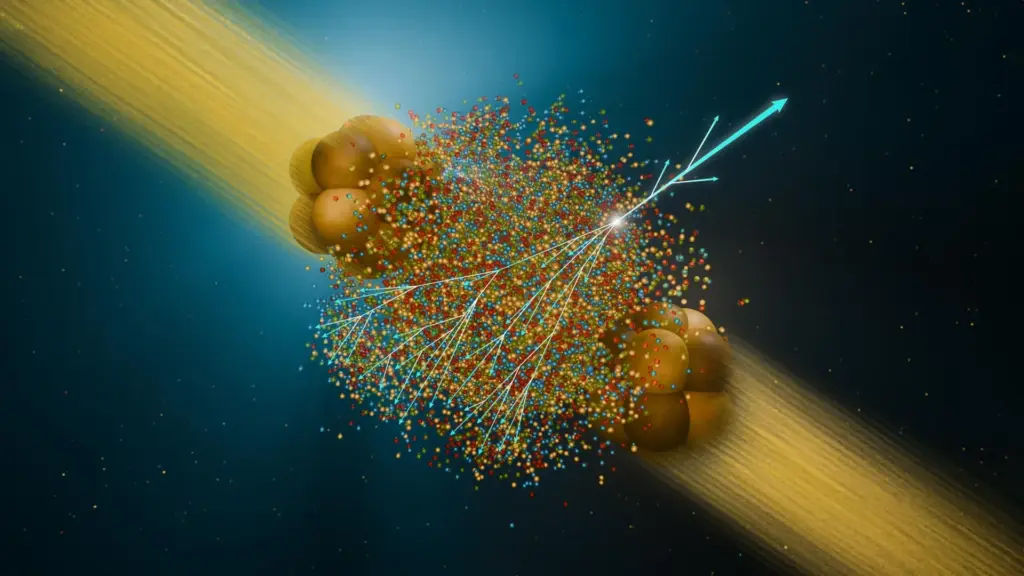
New findings from the STAR experiment at the Relativistic Heavy Ion Collider (RHIC) suggest that scientists can successfully recreate an extraordinary form of matter from the earliest moments of the universe using surprisingly small atomic collisions. By smashing oxygen nuclei together at nearly the speed of light, researchers have uncovered strong evidence of quark-gluon plasma (QGP), an extremely hot and dense state of matter that existed shortly after the Big Bang.
The findings, published in the scientific journal Physical Review Letters, reveal that high-energy streams of particles lose energy as they travel through the material created by these collisions. This effect, called jet quenching, provides an important clue that quark-gluon plasma has formed in systems far smaller than previously thought possible.
Scientists have previously observed jet quenching in collisions involving much larger atomic nuclei at RHIC, a U.S. Department of Energy (DOE) Office of Science User Facility that operated at Brookhaven National Laboratory from 2000 until early 2026. The same effect has also been detected in oxygen collisions at CERN’s Large Hadron Collider (LHC), the premier European particle physics laboratory.
What makes the new RHIC findings especially significant is that the oxygen collisions occurred at substantially lower energies than those at the LHC. The results establish a new lower boundary for the conditions known to produce quark-gluon plasma in this small collision system, helping scientists narrow down what it takes to create matter resembling that of the infant universe.
"The QGP is believed to be the form of matter that filled the early universe—before the protons and neutrons that make up today’s atoms formed. Understanding its properties is essential for uncovering how the early universe evolved in its first microseconds," said Li Yi, a professor of physics at Shandong University who oversaw the STAR analysis.
"One of the most powerful ways scientists study the QGP is by identifying where its signatures appear—and just as importantly, where these signatures turn off," she noted.
Rongrong Ma, a STAR physicist at Brookhaven Lab, explained why investigating smaller collision systems is so valuable to modern nuclear physics.
"This analysis is pushing the boundaries to an extreme case to help us learn something about this jet quenching phenomenon and the conditions needed to generate a QGP," Ma said.
How Scientists Recreate Matter From the Early Universe
RHIC was designed specifically to produce and investigate quark-gluon plasma under controlled laboratory conditions. Traditionally, researchers have accomplished this by accelerating massive gold nuclei to enormous speeds and crashing them directly into one another.
Each gold nucleus contains 79 protons and 118 neutrons. When two such heavy nuclei collide with sufficient energy, the boundaries of their individual protons and neutrons effectively break down, releasing the fundamental quarks and gluons inside them. The tremendous energy of the impact also generates thousands of additional quarks and gluons through the conversion of pure energy into matter, a process described by Einstein’s famous equation, $E=mc^2$.
The result of this violent interaction is a fleeting droplet of primordial matter. It is significantly smaller than an atomic nucleus and survives for less than a billionth of a billionth of a second. Almost immediately, the unbound quarks and gluons recombine into more familiar, stable particles.
Because this exotic substance disappears so quickly, scientists cannot examine it directly with conventional instruments. Instead, they use enormous, highly sensitive detectors such as the STAR apparatus to analyze the complex shower of particles that emerges from the collision point.
One particularly revealing clue comes from particles that escape the collision zone with less energy than expected. Their reduced energy suggests they strongly interacted with the dense, turbulent mixture of quarks and gluons before managing to escape.
Researchers pay special attention to jets, which are narrow sprays of extremely energetic particles. These often originate when a quark or gluon from one incoming nucleus strikes a quark or gluon from the other, sending two particle jets traveling in opposite directions.
If these paired jets, known as "di-jets," form near the edge of the collision region, one jet may have to travel significantly farther through the dense plasma than the other. Comparing their behavior allows scientists to investigate how the surrounding primordial material drains energy from particles passing through it.
Yi offered a familiar, everyday comparison to explain the process clearly.
"You can think of it like shooting a bullet through, say, water," Yi said. "Because of the resistance, the bullet will slow down. It’s the same thing with these high-energy particles. When they go through the QGP, they will lose energy."
The Telltale Signs of Quark-Gluon Plasma
For decades, RHIC experiments have provided clear, reproducible evidence of jet quenching in collisions between large gold nuclei. The effect is especially noticeable in jets that travel longer distances through the newly created matter.
Scientists believe these particles lose more energy because they encounter more constituent quarks and gluons before finally escaping. Jets originating closer to the outer boundary generally pass through less material and experience fewer destructive interactions.
These precise measurements helped establish beyond doubt that RHIC was successfully producing quark-gluon plasma. Additional evidence came from several other experiments, including an unexpected discovery about how the resulting matter behaves as a fluid.
Scientists observed that relatively low-energy particles emerging from gold collisions moved collectively, following highly coordinated patterns. This behavior indicated that the plasma flowed almost like a perfect liquid, exhibiting extraordinarily little viscosity or internal resistance.
The discovery was a major surprise when researchers first identified it. Collective flow has since become another important "smoking gun" signature used to confirm the presence of quark-gluon plasma.
Can Tiny Atomic Collisions Create Primordial Matter?
After establishing these clear signatures in collisions involving large, heavy nuclei, physicists began finding similar collective motion in much smaller systems.
Experiments at the LHC, followed by subsequent studies at RHIC, detected collective flow when tiny projectiles such as protons, deuterons, and helium-3 nuclei struck much larger gold or lead nuclei. Researchers at the LHC even observed comparable flow patterns in unexpected collisions between individual protons.
These results raised a profound and controversial question. Did the coordinated particle motion mean that these much smaller collisions were also producing quark-gluon plasma, or could another, more conventional mechanism explain the observations?
Scientists needed a more definitive, unambiguous sign to settle the debate.
"The next natural question is: Can you see jet quenching, the other key signature that QGP is formed, in these very small collision systems?" asked Brookhaven’s Ma. "We haven’t seen any unambiguous signal, so it’s still kind of under debate in these small systems. We want to search for the smallest system where we can still see an unambiguous jet-quenching signal," he explained.
To investigate this puzzle, researchers turned their attention to collisions between oxygen nuclei.
An oxygen nucleus contains just eight protons and eight neutrons, making it vastly smaller than the heavy gold nuclei typically used in RHIC experiments. Oxygen nuclei also possess a relatively symmetrical, spherical shape, which makes the complex geometry of their collisions much easier to analyze theoretically.
"That means we can more easily look for signs of asymmetric quenching of di-jets produced close to the edge of the circular interaction region in head-on collisions," said Maowu Nie, an associate professor at Shandong University who contributed to the research.
The scientists could also examine how the experimental outcome changed depending on whether the oxygen nuclei collided directly or merely grazed one another.
"We can also compare how jets behave in head-on central collisions—those that produce the most particles and therefore have the highest likelihood of making a QGP—with collisions where the two oxygen nuclei barely strike each other, which aren’t expected to generate a QGP," Nie added.
Nie explained that these grazing collisions are easily recognizable because they generate far fewer secondary particles than direct impacts.
Oxygen Collisions Reveal a 20% Suppression
To search for definitive evidence of jet quenching, the researchers developed a sophisticated analysis method that identifies concentrated streams of high-energy particles and measures how many emerge above a selected energy threshold.
"Our measurements are essentially counting experiments," said Sijie Zhang, who conducted the research for her master’s thesis under Yi and Nie at Shandong University and is now pursuing a Ph.D. at Yale University.
"We have an algorithm that finds the collimated groups of high-energy particles, the jets, and we count how many of these particles above a certain energy threshold come out," she said.
Yang He, a former Ph.D. student at Shandong University who developed the analysis framework and now studies oxygen collisions at the LHC, described how the team used different collision types to identify energy loss.
"We compare what we see in back-to-back jets produced near the edge of the system, and we compare what we see in head-on collisions with the counts in non-central collisions where we don’t expect to see quenching," He explained.
The team analyzed STAR detector measurements from oxygen collisions conducted at RHIC in 2021, operating at a collision energy of 200 billion electron volts (GeV).
The results revealed a clear 20% suppression of high-energy particles directly associated with jet quenching.
Although this suppression was smaller than what physicists typically measure in massive gold collisions, that difference was entirely expected because oxygen collisions generate much smaller interaction systems.
Crucially, the observed effect was still strong enough to provide robust evidence that quark-gluon plasma had successfully formed.
Comparing Big Bang Matter at Different Energies
Oxygen offers scientists another crucial experimental advantage. Apart from standard proton-proton collisions, it is the only nuclear species that has been investigated in dedicated collisions at both RHIC and the LHC.
That gives researchers an unusual, highly valuable opportunity to make an "apples-to-apples" comparison between two major facilities operating at very different collision energy scales.
The LHC carried out its first oxygen collisions in 2025. According to results reported by CERN, those experiments revealed both collective flow and jet quenching, providing additional indications that quark-gluon plasma can indeed form in relatively small nuclear collisions.
However, the LHC operated at collision energies exceeding 5,000 GeV, far above the 200 GeV used in the RHIC measurements.
"With a higher energy collision, it’s more likely to create more and more quarks and gluons and a hotter, denser QGP system," Yi said. "That means the jet quenching signal, if it’s there, should be bigger at LHC compared to RHIC."
While higher energies make it easier to create the hot, dense conditions needed for quark-gluon plasma, lower-energy experiments may be uniquely useful for determining precisely when those conditions are no longer sufficient.
By reducing the collision energy and using smaller nuclei, physicists can approach the fundamental threshold at which the distinctive signatures of primordial matter disappear entirely.
"We are pushing the boundaries in two ways to explore the minimal conditions for creating a QGP, both in terms of the nucleus size by looking at these small oxygen-oxygen collisions, but also by looking at data from lower collision energies—and we still see this crucial QGP signature. That’s a unique feature of our measurement," Ma said.
New Experiments Could Reveal the Limits of Primordial Matter
Although RHIC has now completed its historic operations, scientists still have additional oxygen collision data to investigate in the coming months and years.
During the collider’s final experimental run, researchers collected critical measurements using both STAR and sPHENIX, RHIC’s newest state-of-the-art detector. The facility officially concluded its operations with final oxygen collisions recorded by both instruments on February 6, 2026.
These remaining datasets could provide further insights into how small a collision system can become, and how low its energy can fall, before quark-gluon plasma can no longer form.
Understanding those physical limits may help physicists piece together the exact behavior of matter during the first microseconds of the universe, when quarks and gluons had not yet combined into the protons and neutrons that make up ordinary atoms today.
The research received financial support from the DOE Office of Science, the U.S. National Science Foundation (NSF), and additional international agencies and organizations identified in the scientific publication.
The researchers also utilized the Open Science Grid, which receives direct support from the NSF, along with advanced computing resources at Brookhaven Lab’s Scientific Data and Computing Facilities and the National Energy Research Scientific Computing Center (NERSC), a DOE Office of Science User Facility located at Lawrence Berkeley National Laboratory.