Around the world, billions of people still lack reliable access to safe drinking water, highlighting a growing crisis for communities everywhere. The United Nations estimates that 2.2 billion people do not have safely managed drinking water, while regions spanning from California to the Middle East increasingly rely on industrial desalination plants to turn ocean water into fresh water. While this process is critical for municipal water security, traditional approaches come with significant structural and environmental hurdles that researchers have long sought to overcome.
Desalination can provide a critical water supply, but today’s most common methods come with significant drawbacks. Reverse osmosis forces water through specialized membranes to remove salt, while thermal distillation uses heat to separate fresh water from seawater. Both approaches can consume large amounts of energy, often require extensive water treatment before and after the process, and generate a highly concentrated salty waste known as brine.
When that brine is discharged back into the ocean, it can increase local salinity and reduce oxygen levels, creating harmful conditions for marine organisms and local ecosystems. Finding an alternative method that avoids these ecological consequences while remaining energy-efficient has remained one of the chief engineering goals in water purification research.
A Solar-Powered Alternative to Conventional Desalination
Researchers at the University of Rochester have now developed a different approach that could help address several of those problems at once. Scientists at URochester’s Institute of Optics created a solar thermal desalination system designed to produce fresh water efficiently without generating liquid brine or requiring chemical additives to pre-treat the incoming water. The method is described in a paper published in the scientific journal Light: Science & Applications.
The research was led by Chunlei Guo, a professor of optics and physics and a senior scientist at URochester’s Laboratory for Laser Energetics.
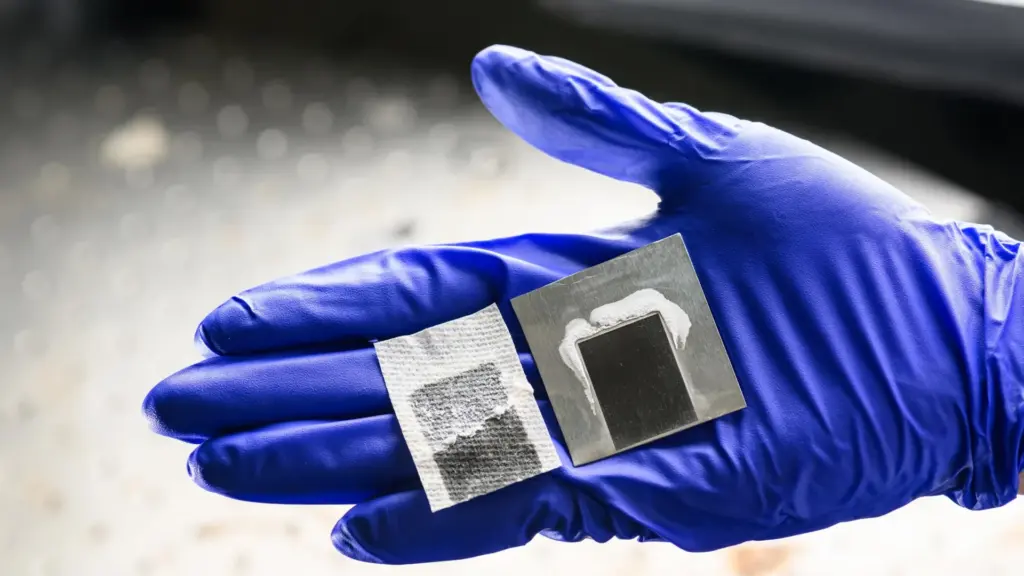
At the heart of the technology are solar panels made from black metal that has been treated with femtosecond lasers. A femtosecond is an extraordinarily short unit of time, equal to one quadrillionth of a second. Pulses from these ultrafast lasers can precisely alter a material’s surface, creating microscopic structures that dramatically change how it interacts with light and water.
The laser treatment makes the metal extremely effective at absorbing sunlight and also gives it superwicking properties, meaning water spreads rapidly across the surface instead of beading up into droplets.
How the Self-Cleaning Surface Works
Each panel contains a laser-treated active region that draws a very thin layer of seawater across its surface. The dark metal absorbs nearly all of the incoming solar radiation, heating the water and causing it to evaporate rapidly.
That evaporation leaves salts and other dissolved minerals behind on the metal surface. Rather than allowing those materials to accumulate where evaporation is taking place, the panel directs them toward untreated areas along its sides, known as the passive region.
This movement is critically important because salt buildup is one of the biggest challenges facing solar desalination systems. If minerals form a hard layer across the active surface, they can block water movement and eventually stop the system from working entirely.
Why Real Seawater Is Much Harder to Desalinate
Guo explains that previous solar thermal desalination systems have often performed well in laboratory experiments using simplified artificial seawater made strictly from pure water and sodium chloride.
When sodium chloride crystallizes as water evaporates, it tends to form a relatively grainy and porous structure. Water can continue moving through those crystals, helping dissolve accumulated salt and making the surface much easier to clean.
Real seawater, however, is far more complicated and presents unique chemical hurdles. In addition to sodium chloride, it contains magnesium, calcium, and many other dissolved substances. Some of those compounds can crystallize into hard, dense deposits that are significantly less porous than simple salt crusts.
It is a process similar to the mineral scale that gradually builds up inside a household shower head or tea pot. In an industrial desalination system, however, the challenge is much greater because natural seawater contains hundreds of times more dissolved salts than ordinary tap water. As those mineral deposits accumulate over time, water can no longer flow freely across the surface, reducing overall efficiency and eventually clogging the system.
Using the Coffee Ring Effect to Move Salt
To overcome that stubborn problem, Guo’s team carefully designed microscopic grooves into the black metal so salts and minerals would be actively pushed away from the active evaporation region instead of forming a persistent crust.
The researchers also took clever advantage of a familiar physical phenomenon called the coffee ring effect. Anyone who has spilled coffee on a counter and watched it dry has probably witnessed the principle firsthand. As water evaporates, suspended particles move toward the edge of the droplet, leaving behind a dark, concentrated ring.
"If you drop coffee on a surface, eventually the water evaporates and there’s a ring left at the outer edge that is the concentrated coffee particles," says Guo. "We use that same principle to advance the salts to the passive region."
Instead of allowing minerals to build up where sunlight is driving evaporation, the system guides them toward the outer edges of the panel. The researchers tested the technique using actual seawater collected directly from the Pacific, Atlantic, and Indian Oceans. In those laboratory experiments, the surface effectively cleaned itself while producing clean fresh water, directing the remaining salts into the passive region where they could later be harvested.
Importantly, that mineral buildup did not reduce the panel’s desalination efficiency, marking a major breakthrough over previous solar-powered systems.
Turning Desalination Waste Into Useful Materials
Another major advantage of the technology is what happens to the salt after the water is completely removed. Rather than producing a concentrated liquid brine that must be treated, transported, or discharged back into the ocean, the system extracts nearly 100 percent of the dissolved salts in solid form.
That dry material could potentially become a valuable resource rather than an environmental waste product. Some of the harvested material could be used as commercial table salt, while other, more valuable minerals could also be recovered.
One particularly important target is lithium, a key material used in the lithium-ion batteries that power electric vehicles, smartphones, laptops, and a vast array of other modern electronic devices.
In a related study published in the Journal of Materials Chemistry A, Guo and his colleagues demonstrated that the same superwicking solar panels can be modified to separate lithium from the other salts produced during the desalination process.
The researchers embedded nanoparticles made from hydrogen titanate into the microscopic grooves of the black metal. Those specialized particles selectively isolate lithium from the complex mixture of salts and minerals left behind by the evaporating seawater.
"Mining lithium from the earth has proven to be very taxing from an energy and environmental standpoint, so pulling lithium directly from saltwater could be a very important future route," says Guo.
Recovering Lithium From Saltwater
Using brine and saltwater samples sourced from the Great Salt Lake, the research team was able to recover about 50 percent of the lithium contained in the salts left behind after the desalination process.
That promising result points to a possible future in which municipal desalination facilities could do significantly more than just produce drinking water. They might also recover commercially valuable materials that would otherwise remain trapped in traditional waste streams.
The technology is still at an early stage of development. So far, the researchers have successfully demonstrated the superwicking desalination approach in proof-of-concept experiments using relatively small devices.
Guo notes that the basic design is inherently scalable, however, and could eventually contribute both to expanding access to fresh water globally and to creating more sustainable sources of critical minerals. If successfully scaled for commercial use, the approach could address two major global challenges at the same time: producing more fresh water for a growing global population while reducing the environmental burden associated with both desalination waste and traditional mineral extraction.
The research was supported by funding from the National Science Foundation, the Bill & Melinda Gates Foundation, and the Worldwide Universities Network. Guo’s colleagues from the Institute of Optics who contributed to the research include Senior Scientist Subash Singh, alumnus Ran Wei ’24 (PhD), PhD students Luheng Tang and Tainshu Xu, and Mingjiang Ma.