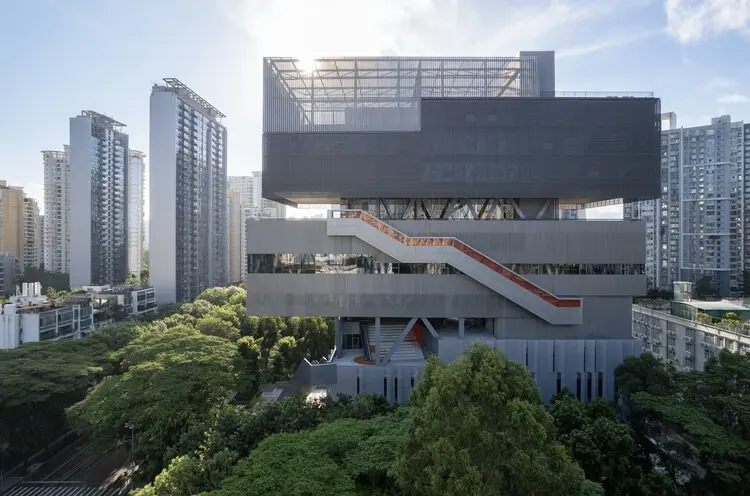
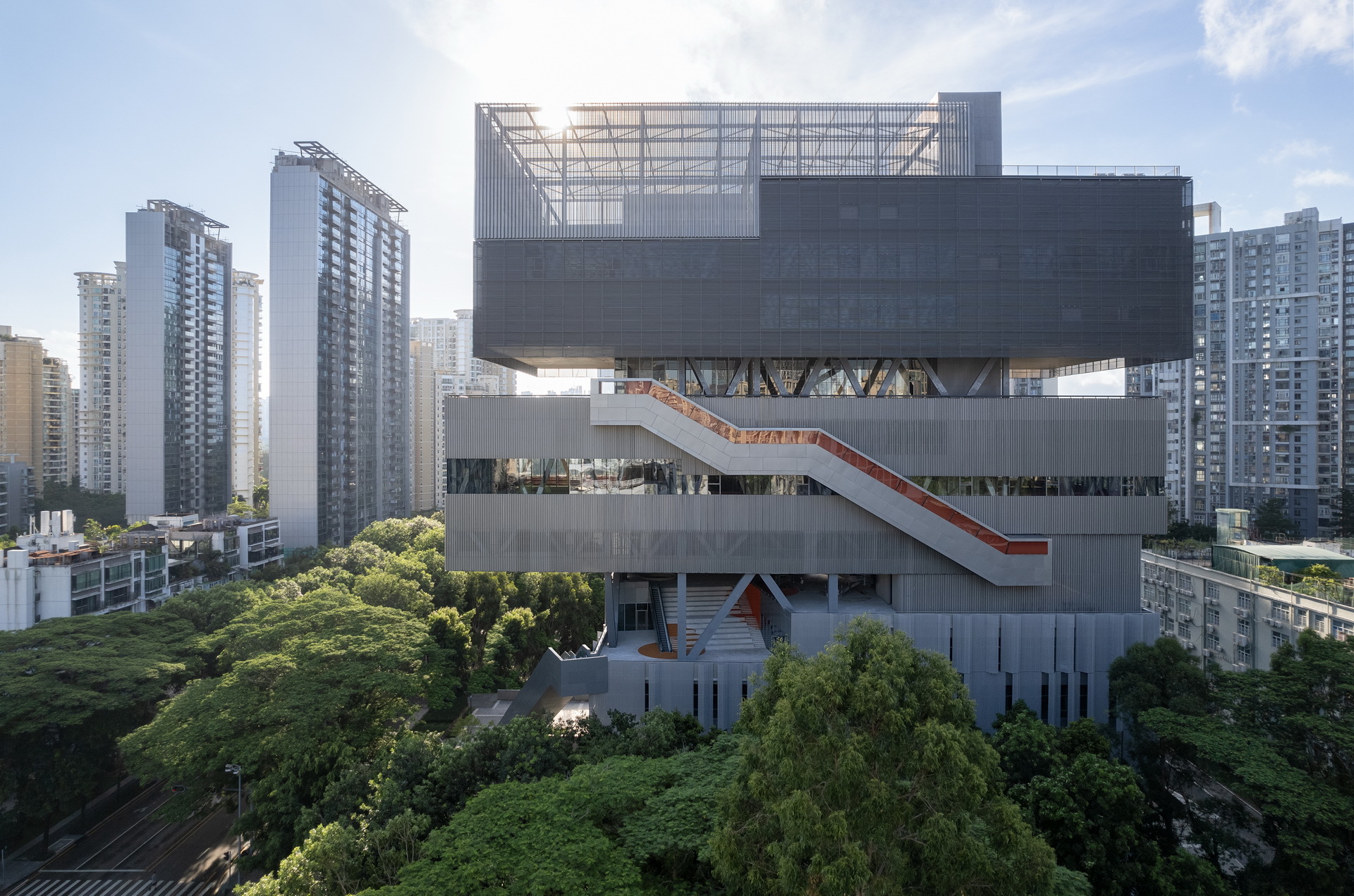
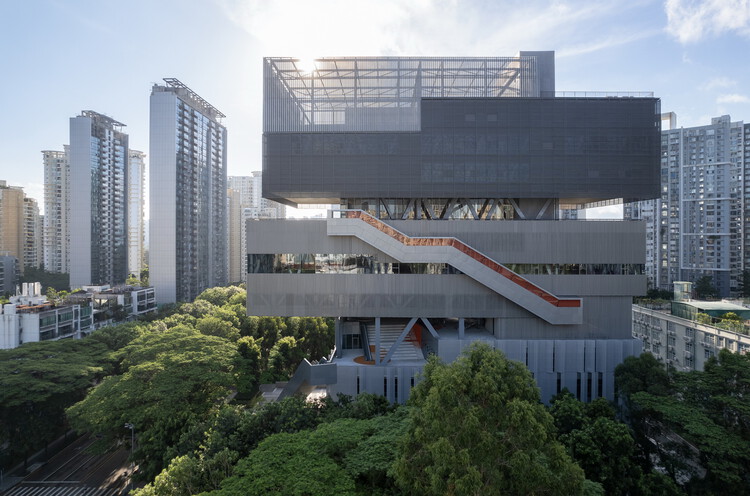
Nestled within the densely populated Yuehai community of the Nanshan district in Shenzhen, the newly completed Yuehai Culture and Sports Center stands as a notable departure from conventional civic architecture. Designed by architect Meng Yan and the renowned practice URBANUS, the project rethinks how cultural and recreational facilities integrate into the hyper-dense fabric of a modern metropolis. Surrounded by towering high-rise residential blocks, academic institutions, and sprawling commercial complexes, the center addresses a fundamental challenge in contemporary urban design: how to prevent public facilities from becoming isolated islands within the city.
In conventional urban planning, large-scale cultural and sports complexes typically segregate their varied programs, operating them as independent, self-contained entities behind closed doors. While this operational compartmentalization is often intended to minimize logistical conflicts between diverse user groups, it frequently comes at a steep price. By walling off different functions, these traditional complexes eliminate the spontaneous opportunities for public interaction that give urban life its vitality. URBANUS sought to challenge this paradigm. The architects recognized that the open, interstitial spaces scattered around and between buildings—the physical zones that accommodate chance encounters and informal gatherings—frequently evolve into the most vibrant and memorable parts of the urban realm.
The Yuehai Culture and Sports Center directly embodies this philosophy of porosity and connectivity. Rather than consolidating all civic functions into a single monolithic block that turns its back on the surrounding neighborhood, the design breaks down the project’s scale to weave it seamlessly into the daily rhythms of the Nanshan district. By distributing programs and creating porous transitions, the architecture encourages a continuous flow of people, movement, and social activity. The layout acknowledges that in a high-density environment like Shenzhen, public space is a precious commodity, and a cultural center should function as an extension of the streetscape rather than an enclosed retreat from it.
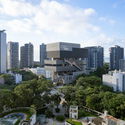
The context of the Nanshan district provides a compelling backdrop for this architectural experiment. As one of Shenzhen’s most dynamic and rapidly developing economic and residential hubs, Nanshan is characterized by an intense verticality. High-rise developments dominate the skyline, creating an environment where open ground-level public space is scarce and highly contested. The Yuehai community, in particular, suffers from a high density of residential and commercial towers, making the provision of accessible, communal cultural and sports facilities both a vital necessity and an urban design challenge. Meng Yan and URBANUS approached this site not as a blank slate, but as an active ecosystem where architecture must mediate between the overwhelming scale of the surrounding towers and the human scale of the pedestrians navigating the ground plane.
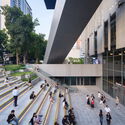
By prioritizing openness and connectivity, the Yuehai Culture and Sports Center challenges architects and urban planners to rethink the typology of civic complexes. Instead of prioritizing operational segregation at the expense of community cohesion, the project demonstrates that cultural and sports programs can coexist within an interconnected, porous framework. The result is a vibrant civic hub that not only serves the immediate athletic and cultural needs of the Yuehai community, but also enriches the broader urban fabric of Shenzhen by fostering spontaneous encounters and a stronger sense of shared public life.