By Sierrah Floyd / MutualArt
November 6, 2026
The Chicago Cultural Center, an architectural jewel that once served as the city’s central library, has long stood as a sanctuary for the vast spectrum of Chicago’s creative life. From the intricate mosaics of the Grand Army of the Republic Hall to the soaring, stained-glass rotunda that captures the shifting Midwest light, the building itself is a testament to the intersection of history and public space. It is within this hallowed, marble-clad environment that curator Mya Lewis has orchestrated a profound intervention: To Be Remembered: Woven Matters of the Heart.
This textile-focused exhibition, which opened in late August 2026, serves as a bridge between the physical permanence of the Cultural Center and the ephemeral, deeply personal histories of five Chicago-based artists: ebere agwuncha, Hale Ekinci, Nnaemeka Ekwelum, Josué Esaú, and Thắng Hoài Trần. Together, these artists invite the public into a contemplative space—a gallery that functions less like a traditional exhibition hall and more like a site for ritual, conjuring, and the reclamation of lineage. Through the tactile language of weaving, stitching, and assemblage, the exhibition collapses linear time, allowing the viewer to sit, however briefly, at the feet of the ancestors and experience the quiet power of being seen.
ebere agwuncha’s Woven Portals
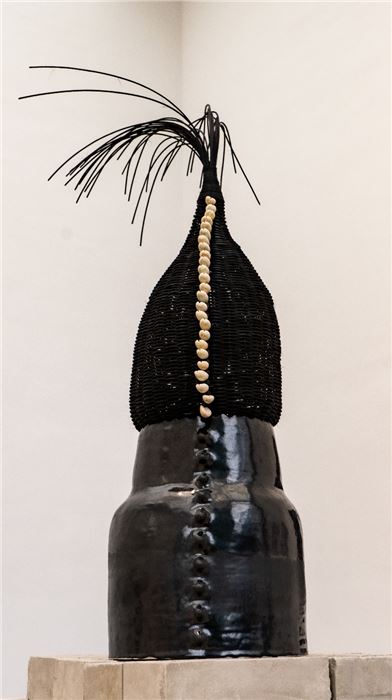
The journey into the exhibition begins with a striking confrontation with materiality. Visitors are immediately greeted by chinelo pillar (2026), a monumental black multimedia sculpture by ebere agwuncha. The work centers on the legacy of the artist’s eldest sister, Dr. Chinelo Agwuncha, a healer whose presence is honored through a form that evokes a traditional Nigerian architectural gathering space. The sculpture, anchored by a glossy, dark ceramic base punctuated with convex indents, rises to a peak in a hand-woven reed basket, with wispy, ethereal threads dancing in the ambient air. Cowrie shells, arranged in a precise vertical line, face the entrance, acting as silent sentinels. Set upon a foundation of rugged cement bricks, the work strikes a deliberate balance between the industrial and the organic, demanding a meditative pause from those who enter.
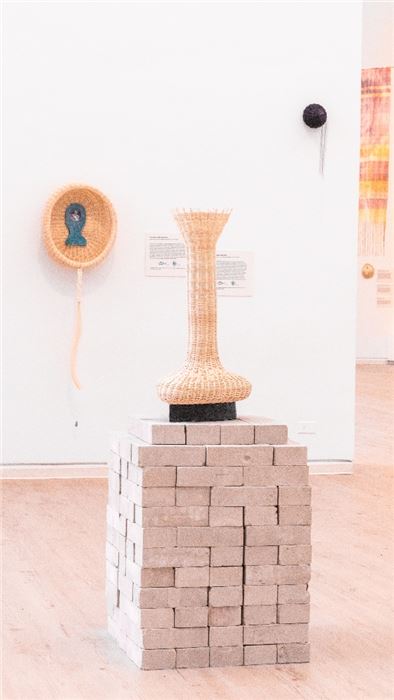
Agwuncha’s contribution extends throughout the first gallery, where traditional weaving techniques are repurposed as tools for ancestral veneration. Works such as water tower II and soft glass II—also completed in 2026—explore themes of self-preservation and the living out of long-held dreams. These pieces are displayed on stark cement blocks or as relief sculptures on the walls, grounding the ethereal nature of the textiles in the grit of urban reality.
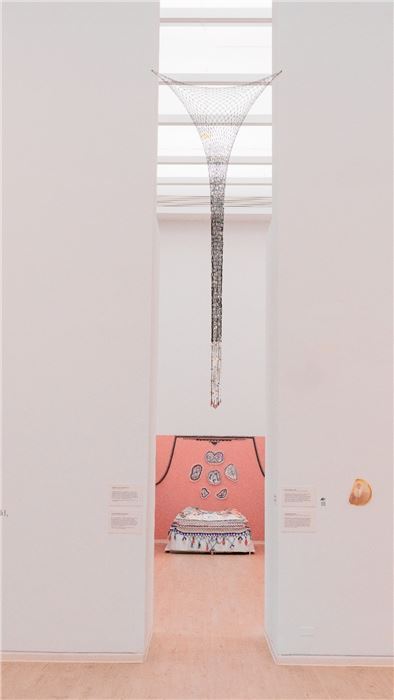
Perhaps most arresting is lancet portal II, a massive installation hanging against a deep turquoise wall. Stretching over ten feet in length, the piece is an intricate interpretation of the lancet architectural arch, hand-woven by the artist using techniques inspired by traditional fishing nets. Adorned with cowrie shells and turquoise beads, the portal invites the viewer to look through its mesh, effectively framing the landscape outside the gallery windows. By mirroring the architectural language of the building itself, agwuncha creates a dialogue between the institution’s permanence and the fluid, shifting nature of cultural memory.
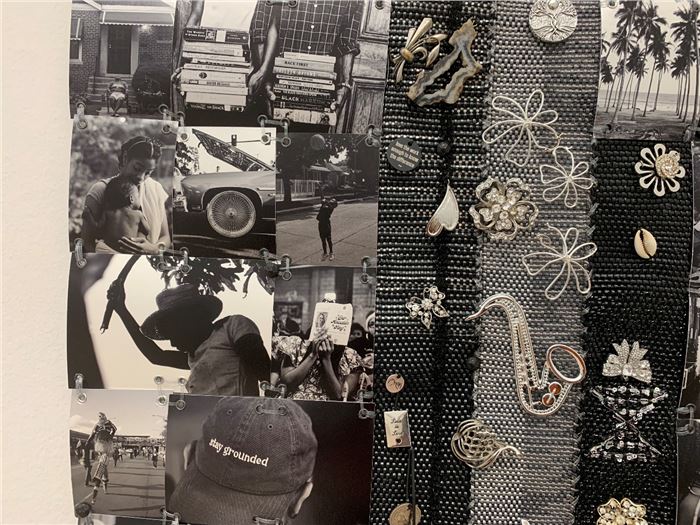
Before leaving the gallery, the viewer encounters a starkly different, yet emotionally resonant, collaboration. Nnaemeka Ekwelum and photographer Tafari Meliziwe present Ethnographic Fieldnotes of a Nameless Village (2026), a sprawling collage that spans the height of the wall. This work is a vibrant celebration of the mundanity and joy found within Black communal life. Through a mix of black-and-white photographs, kitschy adornments, and glitter-dusted ribbons, the piece evokes the warmth of a family mantelpiece or the Sunday hats of a grandmother. Ekwelum’s work bridges the gap between the concept of a "Black village"—a site of collective memory—and the public, civic space of the Chicago Cultural Center, suggesting that the most vital archives of history are often found in the home.
Josué Esaú’s Copper Spiral and the Architecture of Belonging
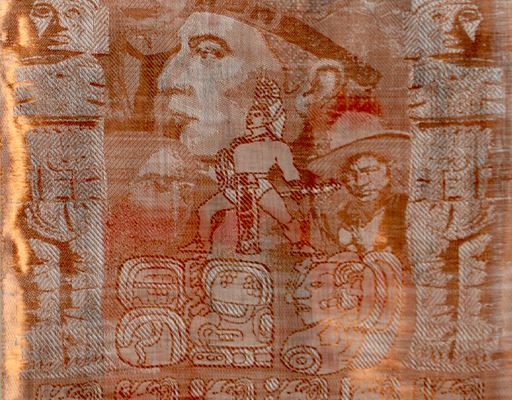
Transitioning into the second gallery, one passes through another of agwuncha’s lancet arches—bowed lancet catcher—which utilizes horsehair and reed to nod to Nigerian Igbo ceremonial practices. Beyond this threshold lies the centerpiece of the second gallery: Josué Esaú’s Cozumel / Temple Silencio / Meditations on the Moon (2026).
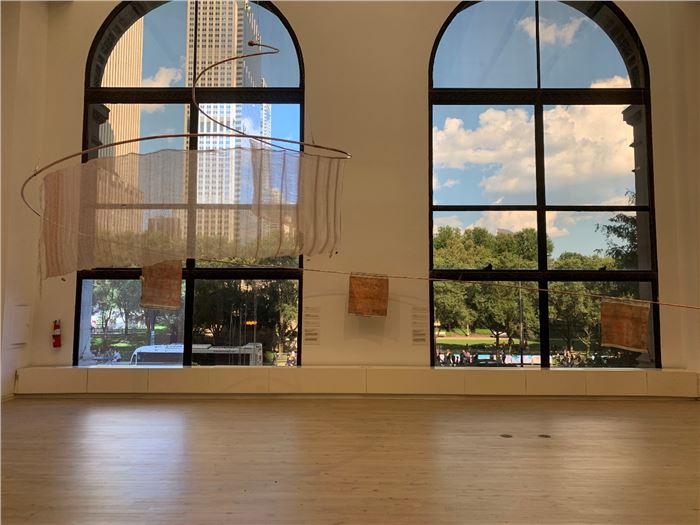
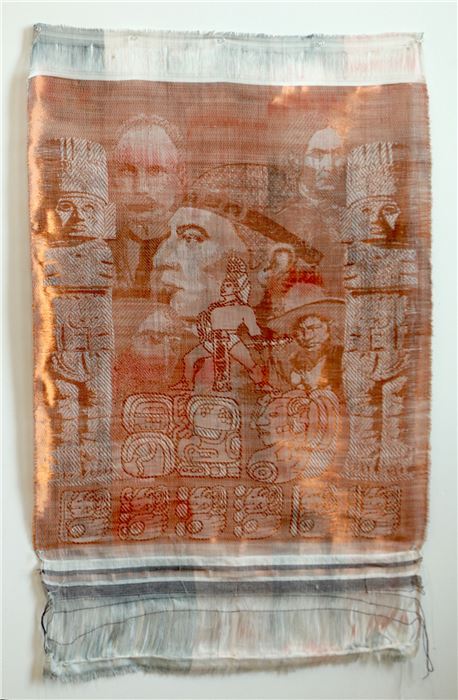
This aerial sculpture is a feat of engineering and grace. A seamless, 28-by-40-foot spiral of hollow copper tubing coils through the gallery space. Suspended within this structure are collaged portraits of revolutionary ancestors and the artist’s own late great-grandmother, all rendered through delicate copper and silk weaving. The spiral descends toward the floor, terminating in a singular conch shell nestled within the hollow pipe. Throughout the run of the exhibition, Esaú periodically updates the installation with new offerings—seasonal leaves, gourds, and shells—transforming the sculpture into a living, breathing altar.
For Esaú, this act of "homebuilding" is a direct response to the persistent experience of unbelonging in a country that often treats his presence as conditional. By forging a path to his ancestors through metal and silk, he constructs a sense of permanence that the world outside has denied him. The work is accompanied by a sound composition by the futurist composer and flautist BSA Gold, which fills the space with an immersive, sonic atmosphere. The result is a profound meditation on the power of lineage; the conch shell, a long-standing symbol of the sea’s mystical and spiritual energy, anchors the work, reminding the viewer that connection to one’s history is a vital form of protection and strength.
Sharing this space are the works of Thắng Hoài Trần, whose tapestries utilize metallic yarn and cotton to weave together the stories of their nuclear and extended family. In Ká»· Niệm Ngày Cưới (Burgandy and Gold), Trần uses the jacquard loom to interpret the past, creating a space for quiet contemplation. Works such as Offerings (2023) utilize transparent fabrics to layer screenprints and lithographs of significant family milestones—from a parents’ wedding to a grandfather’s home in the United States. These tapestries function as a reweaving of familial history, allowing the artist to claim their own narrative in the face of displacement and time.
Hale Ekinci and the Archive of the Bedroom
The final section of the exhibition moves into the deeply intimate, led by Hale Ekinci’s installation Resting Place (2026). Ekinci has transformed a corner of the gallery into a full-scale, coral-walled bedroom, serving as a time capsule for migration and memory. The bed, quilted and adorned with lace and yarn, features life-size woven shadows, suggesting the presence of those who have passed through this space before. The surrounding walls are covered in tapestries that meld found photographs, personal poetry, and prints of oya tulips—a nod to the traditional Turkish headscarf art.
This domestic nook emphasizes the private nature of memory. On the right wall, a woven cone cradles a lithograph of a woman swaying in the wind, a gentle reminder of the resilience of the matrilineal line. This theme is further explored in Tres Hermanas (Three Sisters) (2024), a five-foot-long quilted painting that honors the complex, often fraught, but ultimately unbreakable bonds between Ekinci’s mother and her aunts. Through sequins, embroidery, and found fabric, the artist maps the strength of these women, transforming personal history into a public tribute.
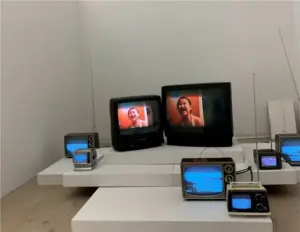
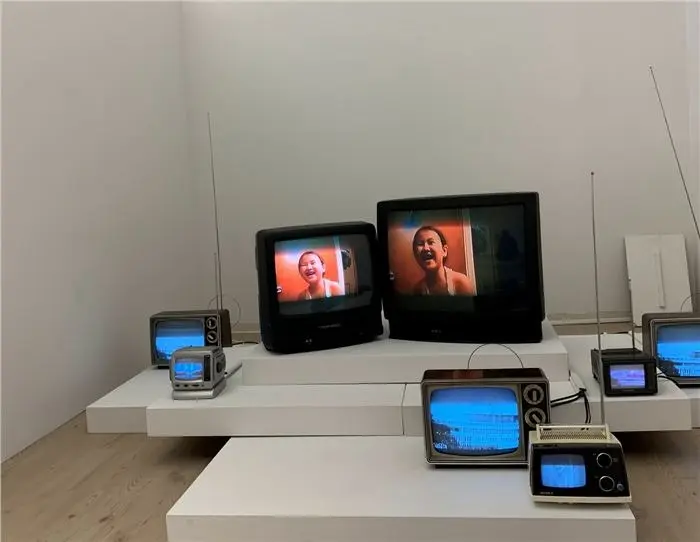
The exhibition draws to a close with Thắng Hoài Trần’s ongoing series, Dear Grandpa. This CRT television installation features multiple channels of archival video footage documenting the artist’s grandfather and their family’s immigration story. The flicker of the vintage screens, combined with a personal letter broadcast to the grandfather, creates a nostalgic, warm embrace. It is a poignant ending to an exhibition that asks, above all, what it means to honor the living while preparing for the inevitable transition into ancestry.
To Be Remembered: Woven Matters of the Heart is a courageous exploration of the methods by which we hold onto one another. By celebrating Black life, commemorating Indigenous heritage, and honoring the hardships and triumphs of their own matrilineal lines, these five artists have created a space that is as rigorous in its technique as it is tender in its intent. It is an authentic representation of how memory can be captured, stored, and eventually passed down—a tall order that the exhibition meets with quiet, monumental success.
To Be Remembered: Woven Matters of the Heart, presented with support from the Department of Cultural Affairs and Special Events, is on view at the Chicago Cultural Center through February 28, 2027.