
PARIS — Coperni, the avant-garde French fashion house that consistently treated the runway as a laboratory for scientific inquiry, has officially ceased operations following a commercial dispute with its distributor and majority shareholder, Tomorrow. Founded by creative directors Sébastien Meyer and Arnaud Vaillant, the label spent the past several years pushing the boundaries of what clothing and accessories could be, merging high fashion with aerospace engineering, robotics, biotechnology, and consumer electronics.
The news of the brand’s closure marks the end of one of contemporary fashion’s most eccentric and forward-thinking voices. While the label’s operational future has come to a sudden halt, its legacy remains deeply embedded in the cultural consciousness. Throughout its tenure, Coperni successfully transformed radical, seemingly impossible ideas into tangible, wearable objects. By collaborating closely with scientists, engineers, researchers, and technology companies, Meyer and Vaillant dissolved the traditional boundaries between apparel and technical research, leaving behind a remarkable catalog of runway moments and material innovations.
The Spray-On Dress That Captured Global Attention
Without a doubt, Coperni’s most iconic and widely discussed moment occurred during its Spring/Summer 2023 fashion show in Paris. In front of a stunned live audience, model Bella Hadid stepped onto the runway wearing only nude-colored underwear. Technicians then gathered around her, using spray nozzles to coat her body in a white liquid substance.

Developed in partnership with Fabrican, a material technology company founded by Spanish designer and scientist Manel Torres, the spray was composed of short textile fibers suspended in a polymer solution mixed with a solvent. As the liquid made contact with Hadid’s skin, the solvent evaporated immediately, leaving behind a flexible, wearable non-woven fabric.
As the layers built up over several minutes, a member of the design team stepped in to carefully sculpt the neckline, adjust the fit, and cut a high slit into the side of the newly formed skirt. Hadid then turned and walked down the runway, demonstrating that a completely bespoke, seamless garment could be manufactured directly onto the human body in real time. The viral moment instantly cemented Coperni’s reputation as a house willing to gamble on high-risk, high-reward technological theater.
Robot Dogs and Intelligent Machines on the Runway
Continuing its exploration of the intersection between humanity and technology, Coperni made waves during its Fall/Winter 2023 presentation by enlisting a pack of five robotic dogs created by Boston Dynamics. Named Spot, these quadrupedal machines were integrated directly into the performance alongside human models, taking inspiration from Jean de La Fontaine’s classic fable The Wolf and the Lamb to imagine a nuanced, cooperative relationship between people and intelligent machines.
In one of the show’s most memorable sequences, a robot dog gently approached a model, delicately removed her jacket, and held it before returning it. Another robot briefly interacted with Lila Moss, pausing to hold her handbag. By allowing the autonomous machines to move freely among the human cast and even approach the front row, Coperni created an uncanny, mesmerizing dialogue between live performance, high fashion, and modern robotics.

Pushing Material Limits with NASA-Grade Aerogel
For its Fall/Winter 2024 collection, Coperni unveiled what is arguably its most scientifically extreme accessory: the Air Swipe Bag. Developed in collaboration with artist and researcher Ioannis Michaloudis, the handbag was constructed from silica aerogel, a space-age material frequently utilized by NASA for capturing cosmic dust particles.
Silica aerogel is recognized as the world’s lightest solid, consisting of approximately 99 percent air and just 1 percent glass-like material. The resulting object possessed a ghostly, translucent, cloud-like aesthetic that challenged traditional perceptions of luxury accessories. Despite its extraordinary chemical composition and a featherlight weight of roughly 33 grams, the accessory carefully preserved the sleek, curved silhouette that defines Coperni’s signature Swipe bag family.
Blending Retro Consumer Tech with Modern Design
Coperni frequently drew inspiration from nostalgic consumer technology, finding ways to recontextualize outdated electronics as high-fashion statements. The same Fall/Winter 2024 collection that debuted the aerogel bag also introduced a 3D-printed metallic handbag that doubled as a fully functioning portable CD player.

Modeled after the brand’s iconic curved geometry, the metallic accessory housed an operational compact disc mechanism, complete with wired headphones and a rechargeable battery pack. By fusing the aesthetic of 1990s personal audio devices with contemporary luxury design, the label offered an ironic yet functional commentary on the rapid evolution and obsolescence of consumer hardware.
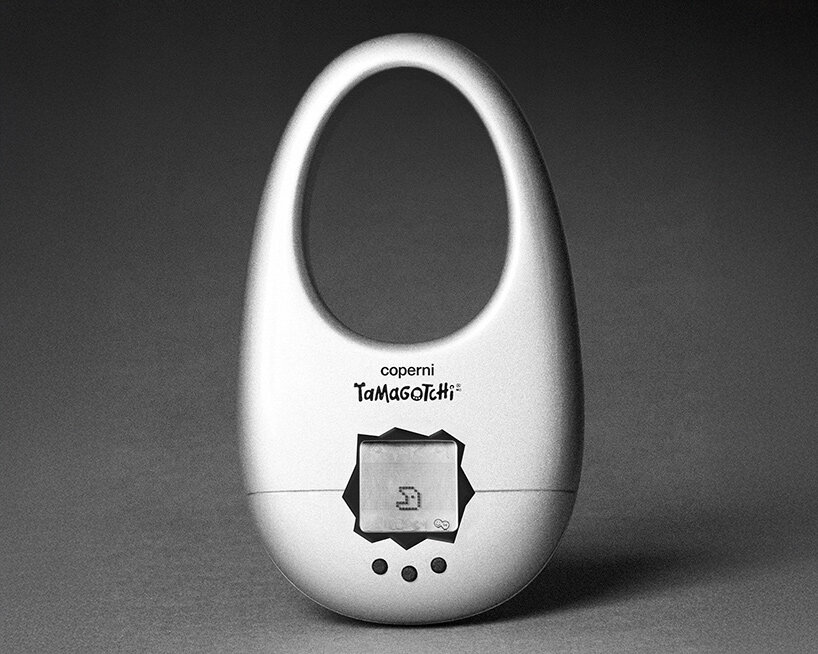
This fascination with late-20th-century gadgets surfaced again in 2025 with the introduction of the Tamagotchi Swipe Case. Developed alongside Japanese toy manufacturer Bandai, the miniature accessory adapted Coperni’s recognizable handbag silhouette to house an interactive digital pet, reviving the pocket-sized electronic craze of the late 1990s. The release coincided with the brand’s Fall/Winter 2025 presentation, which took the form of a massive LAN party inside Paris’s Adidas Arena, where hundreds of gamers played at computer stations while models navigated the space.
Innovative Manufacturing in a Gel Bath
For its Spring/Summer 2025 presentation held against the surreal backdrop of Disneyland Paris, Coperni turned to an entirely novel manufacturing process known as Rapid Liquid Print. Created in partnership with an MIT spinout, the technique was used to produce the Ariel Swipe Bag.
Unlike traditional 3D printing, which builds objects layer by layer against gravity or requires extensive structural supports, this method involved extruding blue silicone directly into a suspended bath of water-based gel. A robotic nozzle moved fluidly through the gel medium, drawing the bag’s curved form in three dimensions. Once completed, the flexible object was simply pulled from the gel bath, emerging with a smooth, continuous surface that defied conventional molding constraints.
Wearable Acoustics and Living Microorganisms
Sound served as the conceptual core of Coperni’s Spring/Summer 2024 collection, which was staged at IRCAM, the renowned music and acoustics research institute in Paris. Collaborating with Swedish audio brand Transparent, the designers engineered a leather jacket embedded with operational speakers seamlessly integrated across the chest.
The engineering feat required carving custom cavities into the leather to house the audio drivers, running concealed internal wiring, and securing an amplifier and battery pack safely within the jacket’s interior pockets. The finished garment functioned as a wearable sound system, allowing the wearer to project audio directly from their clothing.
In one of its final and most unexpected departures, Coperni ventured into the realm of biotechnology. Launched in October 2025, the C+ collection introduced everyday garments—including leggings and bodysuits—treated with active probiotics and prebiotics in partnership with Swiss textile innovator HeiQ.
The fabric incorporated a specialized bio-based matrix engineered to release beneficial microorganisms upon contact with the human skin, triggered dynamically by body heat and physical movement. Designed to support and interact with the skin’s natural microbiome during wear, the collection demonstrated Coperni’s ultimate ambition: viewing clothing not merely as a static aesthetic shell, but as a living, responsive material capable of sustaining a relationship with the wearer long after leaving the runway.