The latest findings reveal a complex, cooperative behavior among these unusual quantum systems, showing that separate time crystals can tune their rhythms to operate in unison across surprising distances. To understand the magnitude of this development, it is necessary to examine what time crystals are and how they challenge traditional concepts of physical equilibrium.
Time crystals are unusual physical systems whose internal behavior repeats in a regular rhythm over time, even though they are not being driven by a repeating external signal. In conventional physical systems, continuous motion or periodic change usually requires a continuous driving force or an input of energy that matches the periodicity of the output. Time crystals, however, break time-translation symmetry inherently. They exhibit persistent, periodic dynamics in their ground state without needing an external periodic pacemaker to keep time, offering physicists a fascinating window into non-equilibrium quantum mechanics.
In the rigorous experiments conducted at TU Dortmund, these time crystals do not form in empty space or complex magnetic containment fields, but rather inside a specially engineered semiconductor. The material is made from gallium arsenide infused with small, precisely controlled amounts of indium and silicon. These added chemical elements create localized electrons within the crystal lattice of the material. When the semiconductor is cooled down to extreme temperatures close to minus 270 degrees Celsius—just a fraction of a degree above absolute zero—the physical dynamics change dramatically. At this cryogenic temperature, each localized electron interacts with roughly one million nearby nuclear spins within the semiconductor matrix.
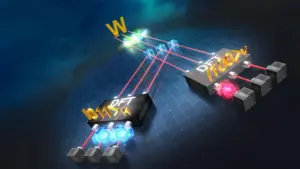
Initiating this delicate quantum process requires a precise optical setup. The researchers use a pump laser to align the electron spins within the material. Once the electrons are polarized, they transfer their polarization to the surrounding nuclear spins through hyperfine interactions. When a weak external magnetic field is applied to the system, the collective polarization of those nuclear spins begins to rotate in a continuous cycle.
Crucially, it is the continuous feedback loop between the electron spins and the nuclear spins that keeps these oscillations going indefinitely without fading away. To observe and verify this continuous motion without disrupting it, a second probe laser allows the researchers to monitor how those delicate oscillations develop and persist over time.
Despite the precision of the semiconductor manufacturing process, different regions of the material are never perfectly identical at the microscopic level. Imperfections, microscopic strains, and minute variations in the local distribution of indium and silicon atoms mean that physical conditions vary slightly from one spot to another. Because of these local variations, time crystals that form in separate areas of the semiconductor would normally oscillate at slightly different frequencies. Left to their own devices, each localized pocket of time crystals would march to the beat of its own drum, leading to a disordered, desynchronized mess of conflicting rhythms.
That dynamic changes fundamentally when the researchers illuminate many different regions of the semiconductor at once using a broad laser beam. Under those specific optical conditions, the separate oscillations can lock together and begin operating at the same frequency. The individual time crystals abandon their independent rates and adopt a shared, collective rhythm.
This emergent phenomenon is strikingly reminiscent of a classic historical observation made by Dutch scientist Christiaan Huygens in 1665. Huygens noticed that two pendulum clocks mounted on the same supporting wooden beam would gradually synchronize their swings, an effect driven by the weak mechanical interactions transmitted through that shared structural support. In the macroscopic world of grandfather clocks, the energy transferred through the wall or the beam is enough to force the pendulums into alignment.
In the quantum semiconductor environment investigated by the TU Dortmund team, the physical connection works through an entirely different microscopic mechanism. Instead of mechanical vibrations traveling through wood or metal, the time crystals become coupled through the continuous movement and exchange of spin-polarized electrons. The electrons act as microscopic messengers, carrying information about spin states back and forth between different spatial domains, thereby mediating a collective interaction that bridges the microscopic gaps.
The research team discovered that this synchronization effect is not merely a localized curiosity. They found that time crystals located as far as 40 micrometers apart could still successfully synchronize their oscillations. To put that scale into perspective within the semiconductor lattice, that distance is more than one thousand times greater than the characteristic size of a single oscillator. The synchronization spans a vast gulf relative to the individual units, demonstrating a robust cooperative phenomenon across macroscopic domains within the quantum material.
Once the spatial separation between the time crystals becomes larger than this critical threshold, however, the coupling effect weakens. At greater distances, the individual time crystals no longer lock together into a shared frequency and instead revert to oscillating independently, governed solely by their immediate local environments.
The findings demonstrated by Prof. Greilich and his colleagues provide clear, empirical evidence of non-local coupling between spatially separated spin systems in a solid-state medium. By proving that multiple time crystals can coordinate their behavior and lock into a shared frequency over significant distances, the study opens new pathways for understanding complex quantum many-body systems. Furthermore, these insights could help lay the fundamental groundwork for future networks of controllable spin oscillators, potentially opening new technological possibilities for spin-based information processing and advanced quantum technologies.