The Metropolitan Museum of Art has launched a monumental and long-overdue cultural reckoning with “Krasner and Pollock: Past Continuous,” a once-in-a-lifetime exhibition gathering more than 120 works by America’s most storied art couple: Lee Krasner (1908–1984) and Jackson Pollock (1912–1956). For decades, the public narrative surrounding this pairing has been heavily lopsided, casting an overwhelming focus on Pollock while reducing Krasner to a secondary figure. That imbalance has been reinforced by decades of market dominance, historical biographies, and cinematic adaptations. A May auction pushed Pollock further into elite financial territory as the newest member of the $100 million club, cementing a decades-long commercial ascendancy. Meanwhile, popular culture canonized the tragic genius narrative through Jackson Pollock: An American Saga, the 934-page 1991 Pulitzer Prize-winning biography by Steven Naifeh and Gregory White. That massive tome inspired the 2000 Hollywood film Pollock, which earned Marcia Gay Harden an Academy Award for Best Supporting Actress for her portrayal of Krasner—a cinematic role that mirrored her historical standing as a supporting player in her husband’s grand artistic drama.
Art historians have long attempted to challenge this reductive view. In 1981, curator Barbara Rose organized the landmark exhibition “Krasner/Pollock: A Working Relationship” specifically to dismantle the dominant narrative that Krasner was merely a second-tier artist and a long-suffering helpmate to her legendary husband. Rose argued that their marriage was instead a complex, working partnership of artistic equals. Yet, despite those early curatorial efforts, Rose never quite succeeded in pulling Krasner permanently out of Pollock’s towering shadow.
The Metropolitan Museum’s “Past Continuous” achieves what previous attempts could not. By paying equal and often deeper attention to Krasner—who outlived her husband by 28 years—the exhibition is far more daring, nuanced, and expansive. Finally, it treats them as genuine equals, upending traditional art history and resetting the historical trajectory of Abstract Expressionism.
The exhibition opens immersively with historical footage, offering a panoramic view of their unheated, two-story, shingled house and studio on Long Island. This cinematic introduction is layered with historic stills of Pollock, Krasner, their dog Gyp, and their tamed crow, Caw Caw. This secluded property was where Krasner and Pollock lived and worked for nearly eleven years. That chapter of their lives came to a devastating end when Pollock was killed in a drunk driving crash that also claimed the life of his passenger, Edith Metzger, and severely injured his girlfriend, Ruth Kligman. At the exact time of the fatal accident, Krasner was traveling in Europe, deliberately distancing herself from her husband’s compounding struggles with severe alcoholism and infidelity.
It was inside that humble Long Island farmhouse, far from the artistic distractions of New York City and his favorite watering hole, the Cedar Bar, that Pollock engineered his revolutionary drip paintings. He famously unrolled unprimed canvas directly onto the studio floor, working horizontally by applying enamel and commercial house paints with sticks and brushes while maintaining a physical distance that kept him from ever directly touching the canvas. Crucially, this breakthrough was inspired by the work of Janet Sobel (1893–1968), a self-taught, Ukrainian-born artist. Pollock saw Sobel’s groundbreaking painting Milky Way (1945) at Peggy Guggenheim’s Art of This Century gallery in 1946, and it directly inspired his own first drip painting, Galaxy, in 1947.

Just two years after that technical breakthrough, a dramatic headline in the widely circulated LIFE magazine asked, “Jackson Pollock: Is he the greatest living painter in the United States?” The feature instantly catapulted him from a relatively obscure abstract painter to an overnight cultural celebrity. The magazine’s four iconic photographs portrayed Pollock as a brooding, hyper-masculine figure smoking a cigarette and wearing paint-splattered jeans. Krasner received no mention in the piece, reinforcing the enduring myth of the solitary male genius.
The Met exhibition systematically subverts that myth from the moment visitors step into the first gallery, which focuses on Krasner’s powerful collage works from the mid-1950s. This period coincided with a time when Pollock had reached a severe artistic impasse and was spiraling completely out of control. Until now, public retrospectives have typically fed upon the lamentable tragedy of Pollock’s decline while entirely omitting the concurrent triumph of Krasner’s emergence and reinvention.
This fresh curatorial retelling proves that by the mid-1950s, Krasner had stepped fully into Pollock’s league as an artistic equal who deserved to be evaluated strictly on her own merits. In Bald Eagle (1955), Krasner constructed a dynamic collage using scraps of dark brown linen and unprimed canvas that both she and Pollock had discarded. Most notably, the white shape in the center of the composition resembles a bird’s profile, marked by a dripped black line executed by Pollock. By incorporating rejected waste materials from both her own studio floor and her husband’s, Krasner was metaphorically reborn like a phoenix from the ashes of destruction.
That narrative serves as an apt metaphor for Krasner’s entire life and career. Plagued by self-doubt and recurring creative blockages, she continually had to find resilience to forge a distinct path forward, all while navigating the immense gravity of Pollock’s larger-than-life persona. Long before she ever crossed paths with Pollock, Krasner had written lines from Arthur Rimbaud’s poem A Season in Hell directly onto her studio wall:
To whom shall I hire myself out? What beast must I adore?
What holy image is attacked? What hearts shall I break?
What lie must I maintain? In what blood tread?
Restless and famously tough-minded, Krasner understood innately how difficult it was to preserve an artist’s core integrity.

After establishing Krasner’s formidable autonomy, the curators pivot to a more biographical approach, placing examples of their early work—created before they ever met—side by side in a shared gallery space. The sequence begins with their early self-portraits: Krasner’s rendered in graphite and crayon around 1929 to 1930, and Pollock’s presented as a muddy brown, moody impasto created between 1930 and 1933. The section also features a selection of paintings from a group show in which they both exhibited, titled “American and French Painting” (1942). Curated by the Russian émigré artist and theoretician John Graham, the exhibition featured Pollock and Krasner hanging alongside major historical figures such as Stuart Davis, Willem de Kooning, Pablo Picasso, and Henri Matisse. After seeing the exhibition and remaining completely unfamiliar with Pollock’s identity, Krasner tracked him down, and the rest became art history.
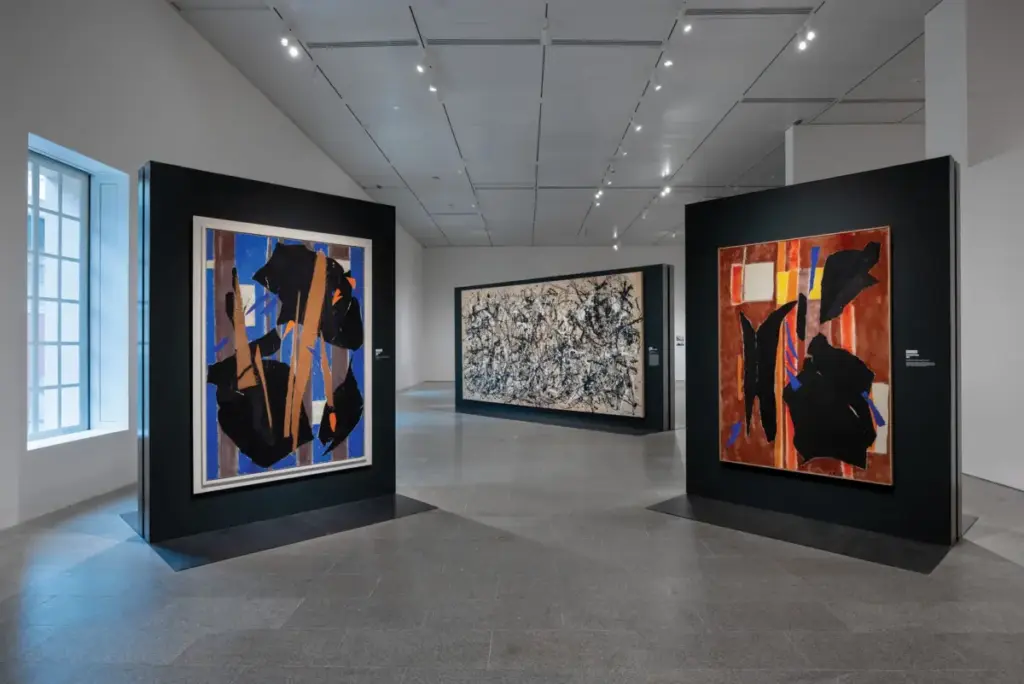
The exhibition is packed with monumental highpoints, stretching from Pollock’s lyrically expansive masterpiece Number 1, 1950 (Lavender Mist) to a meticulous recreation of Krasner’s groundbreaking solo exhibition at the Stable Gallery in 1955. That Stable Gallery show prompted the influential critic Clement Greenberg to proclaim her “a major addition to the American art scene of the era.” Greenberg had previously declared that through his drip paintings, Pollock had successfully moved past Cubism—specifically meaning Picasso—to create the first truly great American paintings. Although Greenberg acknowledged that Krasner had similarly pushed collage past Picasso into new American territory, he stopped short of bestowing the unmitigated praise he reserved for her husband. It was precisely this persistent hierarchical thinking and institutional glass ceiling that Krasner collided with throughout her career.
By utilizing canvas pieces that she and Pollock had destroyed, abandoned, or left unfinished, Krasner forged a body of work entirely her own. In Blue Level and Desert Moon (both 1955), characterized by their commanding fields of solid blues and reds respectively, Krasner constructed a vertical world that stood straight and sturdy, with raw elements pushing past the upper and lower edges of the canvas. The pronounced verticality of these works functions as an aspirational self-portrait where destruction and rebirth are literally and metaphorically intertwined.
The later rooms of the exhibition are firmly dominated by Krasner as she ventures into bold new territory, while Pollock is represented by a handful of distinct paintings from his final years, such as Portrait and a Dream and The Deep (both 1953). In her strikingly expressive The Seasons (1957), a massive canvas stretching nearly 17 feet, Krasner returned to the central theme of rebirth just one year after Pollock’s tragic death. The painting features abundant organic forms resembling genitalia. That creative fearlessness continued unabated right up to Past Continuous (1976), her final monumental collage composed of charcoal drawings originally executed while she was studying under Hans Hofmann.
Throughout the intervening two decades, the exhibition highlights major works from every single decade of her career. Restless and perpetually inventive, she consistently defied expectations. Kufic (1965), for instance, is a spare, contemplative painting whose title references the oldest style of Arabic calligraphy, underscoring Krasner’s lifelong fascination with writing and linear mark-making. Rising Green (1971) stands out as another masterwork in a remarkably sustained career.
The exhibition culminates with Future Indicative (1977), a complex collage incorporating Krasner’s early figure drawings. Self-critical and rarely fully satisfied with her own output, Krasner ultimately produced multiple masterpieces in paint and collage that stand completely on their own, defying easy comparison to any of her contemporaries. Through “Past Continuous,” Krasner is finally and definitively recognized for her towering, independent contribution to American art.