As a teenager growing up amidst the chaos of the Lebanese Civil War, Walid Raad walked the streets of Beirut with a camera, attempting to capture and make sense of a world splintered by conflict. At a glance, those early black-and-white photographs offer cool, detached viewpoints of a city under siege. But Raad quickly discovered there was only so much literal sense to be made of war-torn Beirut.
One day, while walking past a local bakery, he snapped a photograph of a birthday cake displayed in the window. The confection was decorated with birthday wishes for someone named Hassan. It was only later, when he developed the film at home—his father had converted their family bathroom into a makeshift darkroom to encourage his artistic hobby—that Raad registered the significance of the date and the name: The cake was intended for Hassan Nasrallah, who at the time was a rising young militiaman in the Lebanese Civil War and would later become the powerful leader of Hezbollah. Raad briefly entertained a dramatic, youthful fantasy about poisoning the dessert.
“But I was 15,” Raad recalled with a laugh years later. “I was a coward.”
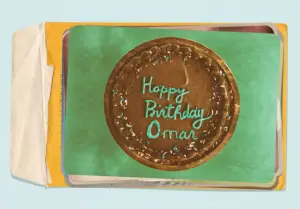
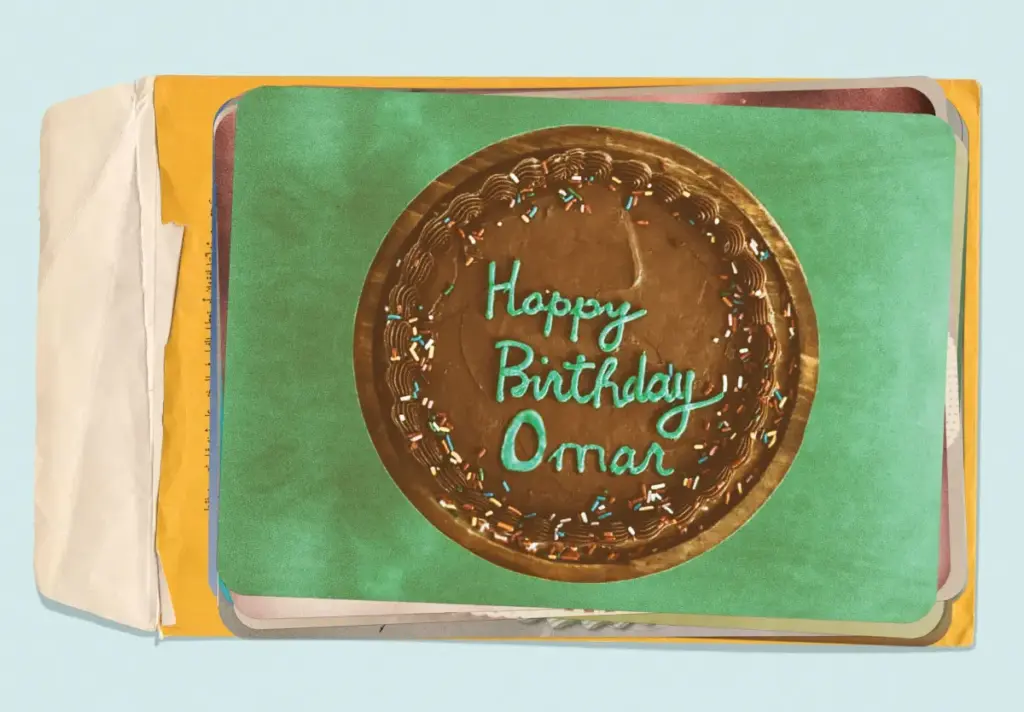
Decades later, with a PhD and a prestigious Museum of Modern Art (MoMA) retrospective under his belt, Raad returned to that formative image for a series of digitally fabricated birthday cakes addressed to various political leaders whom history makes difficult to celebrate: happy birthday to Ali, Kamal, Tony, Walid; joyeux anniversaire to Yasser, Elias, Nabih, Amine. By the time of these later artworks, Nasrallah had risen to lead Hezbollah before being killed in an Israeli airstrike in 2024. Raad’s colorful, meticulously rendered cakes are at once cheerful and chilling—representing his trademark tragicomic blend of fiction and historical fact. In these sculptures, much like the rest of his celebrated body of work, grand geopolitical events unfold on an intimate, profoundly human scale.
Begun, in a spiritual sense, when Raad was just a teenager in Beirut, this ongoing engagement with archival fragments defines his artistic method. He typically starts with something verifiably true—a historical document, a photograph, a receipt—and then extrapolates its underlying logic to create something fictional, speculative, and perhaps a little fantastical. That distinctive methodology has carried him through a nearly 40-year career and counting, establishing him as one of the most innovative conceptual artists of his generation.

The Venice Biennale and the Politics of the Archive
Raad’s work is currently a standout feature in the main exhibition of the Venice Biennale, where his paintings, drawings, and photographs of banal-seeming beds spring to intellectual life when visitors read the accompanying wall text. According to the notes, these beds were slept in by Yasser Arafat, who “is said to have never slept in the same bed two nights in a row.” Given that the Palestine Liberation Organization (PLO) leader survived more than 40 assassination attempts throughout his tumultuous life, “he could not afford to throw caution to the wind… so he lived—and slept—on the move.” Raad notes that he has spent three decades searching for the actual beds Arafat inhabited, drafting incomplete paintings of mattresses and duvets that he seemingly cannot finish.
Across both his bed paintings and his birthday cake series, the narrative unfolds quite literally along the edges of the images. The paintings of the beds remain intentionally incomplete, bordered with raw tape and visible brushstrokes. Meanwhile, the birthday cakes often appear pulled out of weathered manila envelopes alongside piles of archival photographs, presented as if they were being formally entered into evidence at a criminal trial. Raad has frequently stated that through these creations, he is simply “creating the documents I wished already existed.”
Discussing Raad’s Arafat pictures at the Biennale, the prominent scholar Saidiya Hartman described his “belief in the imaginative and the speculative” as “critical.” Hartman has devoted her own life’s work to imagining the lives of oppressed people who left only sparse, fragmented traces in official archives—individuals who were silenced, illiterate, coerced, or forced to lead clandestine lives, much like Arafat. She terms her distinct approach “critical fabulation.”
Indeed, Raad is best known for his own method of fabulation, masterfully marrying stories and pictures, imagination and documented history. This way of working is deeply tied to his primary subject matter: the Arab world, its complex politics, and its devastating conflicts—most notably the Lebanese Civil War that tore the country apart between 1975 and 1990. While a constant flood of images and competing media narratives has come to define the modern digital age, this early battleground of information and misinformation left profound marks on the region.
“During the war,” remembers Khalil Joreige, another Lebanese artist exhibiting alongside Raad in the Venice Biennale, “every militia had its own media station, television, newspaper, or radio. There was a real war of images” that heavily influenced his generation’s “sophisticated relationship to images.”

Harvard art historian Carrie Lambert-Beatty has accordingly described Raad’s work as a prime exemplar of “parafiction,” noting that one of the most powerful things art can achieve is to prompt viewers to experience a given scenario as having been true—while simultaneously reminding them that alternative worlds are always possible. In a recent book dedicated to artistic research, art historian Claire Bishop singled out Raad as well, observing that while many contemporary research-based artists merely reproduce the overwhelming experience of information overload through documents displayed in vitrines, Raad offers genuine synthesis through narrative. Crucially, he achieves this without collapsing into the trope of authoritative master narratives that so much research-based art actively resists.
In her book Fables & Forensics, author and critic-at-large notes Raad’s work as a form of surrealism tailored for the information age, highlighting how he gives playful form to the ordinary yet dizzying glut of misinformation—all without ever falling into the trap of reproducing fake news. Any fact, whether a mattress or a birthday cake, could easily be mistaken for historical truth, yet there are always deliberate clues pointing to the constructed nature of his documents. One simply has to look closely at the edges.
The Atlas Group and the Fiction of Documentation
Raad’s international renown was largely built upon the work he created under the guise of a fictional collective known as the Atlas Group, a project that interrogates photography’s deeply fraught relationship with objective truth. Through works like the video Hostage: The Bachar tapes (#17 and #31)—attributed to the year 2000—the collective presented the narrative of Souheil Bachar, who recounted his decade-long experience from 1983 to 1993 being held hostage in Lebanon alongside five Western men as the sole Arab captive. While some scenes show Bachar simply standing against a blank white wall, the video subtly reveals its own manipulation through green-screened footage of Ronald Reagan. Other clues require linguistic fluency; viewers who do not speak Arabic might entirely miss moments where Bachar’s spoken words directly contradict the English subtitles provided on screen.
Raad has stated that the Atlas Group officially operated from 1989 to 2004. However, dates—like all facts in Raad’s practice—are treated as a flexible medium rather than rigid constraints. Major magazines and international museums have occasionally traced the group’s origin back to 1967, the year of Raad’s birth, or even to 1948 or 1945. Furthermore, the collective has frequently attributed archival photographs to entirely nonexistent institutions, such as the Museum of Fine Art New York.
Both the Tate in London and the Museum of Modern Art in New York have acquired editions of his acclaimed series “My Neck Is Thinner than a Hair: Engines,” yet each institution lists the creation dates differently—cataloging them as 2000–03 and 1996–2004, respectively. And although Raad maintains that he disbanded the Atlas Group in 2004, a work attributed to the collective appeared in the Venice Biennale catalog with the publication date “printed 2023,” leaving it deliberately ambiguous when the piece was truly made and whether the group has genuinely ceased to exist.

Still, one timeline remains clear: over the past two decades, sparked by a pivotal shift around 2005, Raad’s work has grown increasingly uncanny. While the Atlas Group successfully primed audiences to view historical documents as unstable and constructed, his later projects ask viewers to contend with shrunken objects, resurrected paintings, and metaphorical vampires lurking within the archives. The old framework of straightforward fact and fiction no longer fully captures the scope of his practice.
Archives, Upstate New York, and the Concept of Withdrawal
In a restored 19th-century barn perched high on a peak in the "Irish Alps" of upstate New York, roughly an hour’s drive from Bard College where he teaches, Raad maintains a meticulous archive of his life and career. He and his wife duplicated the historic barn’s exact floor plan to build their adjacent home nearby. The view from their front porch resembles a classic Hudson River School landscape painting, providing a tranquil contrast to the geopolitical turbulence that inspires much of his art.
Meeting Raad in person offers a peek behind the curtain of a deliberately elusive public persona. For over two decades, he has worked diligently to keep his physical likeness off the internet, populating search algorithms with alternative faces to throw observers off his scent. When asked about this evasion, he offered a single word—“phobia”—though it is difficult not to view it as yet another extension of how Raad uses photography not to capture and domesticate the world, but to make it feel larger, stranger, and more mysterious. In person, he is warm and welcoming, preparing traditional dishes like homemade tabbouleh and hummus with sumac and olive oil.
Inside the barn, Raad stores ephemeral materials such as exhibition wall labels and name cards from formal dinners he has attended, serving as raw fodder that may eventually transform into future artworks. A leather portfolio contained his early juvenilia, including the teenage photographs he shot while attending high school in Boston. (“They had a darkroom and they had a basketball team, so it was great,” he recalled.) During those years, he experimented with mimicking the distinct visual styles of masters like Cindy Sherman, Diane Arbus, Garry Winogrand, Stephen Shore, Henri Cartier-Bresson, and Lucas Samaras. While he successfully mastered their techniques, the most enduring lesson he took away was the profound psychological experience of adopting a persona from behind the camera lens.
In 1985, Raad began his undergraduate studies at the Rochester Institute of Technology, initially majoring in medicine before shifting his focus entirely to photography. During his time there, he won his first photography prize for a work created under the pseudonym P.X. Chesterfield—a name inspired by real U.S. Marine Corps general P.X. Kelley, whose moniker he simply thought sounded cool. Soon afterward, he enrolled in the University of Rochester’s Cultural and Visual Studies PhD program, which boasted a rising-star faculty including Craig Owens, Kaja Silverman, and Douglas Crimp. It was “psychoanalysis, linguistics, and Marxism,” Raad explained, describing it as “the holy trinity.” For the young artist, persona, critical theory, and photography were beginning to converge.

As a student, Raad visited and photographed Beirut every summer, a routine he maintains to this day. Back home, he attempted to apply the observational techniques of Diane Arbus or Eugène Atget that he studied in photography magazines provided by his father. Yet he quickly realized that “even something as simple as using a tripod was impossible… in a city that’s full of snipers.” Nor was he making traditional war photography; he never captured the active violence, focusing instead exclusively on the aftermath.
After photographing sites scarred by detonated bombs, Raad often felt that something essential was still missing from the frame. Consequently, he began intervening directly in the pictures, outlining the debris with red pencil marks. The conceptual kernels of his most famous projects are clearly visible in these teenage experiments, reflecting an artist whose early inquiries centered on “a certain way of thinking about violence and trauma.”
Versions of those red circles recur in the Atlas Group’s Let’s Be Honest, the Weather Helped (1998/2006), featuring black-and-white snapshots of Beirut marked with brightly colored dots corresponding to the official coding systems ammunition manufacturers use to identify cartridges and shells—and thus, indirectly, their corporate makers. In Raad’s hands, those forensic notations read simultaneously as analytical data and festive confetti.
Under the Atlas Group, Raad also crafted elaborate personas like the gambling historian Dr. Fadl Fakhouri and the unlucky police detective Yussef Bitar—“very serious, very professional people,” as he described them, the exact sort likely to leave behind official records. But eventually, he found the structural confines of the Atlas Group “somewhat limited” and grew interested in exploring how “violence has more insidious effects than we know.” Besides, he noted, by the early 2000s, he felt that “the language of maps and archives had been exhausted.”
The Influence of Jalal Toufic and the Theory of Withdrawal
Raad’s theoretical trajectory shifted dramatically after he met Lebanese writer and artist Jalal Toufic in the early 1990s while working on a video project concerning the Israeli occupation of South Lebanon. He began reading Toufic’s dense books, which he initially found difficult to parse before discovering Forthcoming (2000). The book includes a story about a classically trained photographer who cannot stop producing blurry, indistinct pictures of buildings in Beirut—a description Raad immediately recognized as a reflection of himself.

“I freaked out,” Raad recalled. “It was as if he could hear my internal monologue.” He reflected on how basic photographic tools—such as a tripod—had been rendered unavailable to him in wartime Beirut, but soon began thinking more expansively about all the immaterial things that violence had withdrawn from him and his society. His academic training in Rochester had taught him that language, the human psyche, and the economy constituted the fabric of the world, but Toufic provided him with a vocabulary for cultural dimensions he had never previously encountered.
Toufic’s influence permeated nearly everything Raad produced afterward. “I’m embarrassed by how much I talk about that guy,” he admitted. “It’s as if I cannot have a thought without passing through him.” Of lasting impact was Toufic’s concept of “withdrawal,” articulated most explicitly in The Withdrawal of Tradition Past a Surpassing Disaster (2009). In this work, Toufic describes the immaterial losses that occur in the wake of major cultural upheavals—the ways that rituals, art forms, and traditions become unavailable or lose their potency when the society that birthed them is irreversibly altered by catastrophe.
According to Toufic’s framework, tradition might be clung to steadfastly after a disaster, or it might be suppressed entirely in futile attempts to achieve a clean slate. When a tradition resurfaces in a completely new context, something is always fundamentally altered; Toufic terms this act a “resurrection,” because the tradition is not truly alive so much as undead. The artist’s primary task is to make this withdrawal palpable—to make absence present, much like the missing reflection in vampire lore.
This concept of withdrawal heavily informed the pivotal exhibition Raad mounted at the Sfeir-Semler Gallery, the Arab world’s first white-cube contemporary gallery, which opened in 2005. After declining several invitations, he finally acquiesced in 2008, sensing that something felt deeply amiss. Upon arriving at the gallery, he discovered that the Atlas Group artworks he had shipped had inexplicably shrunk to one-one-hundredth of their original size. When asked how such a phenomenon could occur, Raad explained that “there are conditions under which your own work is no longer available to you, and your only relation to it feels distorted.” For him, this phenomenon is neither a psychological symptom nor a metaphor; it is the physical manifestation of withdrawal.
The close conceptual affinities between Raad and Toufic have even sparked rumors among peers that Toufic might simply be another of Raad’s elaborate personas—a theory that would require hiring a body double to appear publicly alongside him. Yet while Raad is undeniably skilled at constructing fictions, his goal is less about pulling off pranks than exploring fables and investigating what happens when an idea is imagined as true.

Continuing Explorations in Magical Realism and Absence
Following the conclusion of the Atlas Group, Raad’s work expanded beyond the binary of fact and fiction into a realm closer to magical realism, where traditional photography played a less central role. Better be watching the clouds again and again (2000/2017) is a series of collages attributed to a fictional Lebanese Army officer named Fadwa Hassoun, who trained as a botanist. During the wartime years, Hassoun assigned prominent political figures flowers as secret code names; the resulting artworks feature black-and-white portraits of leaders like Benjamin Netanyahu, Saddam Hussein, and Ronald Reagan with their heads crowned by vibrant flower petals and their bodies transformed into stems.
More recently, Raad collaborated with graphic designer Pierre Huyghebaert on I thought I’d escape my fate (again) (2025), an installation gathering statements from individuals involved in museum exhibitions and cultural programs that were abruptly canceled due to expressions of solidarity with Palestine. Printed in small text, cut out, and taped low along gallery baseboards, these quotes require physical effort—crouching down—to read. What immediately catches the eye instead are colorful strips of tape stretching across the walls, serving as empty placeholders for the artworks that were never permitted to hang. It stands as another stark example of how historical conflict leaves traces visible in cultural spaces primarily through absence.
Toufic’s vampire-mirror metaphor resurfaces directly in other recent works by Raad shown in Venice. Copies of stolen Arab and Turkish artworks appear painted on the undersides of discarded wooden pallets. In these pieces, Raad treats modern Arab art itself as the undead subject—holding up a mirror to a cultural market currently undergoing a trendy wave of “rediscovery” or resurrection. An accompanying wall text notes that when the Lebanese Civil War ended in 1990, local militias sold off vast caches of weapons, many of which eventually found their way to the Balkans to fuel the Yugoslav Wars. The text adds that these painted pallets were recently discovered in Ljubljana at the Moderna Galerija, where Raad conveniently had just closed a major mid-career retrospective.
Looking ahead, Raad’s upcoming exhibition at the Paula Cooper Gallery in New York will feature a vintage Volkswagen Beetle placed upside down on its roof like a dying insect—a direct reference to the "flying Volkswagens," the grim nickname American soldiers gave to the artillery shells they fired on Beirut during the 1980s. Surrounding the installation on the gallery walls will be reproductions of handwritten messages left on actual bombs by soldiers serving in various global conflicts, written in English, Russian, Arabic, Hebrew, and French. Sourced from images posted by boastful soldiers on social media platforms like Reddit, Raad has subtly exaggerated the size and altered the colors of their inscriptions. In works like these, little fiction is required: sometimes, historical reality is already strange enough.