Every December 31, hundreds of thousands of people gather for hours in the freezing cold to stare intently at One Times Square, waiting for a glittering ball to slide down its flagpole as the clock strikes midnight. On any other day of the year, tens of thousands more—office workers, tourists, and locals navigating the bustling neighborhood surrounding theaters, hotels, and historic media institutions—walk back and forth right past the iconic 25-story tower. Yet if you asked any of them to close their eyes and describe that narrow wedge of a building, they would likely be stumped.
For much of the past century, the structure marking Manhattan’s most celebrated pinch point at the southern edge of Times Square has remained largely vacant and hidden in plain sight, masked by a dazzling patchwork of massive digital billboards. Now, however, the real estate investment firm Jamestown, which has owned the property for nearly three decades, has finally hit on an ambitious strategy to make its interior square footage earn its keep: by creating an indoor simulacrum of the outdoor simulacrum that is Times Square itself.
The Architectural Challenge of a Manhattan Icon
For decades, One Times Square has suffered from a fundamental architectural limitation: its cramped, triangular floorplates function poorly as modern office space. By the time a developer factors in the mandatory elevators, stairways, air ducts, plumbing systems, and insulation required for a skyscraper, there is scant room left to maneuver or design functional workspaces.
While the brilliant billboards attached to the exterior generate substantial revenue and contribute immensely to the square’s famous radiance, they effectively keep the interiors dark and cryptlike. Recognizing these constraints, Jamestown opted to fill the tower with play spaces rather than traditional workspaces, transforming an obsolete corporate relic into a vertical entertainment destination.
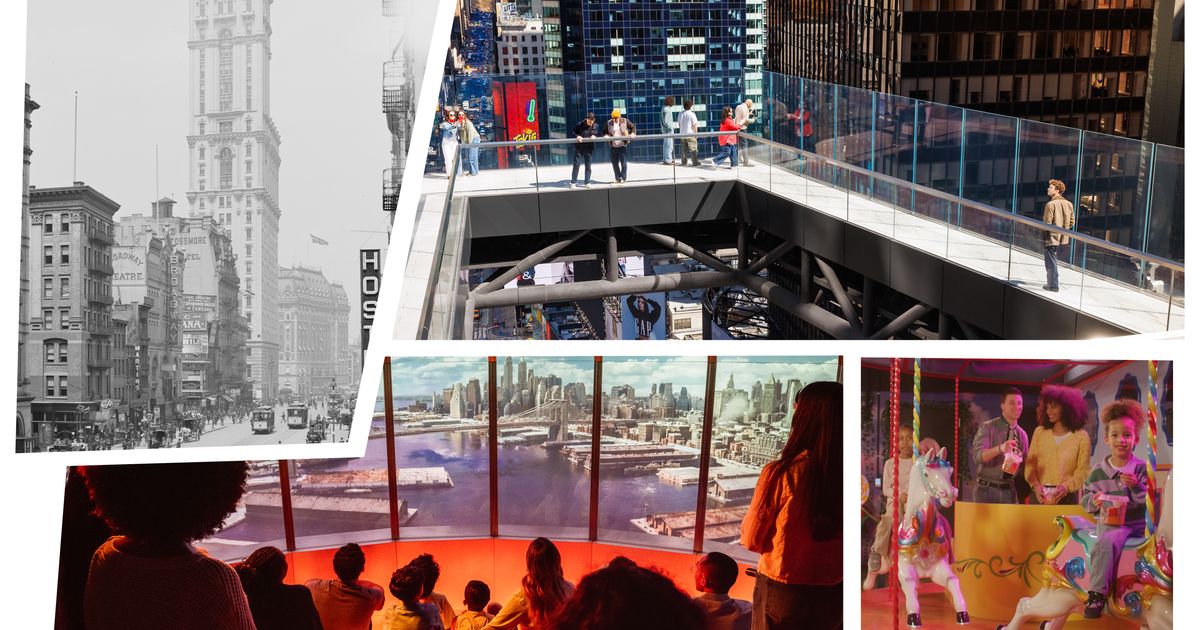
Among the prominent new attractions occupying the building is the iCandy Experience, a four-story, full-immersion sugary overload designed to captivate visitors of all ages. Times Square was already home to massive confectionery flagships like Sugar Factory, Hershey’s Chocolate World, and M&M’s New York—destinations specifically conceived to overstimulate children and sweet-toothed adults. Yet the iCandy Experience attempts to outdo all historical precedents by allowing visitors to scamper around a toy-size miniature city. Complete with a toy fire truck, a construction site, a whimsical crypt, a simulated subway platform, and other urban wonders, the space is surrounded by seemingly endless bins of treats waiting to be scooped out by eager hands.
Novelty Venues and Modern Adaptations
Beyond the retail and candy-themed attractions, the building now features a two-level indoor wedding venue that functions as a hybrid between New York City’s municipal bureaucracy and the high-speed chapel culture of Las Vegas. For a fee of $600—significantly higher than the traditional $25 fee at the Manhattan Marriage Bureau on Worth Street, but still marketed as a relative bargain for prime real estate—couples can march through a facility decorated in a deliberately sterile, bureaucratic style. They can exchange vows inside a Valentine’s-red chapel, pose on a balcony with the electroluminescent heart of Midtown looming directly behind them, and even have their wedding photographs broadcast live on a multistory exterior screen. The resulting experience allows couples to get married in the literal heart of New York City while replicating the aesthetic of getting married at Las Vegas’s New York-New York Hotel and Casino.
Within this awkward architectural relic of several distinct eras, New York’s multifaceted past is continually fetishized, chopped up, and whirled together into digestible pieces of modern entertainment. One Times Square certainly possesses a genuinely rich and storied history. Built in 1904 as the corporate headquarters for the New York Times, then the city’s fourth most widely read newspaper, the skinny, stone-faced Italianate tower famously announced its arrival with a grand display of New Year’s Eve fireworks.
When those fireworks were banned from Midtown Manhattan just a few years later, Times publisher Adolph Ochs replaced them with the iconic ball drop. The design was an architectural echo of the time-ball devices used historically to synchronize marine clocks at the Royal Observatory in Greenwich, England, and more immediately at the Western Union building on lower Broadway.
The New York Times quickly outgrew its namesake home, which had already begun to transition into a prominent platform for public display. The newsroom and core operations eventually moved to the paper’s annex on West 43rd Street, while the famous electric news crawl, widely known as the "zipper," began wrapping around One Times Square starting in 1928.
A Century of Transformation
The tower’s fortunes waxed and waned over the subsequent decades until Allied Chemical purchased the building in 1963. In an effort to modernize, the company stripped off the building’s textured brick and terracotta facade, replacing it with sleek, jet-age white marble panels. However, this cosmetic transformation failed to resolve the core issue of how to effectively utilize the interior space. Allied Chemical ultimately set aside a portion of the building to house a three-floor public showroom dedicated to industrial innovations.
Eventually, the interior fell largely vacant once again, while the exterior acquired a second skin of billboards, effectively converting the skyscraper into little more than a structural scaffolding for advertisements. One of New York’s most celebrated office towers had officially turned into a Hollywood-backlot version of itself.
In its latest architectural incarnation, designed by the firm S9, the curtain wall has been darkened while the electronic billboards have grown even brighter, making the tower resemble a massive digital television mount—more apparatus than traditional architecture. This aesthetic shift is entirely appropriate, as the technological breakthrough enabling Jamestown to finally revive the interiors of One Times Square is the rapid evolution of flexible digital screens that can seamlessly curve along walls and respond directly to human touch.

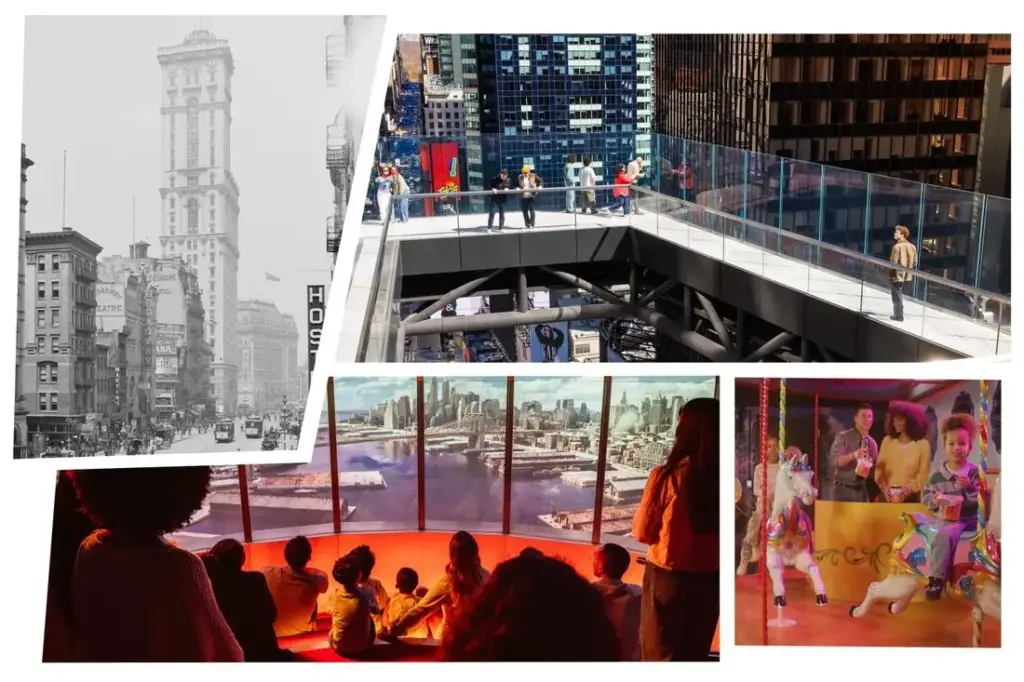
The result of this technological integration is Times Travel, a ticketed, immersive journey tracing the history of Times Square and the evolution of the New Year’s Eve Ball, culminating in a direct view of the physical city outside. It serves as a backward-looking, high-tech evolution of Allied Chemical’s mid-century futuristic exhibitions. As a notable practical addition, the building also houses a rare urban amenity: an entire floor dedicated to free public restrooms.
The Immersive Journey to the Skyline
Visitors purchasing a ticket begin their journey past the lobby, filing along a snaking path flanked by a gauntlet of dynamic screens before taking an elevator up to a series of rooms filled with even more digital displays. Along the way, historical photographs of early-20th-century Manhattan are interspersed with digital re-creations produced just before the widespread adoption of modern hyperrealism, giving them a quaintly cartoonish aesthetic. Crowds dressed in anachronistic fashion mashups—combining 1950s fedoras, 1940s newsboy caps, and 1960s pillbox hats—celebrate an ambiguous, generalized New Year’s Eve of the past.
Visitors can take a seat inside a simulated taxicab where a virtual driver whisks them through various decades of neighborhood brightness, moving from dim antiquity through historical cultural milestones all the way up to the ultra-high-resolution dazzle of the present day. In another screening chamber, an animated loop depicts construction workers clambering across the steel skeleton of the very building visitors are standing inside, complete with recorded voice actors speaking in generalized immigrant accents.
This sequence of make-believe serves as the prelude before the main attraction. Visitors eventually emerge onto a 17th-floor roof terrace with a view so uncannily realistic that it takes a moment to recognize it is entirely authentic. Featuring an overhead canopy, a structural cutout in the concrete slab, and surrounding glass catwalks, the terrace cannot compete with other skyscrapers for sheer vertical loftiness. Instead, its primary selling point is that it places visitors directly into the urban fabric at street level rather than far above it.
From this vantage point, the surrounding matrix of streets and skyscrapers—including Art Deco ziggurats, Beaux-Arts structures, and mid-century glass-skinned blocks—can be read as a vivid urban simulation, particularly when viewed through clear glass walls. For an added thrill, portions of the perimeter pathway are transparent, allowing visitors to look straight past their shoes down to the heads of pedestrians walking two hundred feet below. Just above this observation level rests the real New Year’s Eve Ball, poised quietly for its next global broadcast.
Stepping back out through the exit onto the physical street to join the shuffling crowds of tourists and street performers makes the surrounding reality of Times Square feel surprisingly authentic by comparison. The sharp transition back to everyday city life prompts questions about who would travel across the world to visit a manufactured, containerized version of Manhattan. Yet this ticketed microcosm, fabricated entirely out of sugar and pixels, oddly distills the spirit of a place that has long traded in self-parody for profit. The underlying ethos of these few neon-drenched blocks has always leaned into commercial spectacle. By bringing that spectacle indoors, Jamestown has ensured that the modern iteration of One Times Square embraces its identity completely.