In a breakthrough that could significantly advance global efforts to combat climate change and transition toward a circular economy, scientists have uncovered thousands of previously overlooked chemical reactions critical to converting carbon dioxide into valuable green fuels and industrial chemicals. By blending the predictive power of machine learning with advanced quantum mechanics simulations, an interdisciplinary research team at the Indian Institute of Science (IISc) identified 9,389 individual reactions taking place simultaneously on a copper catalyst surface. This massive network reveals unexpected chemical pathways that traditional, simplified models have historically missed.
The findings, published recently in the prestigious journal Nature Communications, offer a roadmap for scientists and engineers striving to develop more effective, high-yield catalysts for transforming captured greenhouse gases into useful commodities, such as methanol. Furthermore, the research exposed a surprising fundamental behavior regarding how hydrogen gas participates in these catalytic reactions, directly challenging long-held assumptions within the field of chemical engineering and heterogeneous catalysis.
The Hidden Complexity of Carbon Dioxide Recycling
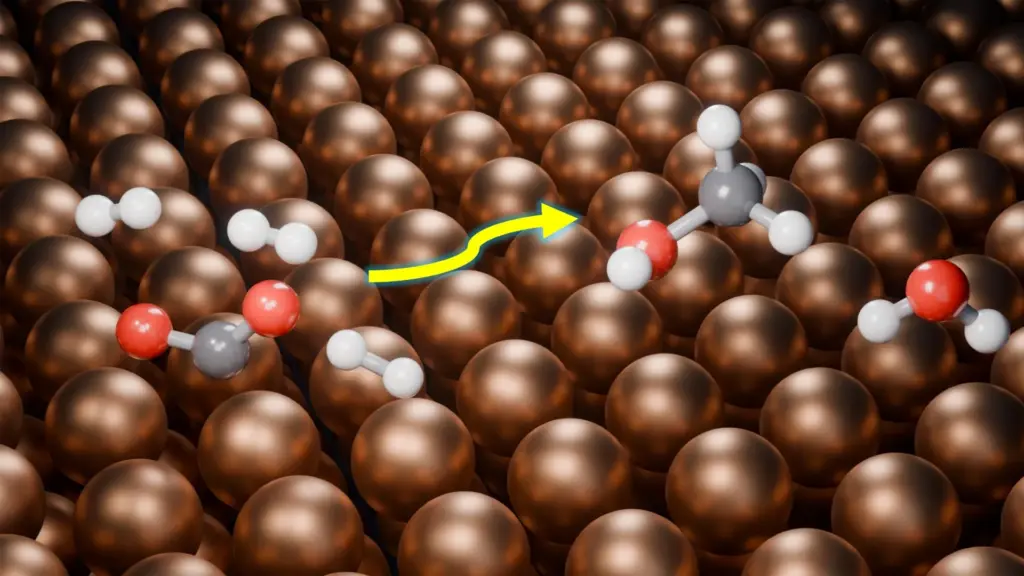
One of the most promising technological approaches to recycling captured carbon dioxide emissions is catalytic hydrogenation. In this process, a specialized solid catalyst is employed to facilitate a reaction between carbon dioxide and hydrogen gas, successfully binding them together to form industrially valuable chemicals, most notably methanol. Methanol serves as a vital building block for a vast array of chemicals, plastics, and synthetic hydrocarbons, and can also be utilized directly as a clean-burning fuel or hydrogen carrier.
However, executing this transformation efficiently on an industrial scale is extraordinarily complex. The catalytic process involves an immense, tangled web of individual chemical reactions taking place across the microscopic and atomic topography of the catalyst’s surface. Accurately simulating every single possible quantum mechanical step required for these molecular transformations demands immense computational power.
Because computing every trajectory is prohibitively resource-intensive, researchers have historically been forced to rely on severe simplifications. Typically, computational chemists focus on a very limited selection of reaction pathways that are widely believed, based on intuition or legacy literature, to be the most important. While practical, this reductionist approach carries a profound risk: it can leave hundreds or even thousands of potentially critical, nuanced reaction steps completely out of the picture.
Anand Mohan Verma, the first author of the study who conducted the research as a CV Raman Postdoctoral Fellow at IISc and is now an Assistant Professor at the Motilal Nehru National Institute of Technology Allahabad (MNNIT Allahabad), highlighted this foundational anxiety in mechanistic research. "We began with a worry familiar to anyone who does mechanistic modeling: How do you know that your reaction network has not omitted the one step that matters?" Verma noted.
AI Reveals Thousands of Overlooked Chemical Reactions
To systematically address and overcome this methodological limitation, the research team designed a hybrid computational workflow. They began by utilizing rigorous quantum mechanics simulations to construct a detailed foundational database containing 152 baseline chemical reactions. Recognizing that manual quantum calculations for thousands of additional steps would take centuries of computer time, the team then trained sophisticated machine learning models. These AI models were specifically calibrated to quickly and accurately estimate the energy barriers that additional, unmapped reactions would need to overcome to proceed.
Equipped with automated computational tools powered by these machine learning algorithms, the scientists systematically mapped out potential reactions involving 105 distinct chemical species present on the copper catalyst surface. They analyzed thermodynamic and kinetic parameters to determine which molecular transformations could realistically take place in a single reaction step. This innovative, automated expansion strategy dramatically scaled up their analytical network, expanding the original baseline of just 152 reactions to an astonishing 9,389 interconnected pathways.
The analytical discrepancy between the small network and the massively expanded network was immediate and profound. When the researchers relied solely on their conventional, smaller network, their predictive model yielded inaccurate conclusions. Most notably, it incorrectly identified formic acid as the primary reaction product rather than the commercially desired methanol. Moreover, the restricted model predicted substantially lower overall rates of carbon dioxide conversion than what had been consistently observed in physical, real-world laboratory experiments.
Ananth Govind Rajan, corresponding author of the study and an Associate Professor in the Department of Chemical Engineering at IISc, elaborated on the stark contrast in model behavior. "When we modeled the process using the 152 reactions considered initially, the network wrongly predicted formic acid, not methanol, as the major product, and underestimated how much CO2 gets converted," Rajan explained. "Only when we expanded the network to include thousands of additional, previously overlooked reactions did the predictions fall in line with what we and others see experimentally."
Expanded Model Predicts 40 Times More CO2 Conversion
The practical implications of mapping this vast reaction network became fully apparent when the scientists incorporated the expanded data into a kinetic model designed to evaluate how quickly the various chemical processes occur. Upon running the simulation with all 9,389 reactions factored in, the predicted amount of carbon dioxide conversion increased by approximately 40 times compared with the output of the original, restricted model.
Beyond merely capturing higher conversion volumes, the comprehensive model successfully aligned theoretical predictions with physical reality. It correctly identified both methanol and carbon monoxide as the major products of the catalytic system, bringing computational theory into direct agreement with empirical findings gathered by experimental partners.
Crucially, the study was strengthened by rigorous experimental validation. Physical testing and validation of the computational predictions were carried out by G Valavarasu and Santhosh Kotni at Hindustan Petroleum Corporation Limited’s Green Research and Development Centre. Additional experimental insights were provided by Amol Amrute and their research colleagues at the Agency for Science, Technology, and Research in Singapore. Furthermore, the development and refinement of the underlying machine learning models benefited significantly from the expertise of Ambedkar Dukkipati, a Professor in the Department of Computer Science and Automation at IISc.
A Surprising Hydrogen Pathway Challenges Conventional Chemistry
Perhaps the most scientifically startling outcome of mapping such a massive reaction network was the exposure of an entirely unexpected physical mechanism involving hydrogen. In standard chemical instruction and conventional catalytic theory, hydrogen gas molecules are universally understood to dissociate—splitting into separate, individual hydrogen atoms—before they can participate in surface reactions with intermediate carbon and oxygen compounds.
However, the IISc team’s expansive reaction network revealed that in several crucial reaction steps, hydrogen could be transferred to intermediate chemical compounds directly as an intact molecular unit, or $H_2$, rather than arriving exclusively through dissociated individual hydrogen atoms. To verify this surprising finding, the researchers conducted additional, highly targeted quantum mechanics calculations. These follow-up analyses confirmed that this direct molecular transfer pathway is not only physically possible, but can be especially thermodynamically favorable when hydrogen is transferred to chemical intermediates containing oxygen atoms.
This discovery challenges long-standing pedagogical assumptions regarding how hydrogen behaves during heterogeneous catalytic reactions. It offers fresh theoretical insights that could fundamentally alter how chemical engineers approach catalyst design for green energy applications.
"The idea that hydrogen can transfer as an intact molecule, without first splitting into atoms, runs against what most of us were taught," remarked co-author Shivam Chaturvedi, a PhD student in the Department of Chemical Engineering at IISc. "This surfaced only because the network was large enough to allow for it, and the observation held up when we went back and computed those steps explicitly. This also suggests that catalysts that interact more strongly with $H_2$ could potentially enhance pathways leading to methanol."
The research team believes that capitalizing on this unexpected molecular hydrogen transfer mechanism could guide the intentional design of advanced catalysts. By tailoring materials to interact more effectively with molecular hydrogen, chemical manufacturers could potentially optimize the chemical pathways responsible for synthesizing methanol and other sustainable fuels directly from captured carbon dioxide.
Looking ahead, the broader computational and methodological framework developed by the IISc team holds significant promise well beyond the specific scope of carbon dioxide hydrogenation. By seamlessly integrating quantum mechanics simulations, machine learning algorithms, automated identification of chemical pathways, and precise reaction rate modeling, the approach offers a powerful new paradigm for investigating a wide array of complex industrial processes.
Potential future applications for this methodology include investigating carbon dioxide reduction using alternative metal catalysts, advancing nitrogen reduction technologies for sustainable ammonia production, and optimizing catalytic water splitting for green hydrogen generation. By bringing to light critical chemical steps that simpler, traditional models inevitably miss, the technique provides scientists with a far more complete and accurate picture of complex catalytic reactions, opening up new avenues to improve the industrial processes essential for a sustainable chemical economy.