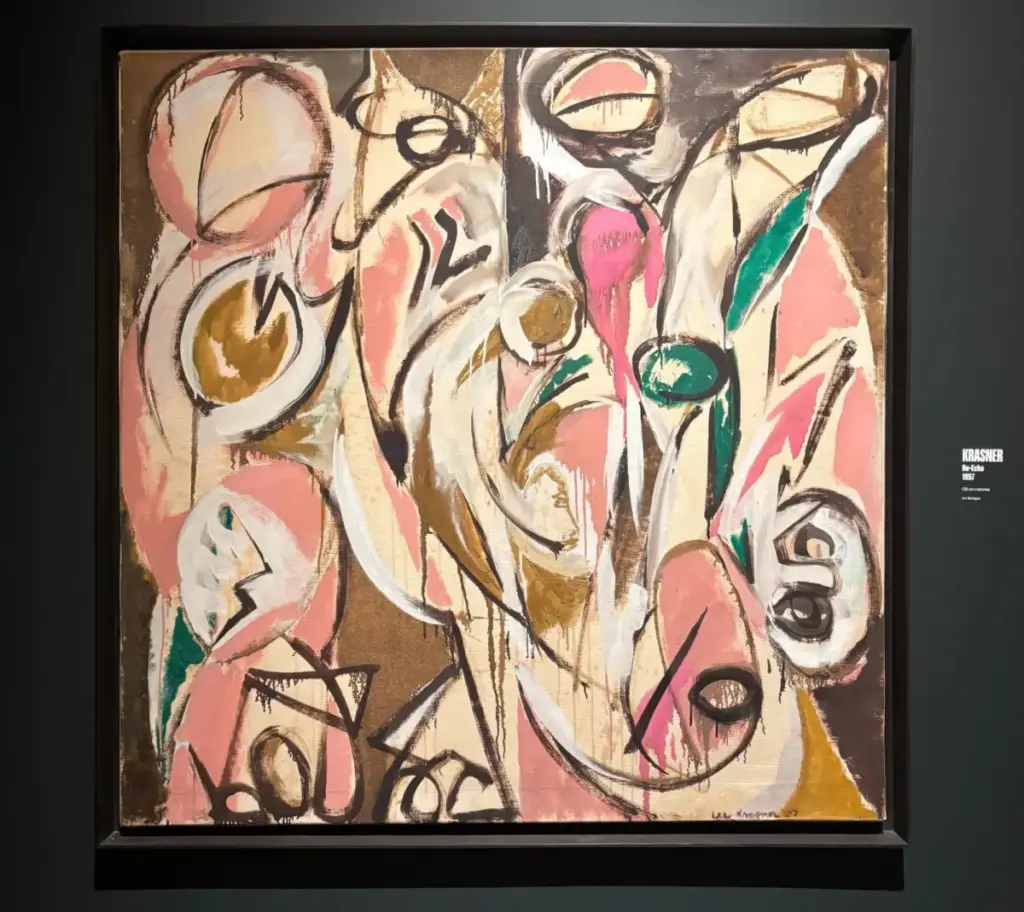
If you are looking for bias or reparations, these volatile contents are all on the surface, quietly and neatly presented.
I was married to an artist once. It was not a good experience, although calling it “an experience” makes it sound like a unified, parsable thing, and it wasn’t that, either. We’re all adults here, is what I’m getting at — so no one should imagine that anyone has bulletproof insight into anyone else’s romantic relationship, much less their own. Certainly, once a relationship is over, it becomes a moving target in permanence: the good, the bad, and the ugly all trading places, each a microcosm in which various genres of chaos and ecstasy hold sway. And whatever we may think of other people’s marriages, we must take care. What we believe we know is almost always something we meant to say about ourselves. The phone call is coming from inside the building. If you see something, well, see something.
The Metropolitan Museum of Art’s new exhibition, Krasner and Pollock: Past Continuous, is by any reckoning one of the most gorgeously designed and ingeniously installed exhibitions in the museum’s history. Yet its strength is in its unfussiness, because there is no mystery about the subtext here. Although the title hints at deeper questions about the restorative power of memory, we all know why we’ve come to these mostly windowless galleries tucked into a somewhat hard-to-access section of the museum’s second floor. We want to stare at somebody else’s marriage.
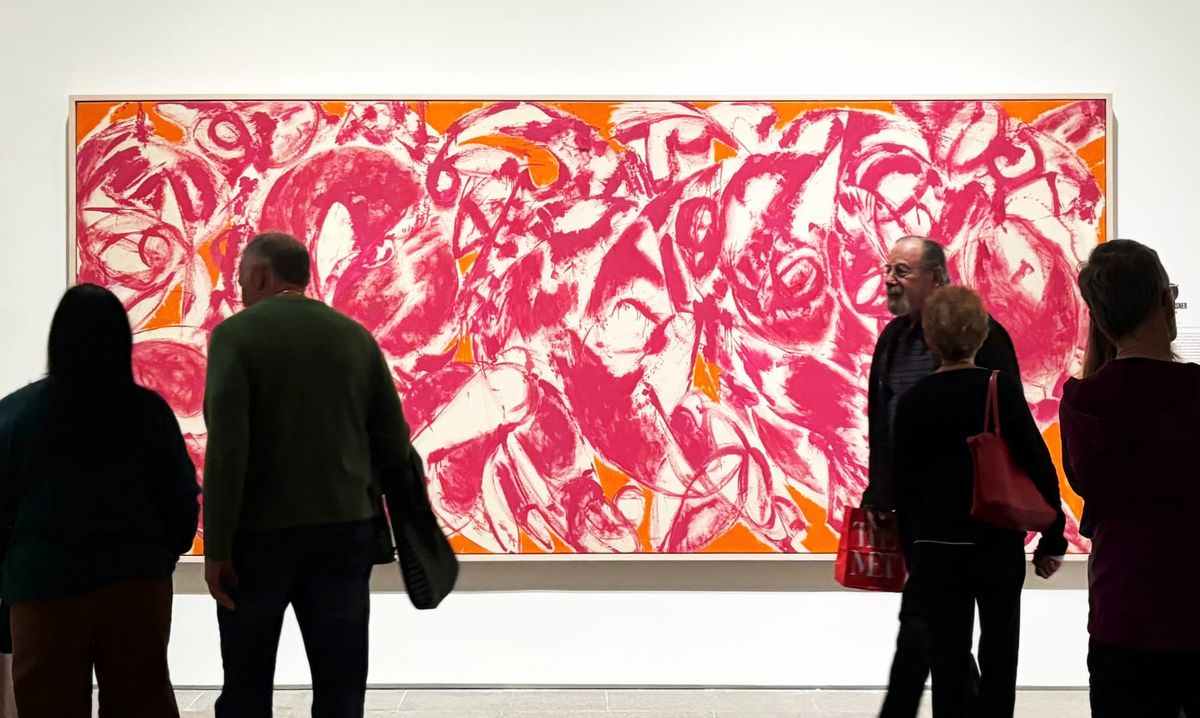
Even more than this, we want to know how she did it. How did Lee Krasner make these intricate and small and big and brash paintings? How did she survive being married to a man who was briefly the most famous artist in America, and who died while driving under the influence? How did she — unlike Edith Metzger, a passenger in the car Pollock crashed on the night of August 11, 1956 — make it out alive, and, moreover, what did it mean for her art?
Navigating the weekend crowds at a major cultural institution can often feel more like a test of endurance than an encounter with fine art. Arriving at the entry to Past Continuous meant first fighting one’s way through the dense Saturday afternoon throngs that regularly fill the cavernous halls of The Met, transforming what should be a quiet contemplation into something approaching a punishment. Yet, once the threshold of the special exhibition is crossed, the atmosphere shifts dramatically.
Visitors are greeted by a narrow, carefully lit hallway featuring a silent video installation. This introductory passage displays a mesmerizing montage of collaged film and photographic images documenting Lee Krasner and Jackson Pollock’s life together at their rustic home and cottage in Springs, Long Island. It is an evocative prelude, setting a reflective and slightly melancholic tone before one even encounters the physical canvases.
Standing in that narrow corridor, lingering amid the ambient light and moving images, the boundary between historical observation and personal intrusion begins to blur. The atmosphere invites a meditative state, one that is easily disrupted by the unfiltered realities of public gallery-going. During a recent visit, this contemplative reverie was sharply broken. Another visitor, apparently studying the archival photographs of Krasner and Pollock posed side-by-side, turned to her companion and delivered a remarkably unvarnished assessment.

"The lady was a homely lady, not pretty!" the visitor exclaimed sharply, before adding as if to either soften or authenticate the blow, "I knew her!"
The moment served as a jarring reminder that misogyny remains stubbornly alive and well, even within the hallowed, high-culture confines of soon-to-be-blockbuster retrospectives. Startled out of a quiet communion with grainy, historic images of painters’ supplies, studio floors, and the verdant marshlands of the Hamptons, there was nothing to do but move forward, leaving the commentary behind to step deeper into the galleries where the true weight of the exhibition awaited.
The layout of Past Continuous embraces its subject matter without sensationalizing the tragedy that defined the final years of Pollock’s life and the subsequent decades of Krasner’s solitary career. Instead of relying on heavy-handed didactic panels that dictate how viewers should interpret the complicated power dynamics of their union, the curation lets the proximity of their work speak for itself. The galleries juxtapose the explosive, myth-making canvases of Pollock with the equally rigorous, deeply psychological, and endlessly inventive output of Krasner.
Krasner’s work—spanning from her intricate early abstractions to the massive, assertive gestures of her later career, such as the compelling 1965 oil on canvas Combat—demands recognition on its own terms. Yet the architectural and curatorial framing of the show acknowledges the inescapable shadow of their marriage without letting it swallow her achievements whole. By presenting the material with such quiet elegance, The Met allows viewers to confront the uncomfortable realities of mid-century artistic partnership, gender inequality in the New York school, and the sheer resilience required to forge a singular artistic voice under the most extraordinary and trying of circumstances.