For most of its history, the physical concept of the nightclub was built on a remarkably simple premise: you had to be there.
John Leo Gillen was literally born and raised inside a nightclub in the west of Ireland, growing up alongside an industry that began to shift and eventually disappear right as he came of age. Before establishing his own architectural path, he channeled his upbringing into throwing illegal raves. Later, he studied architecture to bridge those two worlds, giving birth to a practice called Temporary Pleasure. The studio merges the structural rigor and spatial design of a traditional club with the raw, unadulterated emotion of a rave into a single overarching concept: the ephemeral nightclub.
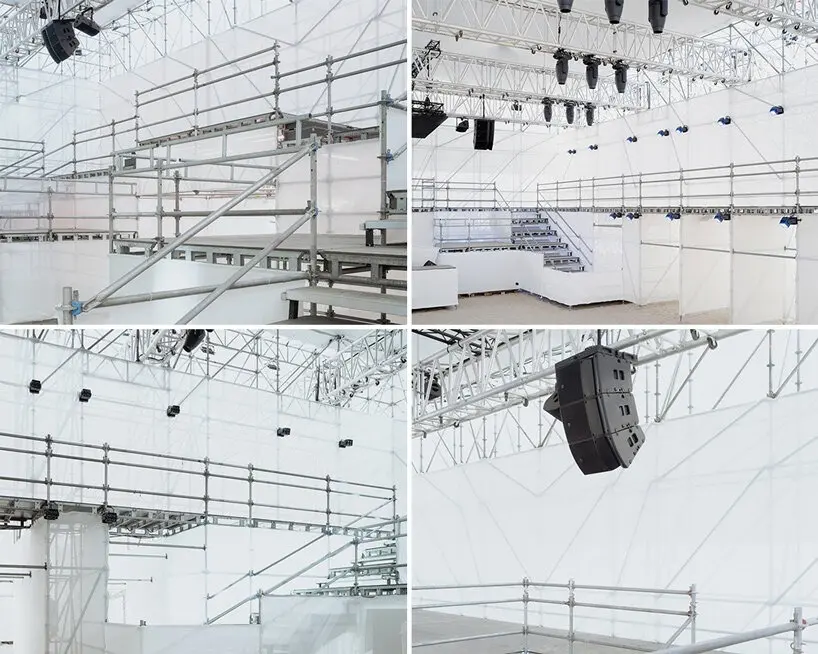
His notable projects include Choreomania at Horst Arts & Music, Joyride at the Barbican, and The Superclub at WeCanDance. Gillen is also the author of Temporary Pleasure: Nightclub Architecture, Design & Culture 1960–Today, published by Prestel in 2023. In an extensive conversation, Gillen discusses time as a tangible design material, the crowd as the ultimate show, and why the moments that truly matter in club culture resist being captured on camera.
"The nightclub once offered something radical: a moment suspended in time that could only be experienced by those who were lucky enough to be in the right place at the right time," Gillen reflects.
In Conversation with John Leo Gillen
Gillen’s unique trajectory—from sleeping as an infant in his family’s west of Ireland nightclub to managing it through his teenage years—provided a front-row seat to the golden era of nightlife. When he watched those physical containers begin to vanish, he turned to temporary spaces.
"I spent my entire life fantasising about the nightclub I would design," Gillen explains. "Then I came of age just about exactly when the nightclub as we knew it started to disappear. I started organising illegal raves, and I had this idea: imagine a nightclub that existed in each place just for a moment. The architecture of a nightclub—with the emotion of a rave."
This philosophy birthed a nomadic approach to spatial design. Temporary Pleasure crafts clubs that materialize temporarily in warehouses across Barcelona or Dublin, hidden car parks in London, or stretches of beach in Belgium, before disappearing and reappearing elsewhere. According to Gillen, a space known to have a finite lifespan communicates a sense of urgency, heightens human behavior, and generates meaning rooted directly in impermanence. When architecture carries this intrinsic message, people react by becoming more present, more invested, and more alive.
Looking back at the architectural marvels of the 1960s and 1970s, Gillen notes that early club designers used light, sound, and the crowd itself as core architectural materials. These spaces were deliberate, spatial breaks from traditional concert halls, actively dismantling the rigid hierarchies of stages and passive audiences.

"Designed to dissolve the central focus, erase stage hierarchy, fracture orientation," Gillen says, describing spaces where platforms existed at varying heights—some brightly lit, others left in shadow—ensuring every square inch functioned as a stage. "Everyone was on stage, and no one was. You weren’t watching the show—you were in it."
This total interior world encompassed facades, doors, entrances, thresholds, loops, dancefloors, bars, bathrooms, and seating zones. It played with compression and release, enclosure and circulation, darkness, density, intimacy, and disorientation. The nightclub did not merely present culture; it actively produced it.
Yet, Gillen argues, these conditions have largely eroded. While the name persists, the spatial DNA has transformed. Stages have crept back into the room, dancefloors now point straight toward the DJ, sound has become entirely frontal, and towering LED screens dominate spatial orientation. The DJ booth has mutated into the focal point, while the rest of the room is demoted to mere infrastructure designed to service it. The nightclub, Gillen laments, has gradually become the very thing it was originally engineered to break: a concert.
The DJ, the Dancefloor, and the Shift in Perspective
This architectural pivot transformed how crowds behave. Where DJs were once residents embedded in the ecosystem of the club—operating out of sight, like Larry Levan in his bird’s-eye nest at Paradise Garage—they are now global headliners driving tourism.
"We’ve forgotten what a nightclub and a dancefloor actually is," Gillen states. "It’s not just a space in front of the DJ booth—it is the club. The crowd is the source of the energy, not the recipient of it."
By placing the DJ booth on a raised stage, modern venues erased the rest of the room. People stopped going to a specific place to immerse themselves in a community and started going simply to watch a specific DJ. Consequently, audiences were turned into passive bystanders.
When asked who people are performing for in spaces where the crowd itself is the show—whether it is the camera, each other, or themselves—Gillen emphasizes that a real rave eliminates passive observation.
"A real rave isn’t about watching—it’s about being essential to the moment," he says. "The space should make people feel like this wouldn’t be happening without them—because it wouldn’t. That they are the energy. That they are the event."
To counteract passive behavior without making visitors feel overly scripted, Gillen relies on architecture loaded with potential. By utilizing shifting platforms, multi-level balconies, mezzanines, and dynamic lighting like a single, unpredictable moving spotlight sweeping across the room, the architecture creates spatial "dares." It cultivates surreal, cinematic moments that catch dancers off guard before dissolving back into energetic chaos.
The Toll of Image Culture and Modern Documentation
The rise of ubiquitous smartphone cameras has further warped this environment. Historically, a nightclub was valued precisely because its experiences could not be fully captured, replayed, or verified. It lived on through fragments, hazy recollections, and oral history.
Today, image culture dictates both design and behavior. "Presence is replaced by extraction," Gillen observes. "The moment is no longer lived for itself, but for its afterlife as content—designed to be replayed before it has even happened."
This obsession with instant capture and archiving flattens the mythos of nightlife. While Gillen’s recent book preserves elements of these spaces through photographs and stories, he acknowledges the inherent limitations of documentation. An image can show what a space looked like, but it cannot replicate the fleeting energy of the live experience. He advocates instead for memory and myth, questioning whether a moment itself can become the true record without parasitizing the live experience through constant digital recording.
Even when attempting to translate these underground principles into large-scale festival environments, such as The Superclub at WeCanDance—where his team recessed the DJ, wrapped balconies around the dancefloor, and emphasized mutual crowd observation—challenges remain.
"A nightclub is a space with its own rules, codes and belief system, shared by the whole crowd," Gillen explains. While spatial designers can fight festival logic from within by decentralizing the DJ and breaking frontality, they cannot completely override the broader cultural programming, staffing, and marketing parameters of a massive commercial event.
This tension extends into cultural institutions that increasingly invite underground club aesthetics into white-cube gallery spaces. Gillen warns that institutions are frequently drawn to club culture for its optics, energy, and demographic appeal, yet shy away from the actual risks involved.
"To appear as a club is safe. To actually offer it is risky," Gillen concludes. "The question is whether they’re willing to offer the conditions, not just the aesthetic: darkness, duration, risk, a crowd that’s allowed to take over the room."