At a time when public funding and institutional support for the arts are facing mounting pressures in countries around the globe, Darat al Funun—translating literally to the "House of the Arts"—remains firmly anchored in its long-standing mission to champion, shelter, and celebrate creative practitioners. Founded by Suha Shoman, the institution has spent decades acting as a vital sanctuary for cultural expression in the heart of Jordan.
Reflecting on the enduring role of creative practitioners during turbulent periods, Shoman affirms the foundational philosophy of the space. "Artists are witnesses of their time," Shoman notes. "Maybe art does not operate change, but it does record it… it points fingers. At the same time, it speaks of, even if it’s so difficult and at times so violent, it speaks of beauty as well."
Situated across the historic hills of Jabal al Luweibdeh, Darat al Funun occupies a remarkably unique geographical and cultural vantage point. The complex sprawls across rugged terrain that dramatically overlooks the vibrant bustle of downtown Amman. The layout of the compound is intentionally porous and welcoming to the public, featuring a lower entrance to the south and an upper access point to the north. Across its cascading terraces, the site is visually and physically open, serving as a physical manifestation of the foundation’s core belief: that art is not merely an auxiliary luxury, but a civic necessity and a living vessel for shared human history.
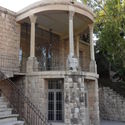
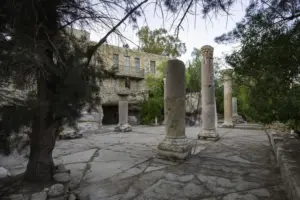
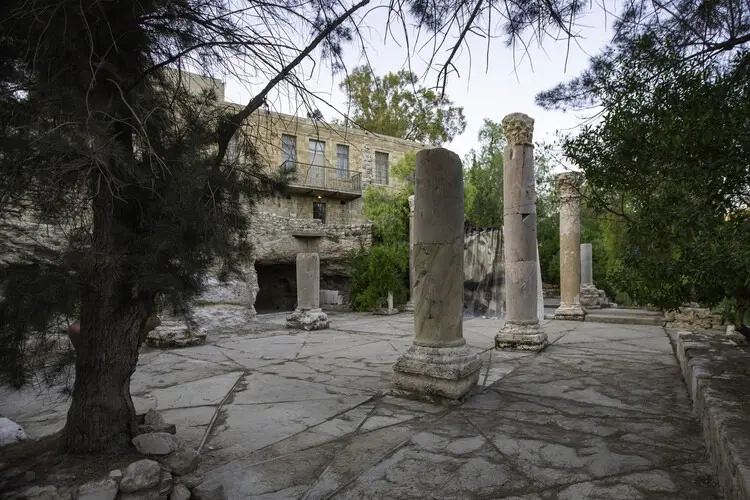
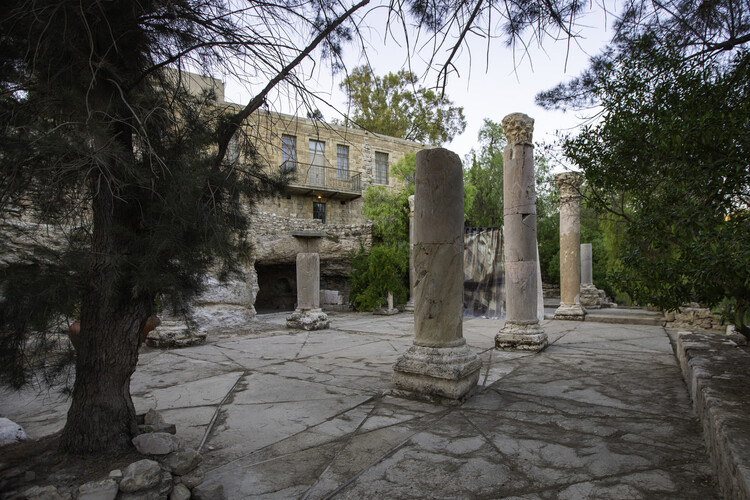
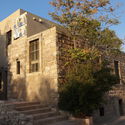
This integration of the contemporary and the ancient is embedded into the very fabric of the site. Darat al Funun is not housed in a monolithic, sterile white-cube gallery; rather, it occupies a collection of historic mid-century residential buildings harmoniously intertwined with significant archaeological ruins, including the remnants of a sixth-century Byzantine church. This physical layering creates a dialogue between past and present, positioning the artist not just as a creator, but as a historiographer engaging directly with the built environment, deep cultural memory, and the physical traces of preceding civilizations.
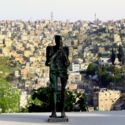
Throughout the terraced landscape, sculptures and installations such as Iraqi artist Ismail Fattah’s 1980 bronze sculpture, "Man and Mask," stand as permanent sentinels overlooking old Amman. These works engage in an ongoing visual conversation with the surrounding urban fabric, bridging the gap between modern Arab art movements and the historical context of the Levant. By weaving together contemporary creative expression, historical preservation, and architectural heritage, Darat al Funun continues to function as an essential gathering place for thinkers, makers, and the wider public, demonstrating how cultural spaces can thrive by deeply embedding themselves in the historical and urban landscapes they inhabit.