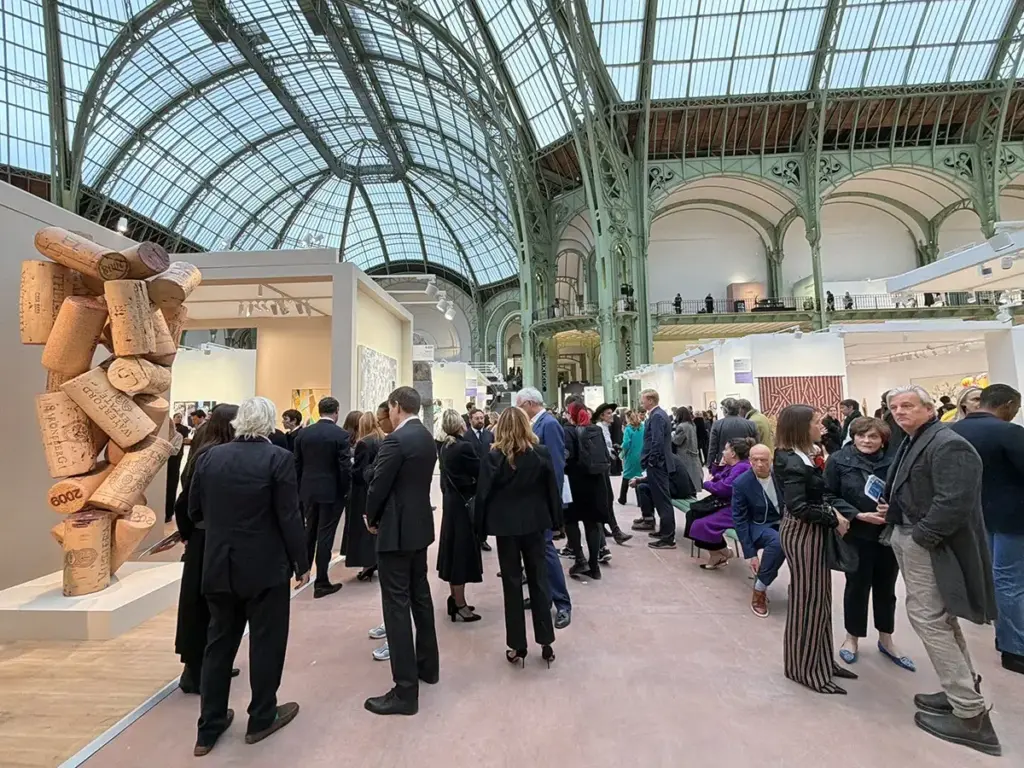
Despite the lingering visual reminders of weekend protests scattered across several of Paris’s arrondissements, the international art world proceeded with business as usual as Art Basel Paris launched its highly anticipated Avant Première preview at the iconic Grand Palais.
Opening its doors at 3 p.m. on Tuesday, the architectural marvel welcomed an eager crowd, though initial observations suggested a slightly more measured pace compared to last year’s debut of the ultra-VIP initiative. Approximately ten minutes before the doors unlocked, only a modest line had formed outside, setting the tone for an afternoon characterized by full but easily navigable aisles and robust buyer interest at blue-chip booths. The galleries and the fair organizers appeared to have carefully curated their invitation lists, refining the pool of attendees down to the most serious and dedicated collectors.
While some dealers and art advisers noted that a handful of international clients had opted to cancel their travel plans to the French capital due to ongoing demonstrations, concerns that American collectors would stay away proved entirely unfounded. The exhibition floor buzzed with prominent art patrons, including Top 200 Collectors Allison Berg, Glenn Fuhrman, Pamela Joyner, Nancy A. Nasher, Bob Clark, and Jason and Michelle Rubell, alongside Anne-Cecilie Speyer, Jessica Seinfeld, and Adam Lindemann.
The art world’s institutional leadership also turned out in force. US museum directors and curators spotted along the aisles included Michael Govan of the Los Angeles County Museum of Art, Massimiliano Gioni of the New Museum, Ruba Katrib of MoMA PS1, Giampaolo Bianconi of the Art Institute of Chicago, and Max Hollein and David Breslin of the Metropolitan Museum of Art, the latter of whom traveled alongside a large contingent of Met trustees. High-profile attendees from outside the traditional art sphere were also present, with actresses Katie Holmes and Natalie Portman navigating the crowded booths.
Art adviser Ana Sokoloff expressed strong praise for the initial offerings, highlighting the thoughtful curation of the booths. "This place is magical," Sokoloff said, noting that visitors cannot help but be seduced by the historic grandeur of the venue.
Dealers resoundingly reported positive energy across the board during the shortened Avant Première preview. "We’re off to a great start—we’re at home," said Mathieu Templon of the Paris-based gallery Templon, speaking just over an hour into the event. Templon quickly confirmed a notable sale: Bilal Hamdad’s painting L’envers du soir (2026), which traded for €65,000. Hamdad, who mounted a prominent solo exhibition at the Petit Palais during the previous edition of Art Basel Paris, continues to command heavy market demand ahead of another highly anticipated solo show scheduled for March.
Because the Avant Première format utilizes a compressed timeline, most galleries shared only initial sales figures rather than the extensive tallies typically associated with the close of a full opening day. This contrasts with traditional fair schedules, such as those seen at competing events like Frieze London, which recently concluded its flagship UK fairs.

Discussing the ongoing dialogue surrounding the London-versus-Paris fair circuit, collector Will Paley, who divides his time between New York and São Paulo, characterized the two cities as complementary forces in the global market. "Frieze is primarily for young galleries, young artists, and young collectors with a more adventurous tone, while Art Basel Paris has a higher price point," Paley explained.
Hauser & Wirth president Marc Payot echoed the sentiment that the draw of top-tier attendees remains the primary strength of the French fair. At the same time, he pointed out a unique logistical challenge: "The problematic side is that you get distracted by the city. People come here to see a thousand things."
Thaddaeus Ropac agreed, observing that collectors make decisions quickly in Paris because the fair must compete with a multitude of simultaneous cultural attractions. While some clients indicated they would return Wednesday morning for the official VIP opening, others planned to skip the main floor entirely to explore the city’s extensive network of museum exhibitions, gallery shows, or even indulge in retail shopping. Despite these competing distractions, major dealers brought high-value inventories traditionally reserved for Art Basel’s flagship Swiss fair, where the focus remains almost exclusively on the convention center itself.
Ropac’s gallery reported 15 sales on Tuesday alone. Among them were four authenticated Picassos dating from 1906 to 1938 sold for undisclosed prices, a 1953 mixed-media work by Lucio Fontana for €1.8 million, and a 2019 painting by Georg Baselitz for €800,000. "We’re doing very well—but it was expected, to be honest," Ropac remarked.
Payot reinforced the observation that transactions unfold rapidly at fairs compared to standard gallery operations, even if overall purchasing velocity has tempered compared to historical peaks. "It’s definitely a slower pace than about five years ago, but great things do find great homes," Payot said.
During the brief Tuesday afternoon preview, Hauser & Wirth successfully placed Gerhard Richter’s 1965 painting Rokokotisch (Rococo Table) for a price in the region of $10 million. The rare early canvas was a surprise addition to the booth and had not appeared in preliminary preview catalogs. The gallery also parted with Georg Baselitz’s 1965 painting Der Hirte (The Shepherd) for approximately $10 million, George Condo’s Woman with Designer Shirt (2026) for $2.9 million, Lucio Fontana’s 1961 abstract work Concetto spaziale (Spatial Concept) for €1.7 million (roughly $1.9 million), Philip Guston’s Untitled (1969) for $1.5 million, and Alexander Calder’s mobile sculpture Four Dots and Brass Tail (circa 1953) for just under $1 million.
Meanwhile, Pace Di Donna Schrader unveiled what is widely considered the most expensive artwork on offer at the fair: a rare, striking reclining nude by Amedeo Modigliani titled Nu étendu (Lolotte) from 1917, valued at more than $100 million. The painting has remained largely unseen by the public for nearly a century and originally featured in Modigliani’s scandalous 1917 exhibition at Galerie Berthe Weill—a presentation that provoked indecency complaints and stands as the artist’s only solo exhibition during his lifetime.

Emmanuel Di Donna noted that while the fair’s opening hours were exceptionally successful, placing a work of the magnitude and value of the Modigliani will require time. Describing the general volume of trade, he added that the overall sales activity felt "like drinking from a fire hose."
Other major galleries reported strong initial numbers. Gagosian declined to disclose specific figures but confirmed the eight-figure sale of a 1987 Willem de Kooning painting, alongside the placement of a work by Peter Doig. White Cube registered 16 sales, highlighted by two paintings by Julie Mehretu—dating from 2001 and 2018 respectively—that sold for $7.85 million each, alongside historical works on paper including a Picasso for €150,000 and a Léger for €65,000.
Additional transactions recorded across the floor included a painting by Victor Man for $1.3 million and two collage works by Wangechi Mutu for $325,000 each via Gladstone, alongside a sculpture by Haegue Yang sold by Kurimanzutto for $110,000.
Brussels-based dealer Xavier Hufkens reported 10 completed sales, led by a painting by Charline von Heyl priced at $475,000. "Despite a rather turbulent weekend, we’ve felt a genuine enthusiasm for art from the very start of the fair," Hufkens said via email. "There’s something about Paris: its contradictions, its restless energy, its ability to surprise you at every turn. Fluctuat nec mergitur, as the city’s motto goes. It feels particularly fitting this week."
Mike Homer, a partner at David Kordansky Gallery, noted that several pending holds successfully converted into completed sales during the preview, signaling a renewed appetite for tactile engagement with art. "There is a desire to see works in person, in the round—it’s a nice return," Homer said, confirming the sale of Sam Gilliam’s rare 1965 hard-edge abstraction Mycenaean Ode for $300,000.
A notable structural trend at this year’s fair was the inclusion of 12 shared booths representing 24 galleries, marking the highest number of cooperative presentations in the event’s history. On the second floor, a shared booth by Vienna’s Layr and Berlin and Munich’s Kraupa-Tuskany Zeidler yielded multiple placements.
"We sold a lot of things that we were very keen on placing in very prominent collections, so we’re very happy," said Amadeo Kraupa-Tuskany, confirming that several works entered major European collections, while Emanuel Layr noted successful placements with American buyers as well.

The collaborative booth juxtaposed historic and contemporary pieces from both gallery stables, pairing Franz West’s 1983–1984 sculpture Passstück—a piece intended to be manipulated like a sculptural crutch to alter human movement—with Anna Uddenberg’s 2026 sculpture White Noise (Soft Skills), which depicts a life-size, faceless mannequin contorted around futuristic, ergonomic office furniture configurations.
"Something that really matters to us is staying excited ourselves, but also exciting other people, and asking new questions," Layr reflected. "Now you have to be super open about how you operate—how you present yourself, and how you join forces."
Art adviser Nicolas Nahab, cofounder of NG Partners, observed that such creative gallery collaborations reflect a broader market adjustment, particularly as buyers exercise heightened scrutiny over the pricing of ultra-contemporary art.
"Collectors today don’t trust prices like they used to, and don’t take them at face value," Nahab explained. "This lack of trust makes them doubt and interrogate information given to them. They need reassurance, research, and a global understanding of an artist’s practice and market before making a decision, which is why the decision-making is so slow."
"If trust is there," he concluded, "then the decision is easy for collectors."