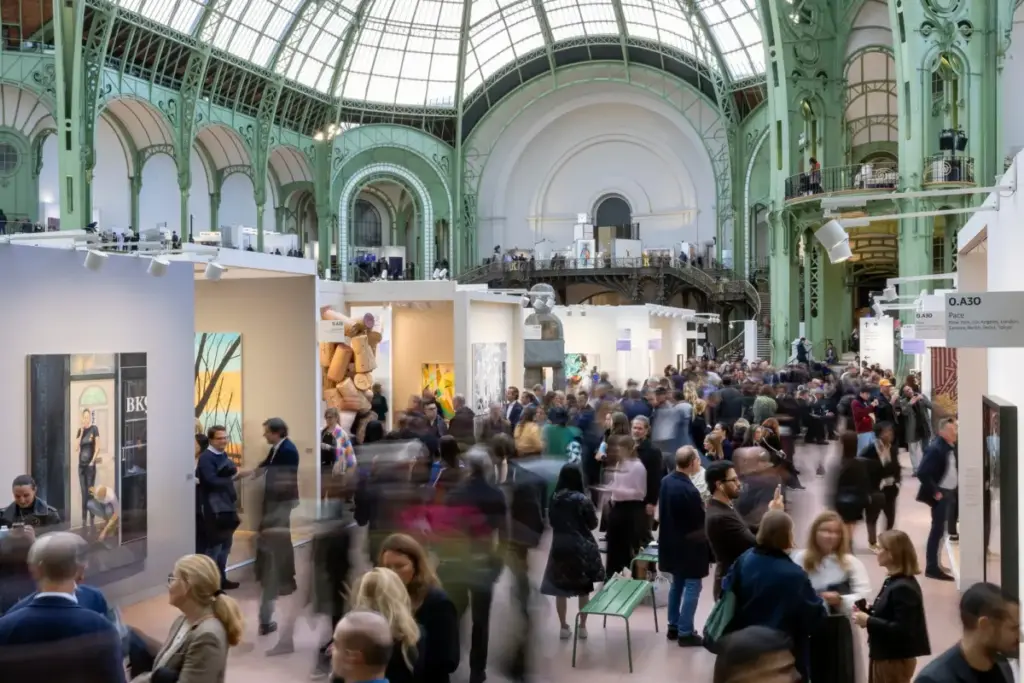
Art Basel Paris has announced that it will prematurely close its doors on Friday, October 23, at 7 pm, cutting its flagship international contemporary art fair short by two full days. Organizers pointed to potential nationwide demonstrations across the French capital over the weekend and emphasized that the decision was made strictly “in the interest of safeguarding our visitors.”
The premier art fair’s main program at the historic Grand Palais was originally scheduled to run through Sunday, October 25. The abrupt truncation follows an already tense buildup to the event, which included a temporary lockdown during the fair’s installation phase on October 17. Despite that initial security scare, event organizers had initially chosen to push ahead with their original programming before ultimately reversing course as the weekend approached, driven by escalating nationwide unrest.
The backdrop to the art fair’s closure is a broader socio-political crisis sweeping France, characterized by continuous demonstrations calling for better living conditions, alongside widespread anger over the country’s struggling education system and deteriorating public services. These mass movements have drawn diverse segments of French society into the streets, creating a volatile environment in major urban centers, particularly Paris.
The cultural sector has increasingly found itself at the intersection of these societal tensions. Several artist advocacy groups and labor unions—including the Syndicat National des Artistes Plasticiennes, a prominent organization representing visual artists and graphic designers—had openly pledged to stage a protest directly outside the fairgrounds on Saturday afternoon at 4 pm. A digital flyer circulating widely online sharply criticized what organizers termed the “privatization of culture and an art market that accompanies the extreme right-wing shift in our country.”
As the security situation deteriorated, the French government responded with an aggressive posture. Prime Minister Sébastien Lecornu announced that military forces belonging to Operation Sentinelle would be deployed over the weekend rather than standard police units to maintain public order and manage protesters. Operation Sentinelle was originally established in the harrowing aftermath of the January 2015 Charlie Hebdo and Hyper Cacher terrorist attacks with the explicit mandate of defending domestic locations against extremist threats, making its deployment for domestic civil demonstrations a notable and controversial escalation.
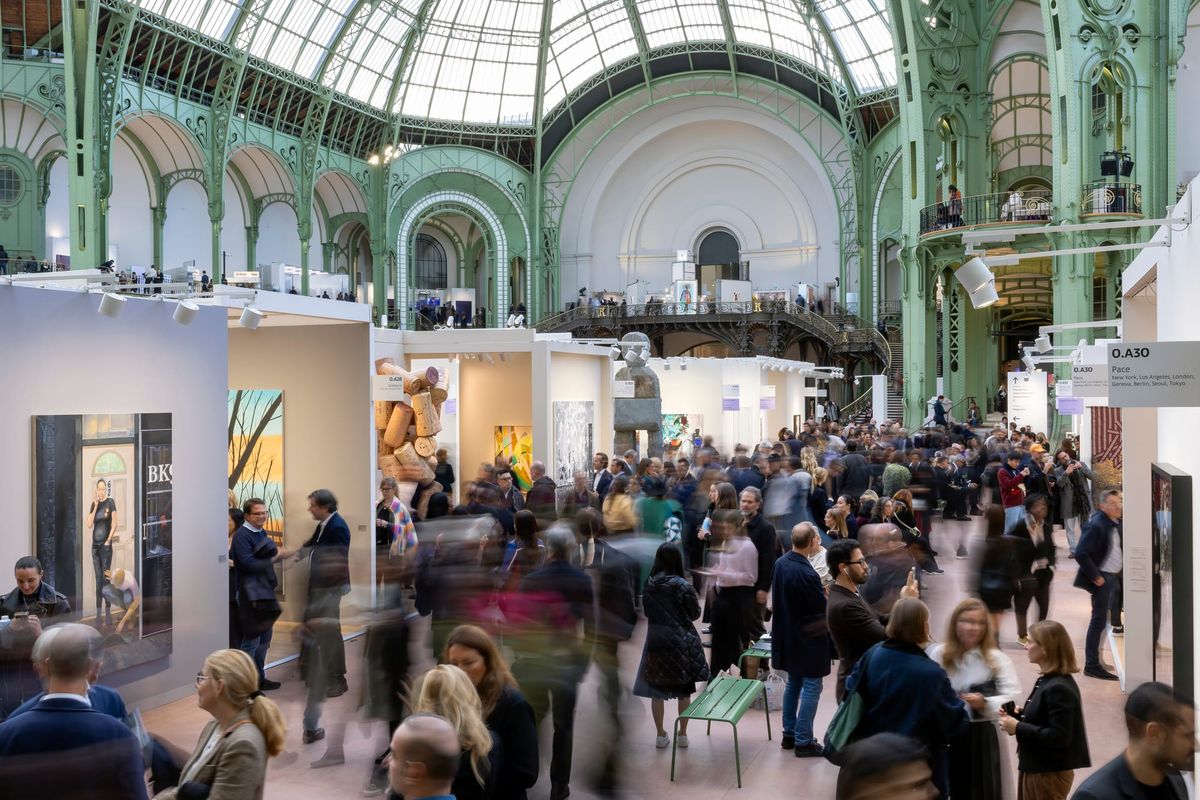
In an internal email reviewed by Hyperallergic, Art Basel’s chief artistic officer Vincenzo de Bellis and Paris fair director Karim Crippa addressed the exhibitors to manage the chaotic transition. “We strongly encourage galleries to keep their representations intact through the fair’s close tomorrow at 7 pm, and ask that general move-out not begin until access and removal instructions have been issued,” the directors wrote.
However, the sudden shift has left many participants scrambling. Speaking on the condition of anonymity, one gallerist confirmed that concrete operational guidance and dismantling instructions remained pending from the fair’s administration, creating widespread uncertainty among international dealers who had invested heavily in shipping, insurance, and booth presentation for the high-profile event.
The anxiety extending beyond Art Basel Paris highlights a broader wave of closures affecting the French cultural landscape. Major institutions and individual creators alike have chosen to preemptively scale back their operations. A prominent banner on the official website of the Fondation Louis Vuitton confirmed that the institution would close its doors on Saturday, October 4, amid the mounting climate of disruption.
Meanwhile, individual artists participating in official satellite events have also taken matters into their own hands. Sculptor Alicja Kwade, one of eight internationally renowned artists featured in the fair’s public program along Avenue Winston Churchill outside the Grand Palais, utilized Instagram to announce the immediate removal of her massive 14-foot sculpture, titled L’Élévation des Mondes (2026). Kwade cited “announced riots and people who simply want to resort to violence” as the driving factor behind her decision to pull the installation prematurely.
The broader civil unrest has been marked by significant friction between demonstrators and law enforcement agencies. Reports from ongoing protests have documented severe incidents of police brutality directed at student demonstrators and youth. Among the most alarming cases cited by human rights observers are a 14-year-old child who was maimed by a tear gas grenade and a 15-year-old whose hand was severely injured and partially blown off by a stun gun during clashes. In an effort to curb nighttime assemblies and reduce urban conflict, French authorities have concurrently enforced strict nightly curfews across various affected municipalities.
As Art Basel Paris prepares to lock its doors ahead of schedule on Friday evening, the premature conclusion underscores the profound vulnerability of major commercial and cultural enterprises when confronted with deep-seated social upheaval and the logistical realities of a nation gripped by sweeping political unrest.






